2cornucopias

Archive for 2016|Yearly archive page

“Know how to forgive one another”

In 01 Daily Meditations on 2016/07/15 at 12:00 AM
How very insistent the Apostle Saint John was in preaching the mandatum novum, the new commandment that we should love one another. I would fall on my knees, without putting on any act – but this is what my heart dictates – and ask you, for the love of God, to love one another, to help one another, to lend one another a hand, to know how to forgive one another. And so, reject all pride, be compassionate, show charity; help each other with prayer and sincere friendship. (The Forge, 454)

Our Lord Jesus Christ became incarnate and took on our nature to reveal himself to mankind as the model of all virtues, ‘Learn from me,’ he says to us, ‘for I am meek and humble of heart.

Later, when he explains to the Apostles the mark by which they will be known as Christians, he does not say, ‘Because you are humble.’ He is purity most sublime, the immaculate Lamb. Nothing could stain his perfect, unspotted holiness [1]. Yet he does not say, ‘You will be known as my disciples because you are chaste and pure.’

He passed through this world completely detached from earthly goods. Though he is the Creator and Lord of the whole universe, he did not even have a place to lay his head. Nevertheless he does not say, ‘They will know that you are mine because you are not attached to wealth.’ Before setting out to preach the Gospel he spent forty days and forty nights in the desert keeping a strict fast. But, once again, he does not tell his disciples, ‘Men will recognize you as God’s servants because you are not gluttons or drunkards.’

No, the distinguishing mark of the apostles and of true Christians in every age is, as we have heard: ‘By this’, precisely by this, ‘shall all men know that you are my disciples, if you have love for one another.’

(Friends of God, 224)

[1] cf John 8:46

“Blessed are the poor in spirit, for theirs is the kingdom of heaven.”

In 06 Scripture & Theology on 2016/07/08 at 12:00 AM

The poor in spirit are those who remember that all they are and have is from God and give back to Him whatever He wants of them. We live the virtue of simplicity when we maintain the proper intention in our love for Our Lord. This includes  being completely dependent on our Heavenly Father  by abandoning ourselves confidently to his loving Providence, just as a child entrusts everything to its father.

A child does not hold grudges, is ignorant of duplicity or fraud, does not deceive, does not seek revenge, easily forgets, does not store up grievances and has no deep sorrows.  Simplicity is one of the principal manifestations of spiritual childhood. It is the result of becoming defenseless before God like a vulnerable and trusting child before its father. Spiritual childhood always holds to the freshness of love in a soul by not dwelling on adverse experience.

Simplicity, which is close to humility, will lead us to ask forgiveness often; to admit and correct our mistakes.  Simplicity is the opposite of artificiality, deceit or phoniness. Simplicity never looks at anything from the viewpoint of personal advantage.  Simplicity is an indicator of humility.

The simple woman is neither naive nor suspicious; rather, prudent but not distrustful. She does not make hasty judgements on superficially based facts.  She lives the teaching of the Christ to be wise as serpents and innocent as doves.  The simple person is transparent, never appearing to be what she is not or to have what she does not have.  She seeks to correct matters gone wrong by putting things right and asking forgiveness. She is definitely not hyper-sensitive, inflexible or impatient.  Nor is she cold or indifferent but warm, caring and compassionate.

The real cause of egotism and selfishness is pride. It looks at everything from our its own viewpoint and it’s own agenda. Pride inflates one’s own abilities, aggrandize one’s own qualities and demands the attention of others to them. Consequently, proud people are egocentric and selfish, not really knowing how to love anyone but themselves, loving only for what they can obtain from others for themselves.  Pride strangles; egoism deforms the personality.  Humility opens the way to act charitably with a joyful spirit.

To conquer this vice, we must fix our gaze on Christ, admitting our mistakes and correcting them. Thus, we will grow in humility, thanking God for all the benefits received from Him, allowing ourselves to be helped, seeking advice, stopping excusing our sins and failures, asking forgiveness of those we offend.
The will of God is the compass that guides and directs the humble woman to follow God’s will cheerfully.  She serenely sees God’s will in all the things He allows to happen, accepting them as  helping her encounter God.  She prays always because she is confined of her need for God.  The humble woman radiates joy.

Major Religious Orders of Men

In 15 Audio on 2016/07/08 at 12:00 AM

 The Major Religious Orders of Men

Host – Fr. Charles Connor

In the series, The Major Religious Orders of Men, Fr. Charles Connor examines the historical development of the major religious orders of men in the Catholic Church.

Program Name

Audio File Name – Click to download

1.

The Rise of Monasticism in the East 

Host – Fr. Charles Connor

relordmen_01.mp3

Fr. Connor explores the origins of the monastic tradition in the Church.

2.

The Contribution of Eastern Monasticism to the West 

Host – Fr. Charles Connor

relordmen_02.mp3

Here Fr. Connor contributes that the fruit of Eastern Monasticism for the West was the rise of Irish monks and missionaries.

3.

Benedict and the Order He Began 

Host – Fr. Charles Connor

relordmen_03.mp3

Fr Connor explains the foundation of the Order of St. Benedict.

4.

The Benedictines: Conversion of England and Germany 

Host – Fr. Charles Connor

relordmen_04.mp3

Fr. Connor expounds on the ramifications of the Benedictine evangelization of England and Germany.

5.

The Monastic Reform of Cluny: Cistercians and Carthusians 

Host – Fr. Charles Connor

relordmen_05.mp3

Fr. Connor shares the immense reform of monasticism that sprung forth from Cluny in France.

6.

The Order of Carmel 

Host – Fr. Charles Connor

relordmen_06.mp3

Here Fr Connor shares the contemplative heritage which began with the prophet Elijah seeking God on Mount Carmel in Israel, was deepened with the apparition of Our Lady to St. Simon Stock, and was furthered with the lives and mysticism of Sts. Teresa of Avila and John of the Cross.

7.

The Poor Man of Assisi and His Order 

Host – Fr. Charles Connor

relordmen_07.mp3

Fr Connor examines the witness of holy simplicity lived out by St. Francis in Assisi, Italy. By his example Francis encouraged single-hearted devotion to the life and Passion of Jesus Christ.

8.

The Franciscan Family 

Host – Fr. Charles Connor

relordmen_08.mp3

Fr. Connor declares that Francis’s charism for living out the Gospel in the charity of Christ attracts a multitudinous following and ultimately causes the Franciscan Order to become the world’s largest.

9.

Dominic and the Order of Preachers 

Host – Fr. Charles Connor

relordmen_09.mp3

Fr. Connor shares how the Spaniard Dominic de Guzman received his calling in the same time period as St. Francis of Assisi, and how the two fraternal orders bolstered the faith-life of the Church in a time of crisis.

10.

Ignatius and His “Company” 

Host – Fr. Charles Connor

relordmen_10.mp3

Fr. Connor witnesses to the heroism of Ignatius of Loyola, former Spanish soldier become saint through reading the life of Christ and of the saints. The group of men Ignatius inspired would spread his evangelical zeal throughout the world.

11.

The Mission of the English Jesuits 

Host – Fr. Charles Connor

relordmen_11.mp3

Fr. Connor focuses on the phenomenal blossoming of faith in the midst of the horrific persecution in Britain by Henry, Elizabeth and protestant successors to the throne. The Jesuits defended the Apostolic Faith with their lives, ensuring that Catholicism would endure forever in their homeland.

12.

The French Connection: Sulpicians and Vincentians 

Host – Fr. Charles Connor

relordmen_12.mp3

Fr. Connor reveals the tremendous spiritual work in France by the Society of St. Sulpice and the followers of St. Vincent de Paul.

13.

Alphonsus and Paul of the Cross: Redemptorists and Passionists 

Host – Fr. Charles Connor

relordmen_13.mp3

Fr. Connor shares the inspirational work of orders faithfully dedicated to the parish missions by Sts. Alphonsus Liguori and Paul of the Cross.

<img alt=”DCSIMG” id=”DCSIMG” width=”1″ height=”1″ src=”http://host207.ewtn.com/dcse9jbqv1000086a2st7fxvz_4z7w/njs.gif?dcsuri=/nojavascript&WT.js=No&WT.tv=1.0.7″/&gt;

Transfiguration of Our Soul

In 05 Homilies by Fr. Reid on 2016/07/08 at 12:00 AM

• Last Sunday I used the image of expanding one’s soul as a way of speaking about the process of growing in holiness.
• Because our Lord dwells in our souls through baptism, as Christians we should seek to increase the capacity of our soul so that our Lord will find in it a comfortable home.
• According to St. Bernard of Clairvaux, we can judge the capacity of our soul by how much charity we possess. But expanding the capacity of our soul isn’t just a matter of practicing the virtue of charity.
• Holiness requires that we make our souls pleasing to God in every way! Thus, there is a purification process through which we must pass if we are to love God as we should. So last Sunday I spoke about the necessity of praying and fasting.
• Through prayer we learn how to focus our attention on God so that we can come to know and trust Him. In prayer we learn to submit ourselves to God’s humble yoke, and we receive the grace to give ourselves wholeheartedly to Him.
• And by the practice of denying ourselves through fasting those things that we enjoy, we learn to master our wills so that we have the courage to turn away from even the most enticing sins.
• So while the evil one does test and tempt us, just as he tested and tempted Jesus in the desert, with God’s grace we can conquer the devil and over time and be freed from the bondage of sin so that we can become more pleasing to God.
• In speaking of people with “spacious” souls, St. Bernard says they, “cannot afford to be entangled in law-suits nor by worldly cares; [they] cannot be enslaved by gluttony and sensual pleasures, by the lust of the eyes, the ambition to rule, or by pride in the possession of power. If [they are] to become heaven, the dwelling place of God, it is first of all essential that [they] be empty of all these defects” (SBoC: Song of Songs, 27:10).
• So as we begin our spiritual lives and seek the “soul-expanding” holiness our Lord desires of us all, in addition to praying and fasting, we must be willing to move away from and detach ourselves from the things of the world, especially our mortal sins.
• You see, there is a radical detachment from the things of the world as well as from one’s own sinful desires that is necessary in order for one’s soul to expand to such an extent that our infinite Lord finds it a comfortable home.
• As we move away from and detach ourselves from the things of the world, we become more and more capable of attaching ourselves to God! Remember: you cannot love both God and mammon. We all must choose Whom or what we will love in this life.
• Truly, the soul that chooses the mammon of this world over God and persists in mortal sin will never be a fitting home for our Lord in this life, and that soul will be denied entrance into our Lord’s eternal home in the next life.
• But if we seek to live in a perpetual state of grace and be free from attachments to all worldly things, and if we are truly humble, then our Lord Himself will set to work on our soul to make of it a fitting dwelling place for Himself!
• Just as our Lord was transfigured before Sts. Peter, James, and John in our Gospel today, so too does He work through the power of His Holy Spirit to transfigure our souls so that they can be a fitting dwelling for our Lord.
• However, I must warn you that, just as sharp scalpels are necessary to excise a cancerous tumor from a body, so too are painful treatments necessary to excise the grave sin from our lives. Our Lord’s favorite tool for such a procedure is suffering.
• As I’ve mentioned so many times from this pulpit, sin disfigures and distorts our true selves. Sin corrupts and misshapes us. So the process of being remodeled and reshaped into an image of Christ is necessarily painful.
• But we must keep in mind the words of St. Paul to St. Timothy in our epistle today, that our Lord has “saved us and called us to a holy life, not according to our own works but according to His own design and the grace bestowed on us in Christ Jesus.
• And therefore, we must be willing, as St. Paul says, to “bear [our] share of hardship for the Gospel.” We must be willing to suffer through whatever pain and suffering is necessary to rid our souls of sinful and worldly attachments.
• Sometimes the suffering we must endure is simply the bad consequences that typically follow a sinful choice on our part. This is the easiest suffering to endure because it is a just suffering. Suffering is easier to accept when we know we deserve it!
• But occasionally suffering totally unrelated to our sins enters our lives, like the loss of a loved one, a terrible accident, a catastrophic loss of property, or a serious illness.
• And as these sufferings come, we may be tempted to be angry with God for allowing something so bad to happen. But in truth, my brothers and sisters, every form of suffering that we must endure is a gift from God, if we have the eyes of faith to see it.
• I say this because there is always a lesson to be learned from suffering. God always has a way of bringing some good out of the evil of suffering. But again we must be willing to face our sufferings with faith in God’s goodness and providence.
• If we bear all sufferings with faith, we learn to cling to our Lord with a confident hope of eternal union with Him. And as we hope in God, we in turn learn to love Him more.
• This is part of the meaning of our Gospel today. Jesus’ transfiguration prepared the
apostles for their future trials by fortifying them with hope of the glory to come, and
their hope in Christ and love for Him helped them to suffer even martyrdom for Jesus.
• Thus, we too must keep before us the vision of Christ glorified, realizing that we are
called to that same glory – but only if we endure our sufferings with virtue.
• When we endure our sufferings with faith, hope, and a true love for God, then our
sufferings help us to make reparation for our sins. They also help us to see how short
this life really is and to cling to God all the more. This is what expands our souls!
• Ultimately, in the face of suffering, we have to make the decision to allow our souls
either to expand in holiness by suffering with a faith that leads us to hope in God and
love Him all the more, or to contract in anger, despair, and self-centeredness.
• While painful, the sufferings of this life are the necessary crucible through which we all
must pass if we wish our souls to expand so that they might be transfigured into the
likeness of Christ.
• So as we continue along our Lenten journey toward the glories of Easter, may we all
resolve to accept and endure our sufferings with faith so that we might hope in God and
love Him all the more.
• And in practicing these virtues, may our souls be expanded so that we might be, with
Christ, God’s beloved in children in whom He is well pleased.

© Reverend Timothy Reid

Fr. Reid is the pastor of St. Ann Catholic Church, Charlotte, NC

Homilies from June 17, 2012 onward have audio.
To enable the audio, lease go directly to Fr. Reid’s homily homilies and select the matching date.

Link to Homilies:
http://stanncharlotte.org/content/index.php?option=com_content&view=section&id=8&Itemid=61
3/16 Trasfiguration of Our Sou

St. Otto

In 13 History on 2016/07/01 at 12:00 AM

The Church celebrates the life and work of St. Otto. He was born in 1060 in Swabia, and died on June 30, 1139. He was the Bishop of Bamberg, an indefatigable evengelizer, and the apostle of the Pomeranians.

He was born of noble rank and ordained a priest sometime before the age of 30. He joined the service of Emperor Henry IV in 1090 and became his chancellor in 1101. He served Henry IV and his successor, Henry V, loyally, but he disaproved of the latter’s disgraceful treatment of Pope Paschal.

Otto was consecrated a bishop on May 13, 1106, and set to work founding new monasteries, reforming existing ones, building schools and churches, and completing the construction of the cathedral. He lived a poor and simple life, and was called the “Father of the monks” for the concern he showed toward religious orders.

In 1122 Otto was commissioned by the Polish Duke Boleslaw III to convert Pomerania to Christianity, and he set about this mission in 1124. He traveled across Pomerania twice, and won over the people with his holiness, quiet generosity, and gentle, inspiring sermons.

The conversion of Pomerania was his greatest apostolic work. He baptized over 22,000 people and established 11 churches. Many miracles were attributed to him throughout his two journeys, and many more after his death.


Catholic News Agency

St. Clare

In 05 Homilies by Fr. Reid on 2016/07/01 at 12:00 AM

You’ll notice that our beautiful statue of St. Clare – here on my right – depicts this heroic virgin holding a monstrance with our Eucharistic Lord. This is to commemorate a most daring moment in the life of this extraordinary woman.

In September 1240 a band of Saracen soldiers, in the employ of Emperor Frederick II of Sweden, laid siege to the picturesque town of Assisi in the Umbrian mountains of Italy.
Not content to pillage only the town, the Saracens broke into the cloister of San Damiano, where St. Clare of Assisi lived with her newly formed community of women religious, whom we now know as the Poor Clares.
Terrified at the invasion of the Saracen soldiers, the sisters cried for help to St. Clare, who at the time was deathly ill.
Despite her illness and the natural fear that anyone would feel in such a situation, St. Clare summoned her daughters to courage and faith in the Lord.
With a look of steely resolve and unwavering trust in our Lord’s goodness, she took up the monstrance with the Eucharist inside and met the Saracens at the wall of the cloister, all the while praying to our Lord for deliverance.
Though merely a defenseless and sickly woman, St. Clare possessed an authority that made her stronger than all the soldiers in her midst: the authority of Christ Himself. With the authority of Christ, she struck fear into the hearts of those brutish men without uttering a word, and they turned away and fled.
Interestingly, the name Clare means “light that stands against the darkness,” and so she is a natural patron for all who fight the darkness of evil.
While this story in the life of St. Clare is recounted as one of her miracles, the truth is that we are all called to this same type of prophetic witness. We are all called to face evil head on by calling on the authority of Christ, just as St. Clare did.
Our readings today speak of this prophetic witness and the authority of Christ, especially over evil. And as we consider the current state of affairs in our country, I think it’s especially important that we all understand the necessity of being a prophetic witness in our world today.
Truly, now more than ever, our dear country needs people to stand up as prophetic witnesses to the Gospel of Jesus Christ, for it is only through Jesus Christ and by the power of His grace and mercy that any of us will ever be saved.
The culture wars that have plagued our country (and all of western civilization) for the past several decades are not merely political issues. They are moral issues.
And the fights that we see taking place in our country are not simply disagreements between opposing political forces. There is truly a fight between good and evil, and souls are at stake.
Last Sunday I mentioned briefly the new mandate from Health & Human Services that beginning this August, virtually all insurance plans must cover contraceptives, sterilization procedures, and even abortifacient drugs free of charge. I’ve also written about it in this week’s bulletin.
Despite the massive protests and lobbying by our Catholic bishops, our Catholic agencies, institutions, and Catholic for-profit companies will be required to provide this type of insurance coverage, even though it violates our consciences and most deeply held principles.
The exemption clause is so narrow that even the Diocese, which is staffed primarily by Catholics and serves primarily Catholics, will have to comply.
This is not simply a religious issue; this is a constitutional rights issue – for Catholics in the United States are now being denied the right to practice their faith fully in the public square.
Last Sunday I spoke about the need to do reparation for the sins of our country, most especially for the sin of abortion. But we must also be willing to fight the evils of our society by other means too.
Whether we want to face the truth or not, our country is now reaping the fruits of widespread acceptance and usage of contraception. Contraception promises the joy of the conjugal act without consequence and without responsibility.
Contraception and sterilization change the very nature of the conjugal act by rendering void its life-giving quality. Over time this had led to the widespread belief that the conjugal act is not primarily about procreation, but rather about recreation.
What was designed by God to be an act of sacrifice and self-gift leading to new life has now become an act of selfishness that often leads to death for an unborn child. We have distorted one of God’s most precious gifts to satisfy our own selfish desires.
And now our country sees fit to enshrine contraception, sterilization, and abortion as rights so sacred that all who want them must have unfettered access to them through their insurance plans, at the expense of us all.
Our government is now telling us that the right to contracept our children into oblivion, to maim ourselves through sterilization, and to take pills that induce the abortion of unwanted babies is so sacred that it trumps even the consciences of those who object to these evil practices.
Truthfully, we cannot be surprised, for we cannot distort the natural law and the God-given order of creation for selfish reasons and expect there to be no serious consequences.
But brothers and sisters, if we are anything as Catholics, we are people of hope. Moreover, we know by faith that when we preach the Gospel of our Lord Jesus Christ with courage and integrity, we speak with the very authority of Christ Himself.
It is not too late for us to be a prophetic witness to our society that seems hell-bent on destroying itself.
So in addition to doing reparation for the sins of our country, as I mentioned last Sunday, we must also convert! If we want our country to change, we must change by refusing to cooperate with the culture of death in our country.
We must say no to any practices that close the conjugal act to the gift of new life, such as contraception and sterilization.
We must say no to anything that mocks or tears at the fabric of traditional family life, such as cohabitation and same-sex unions.
And we must say no to anything that violates our God-given human dignity or destroys innocent life, such as in-vitro fertilization, embryonic stem cell research, euthanasia, and especially abortion.
These things are not freedoms that should be protected and enshrined within our laws. They are evils that lead to selfishness and spiritual bondage, and we must oppose them both privately within our own lives, and publicly as well.
Like good St. Clare, we must arm ourselves with Christ Himself, which we do through prayer and by living our Catholic faith with integrity and in its fullness. And then we must be willing to speak out against these evils and to share the good news of the Gospel.
May God bless our country and save us from our sins. St. Clare of Assisi, pray for us.

29 January 2012

© Reverend Timothy Reid

Fr. Reid is the pastor of St. Ann Catholic Church, Charlotte, NC

You can go directly to his homilies:
http://stanncharlotte.org/content/index.php?option=com_content&view=section&id=8&Itemid=61

Consider the Beatitudes

In 06 Scripture & Theology on 2016/07/01 at 12:00 AM

The Beatitudes clearly image the perfect fruits of the Holy Spirit in man’s soul.  The Beatitudes are as “divinely” human acts we can perform.   In living the Beatitudes, we will gain the reward attached to them now and in the afterlife.

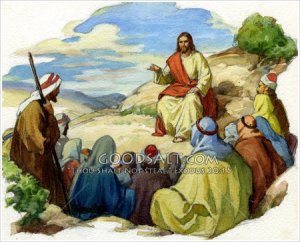
sermon-on-the-mount-13-1-GoodSalt-prcas6178All the Beatitude align to our human desire for happiness.  This desire was placed in our hearts by God to draw us to Himself who is the fulfillment of those desires.  St. Augustine stated it clearly: “Thou hast made us for Yourself O Lord, and our hearts are restless until they rest in Thee.”

We are called to imitate Christ; to be Christlike.  the Beatitudes are a mini biography of Christ, of His charity.  They describe His perfected humanity, the one we are to follow, the one He models for us.

Our Lord Jesus Christ is the Way – our only way. He is our Truth – our only truth. He is our Life – our only life. To know Jesus Christ is the supreme goal of every Christian.

Jesus drew up and eight point plan to guide us. The Beatitudes teach us that real happiness comes from fulfilling God’s will for us. It is a good idea to follow Pope Francis’ admonition to dwell on Our Lords’ magnificent plan contained in the Beatitudes. These Beatitudes are Our Lord’s invitation to a godly life. Let us accept this divine invitation with joy and determination.

All the Beatitudes have the sanctification of our souls as their goal. Our Lord, through the Beatitudes, calls each and every woman, NOW, to reform, to conform herself to Him. In the Beatitudes you have the one and only strategy you need to be filled with a supernatural joy you will be able to communicate to others. They will enable you to be exemplary lay apostles radiating Christ to others.

The Beatitudes contradict the spirit of our times. The culture and media of today call losers winners and losers those whom Jesus declares winners. For as where the world exalts wealth, power, glamor and influence, Our Lord commends humility, meekness, mercy, purity, generosity and detachment.

Which path are you following? What path will you take? Let’s be like St. Peter who recognized that Jesus has the words of eternal life and say “YES” to Him.


“Never give way to fear or routine”

In 01 Daily Meditations on 2016/06/24 at 12:00 AM
You are going through a critical stage. You feel a certain vague fear and find it difficult to adapt your plan of life. Your work seems to weigh you down, since twenty-four hours are not enough to do everything you ought to each day. Have you tried following the Apostle’s advice: “let all things be done decently and according to order”? That means, in the presence of God, with Him, through Him, and only for Him. (Furrow, 512)

How shall I manage, you seem to ask, to act always in a spirit that leads me to finish all my professional work perfectly? The answer comes not from me, but from St Paul: ‘Work courageously, be strong. And let everything you do be done in a spirit of charity’ [1]. Do everything for Love’s sake and do it freely. Never give way to fear or routine. Serve God Our Father.

Having put them very much to the test, I am very fond of repeating these artless but very expressive verses:

My life consists in loving,
And if with loving I’m familiar,
‘Tis because I’ve sorrowed much;
For there’s no finer lover,
Than one who’s suffered much.*

Go about your professional duties for Love’s sake. Do everything for the sake of Love and (precisely because you are in love, even though you may taste the bitterness of misunderstanding, of injustice, of ingratitude and even of failure in men’s eyes) you will see the result in the wonders that your work produces — rich, abundant fruit, the promise of eternity!

It happens, however, that some people (who are good, or should we rather say ‘goodish’) pay lip service to the beautiful ideal of spreading our faith, but in practice they make do with a superficial and careless professional output. They seem scatterbrained. If we happen to come across such Christians, we should do our best to help them, affectionately but uncompromisingly, having recourse where necessary to the gospel remedy of fraternal correction: ‘Brethren, if a man is found guilty of some fault, you who are spiritually minded ought to show a spirit of gentleness in correcting him. Have an eye upon thyself, lest thou too be tempted. Bear one another’s burdens and so you will be fulfilling the law of Christ.’ (Friends of God, 68-69)

[1] 1 Cor 16:13‑14

Catholicism: The Heart of History

In 15 Audio on 2016/06/24 at 12:00 AM


Catholicism: The Heart of History Back to Series List
Program Name Audio File Name – Click to download
1. The Roman Imperium and Christendom: Constantine, Justinian and Charlemagne
Host – Joanna & James Bogle
cathhh01.mp3
History of the spread of Christianity and Catholicism through the Roman Empire and it’s subsequent fall to the Franks – Charlemagne crowned Holy Roman Emperor by Pope Leo III.
2. The Roman Pontiff & Emperor: Keystones to the Commonwealth of Christ
Host – Joanna & James Bogle
cathhh02.mp3
In Pagan Rome the Emperor was also the head of the pagan church and had the title “Pontifax.” The Church changed the word from Pontifax to Pontiff. The Christian Holy Roman Emperor and the Pontiff were a support for one another – the Pope would approve and crown the Emperor and support the idea of the “Divine Right of Kings, while the Emperor would support and protect the Church.”
3. The Knights Templar and Hospitaller
Host – Joanna & James Bogle
cathhh03.mp3
Order of Knights created to serve the Church during the Crusades to protect pilgrims and Catholic Christian Churches in the Holy Land from Muslim invaders.
4. The Inquisition: Medieval, Spanish and Roman: What’s the Real Story?
Host – Joanna & James Bogle
cathhh04.mp3
The Roman inquisition was quite different from the Spanish and in fact was quite mild in comparison. The purpose was to root out heresy and protect the doctrines and deposit of Faith of the Church. In Spain, the State was experiencing cases where false converts, particularly from Islam, were trying to infiltrate and overthrow the Monarchy.
5. Spain, England & America: The Black Legend, True or False?
Host – Joanna & James Bogle
cathhh05.mp3
The Tears of the Indians, a book published in England, claimed that the Spanish explorers and settlers of the New World were exploiting and forcing the American natives to convert to Catholicism. This was propaganda aimed at denouncing the Catholic Church and the Spanish Monarchy as well.
6. Galileo: The Church and Science
Host – Joanna & James Bogle
cathhh06.mp3
Galileo was asked to refrain from speaking about his agreement with the Copernican view of the Universe. The Church and the Pope never said that Copernicus theory was wrong, rather the Church wanted to avoid confusion for those who would not understand the change from a Ptolemaic view to a Copernican view of the universe. Almost all of the scientific discoveries of the age were made possible through the Universities established by the Church.
7. The Protestant Reformation and How The People of England Opposed it
Host – Joanna & James Bogle
cathhh07.mp3
8. The English Civil War: What Really Happened?
Host – Joanna & James Bogle
cathhh08.mp3
9. The Enlightenment and the Suppression of the Jesuits
Host – Joanna & James Bogle
cathhh09.mp3
10. The French Revolution and the Destruction of Christendom
Host – Joanna & James Bogle
cathhh10.mp3
11. The Counter-revolution in France & Austria
Host – Joanna & James Bogle
cathhh11.mp3
12. 1848 to WWI: The Rise of Secularism, Nationalism & Totalitarianism
Host – Joanna & James Bogle
cathhh12.mp3
13. The Church in the 20th Century
Host – Joanna & James Bogle
cathhh13.mp3

Angelic Hosts

In 05 Homilies by Fr. Reid on 2016/06/24 at 12:00 AM

For a Gospel today we are given the familiar story of the rich man, “who dressed in purple garments and fine linen and dined sumptuously each day”, and poor Lazarus, “who would gladly have eaten his fill of the scraps that fell from the rich man’s table.” It’s a compelling story that reminds us of the hellish power of the sins of greed and sloth, as well as the fact that sufferings borne humbly and patiently in this life can lead us to glory in the next life. Ultimately, our Gospel today reminds us to prepare well for death. While the rich man may have forgotten or ignored poor Lazarus, Holy Mother Church has not. In fact, there’s a very beautiful chant that references Lazarus called In Paradisum that is traditionally used at the end of Requiem Masses. The words of the chant are as follows: “May the Angels lead thee into paradise: may the Martyrs receive thee at thy coming, and lead thee into the holy city of Jerusalem. May the choir of Angels receive thee, and mayest thou have eternal rest with Lazarus, who once was poor.” One of the interesting points about this chant is that it references angels twice. And I bring this up because today, September 29th, is the Feast of the Holy Archangels, while this Wednesday, October 2nd, is the Feast of the Guardian Angels. While both the Gospel as well In Paradisum, make mention that it is the angels who lead us into Heaven, they also do many other things as well! And these two feasts that the Church celebrates this week are the Church’s way for giving thanks to the angels for all they do. The primary mission of all of the angels is to give glory to God. However, each angel has it’s own particular mission for which it is perfectly suited and equipped. Scripture and Tradition divide the angels into 9 different categories or “choirs”: angels, archangels, principalities, powers, virtues, dominations, thrones, cherubim and seraphim – the seraphim being the highest and most important and powerful of the angels. Amongst these 9 choirs of angels are 3 hierarchies. The 3 highest choirs of angels: the seraphim, cherubim, and thrones, form the first hierarchy, and they are concerned with contemplation of God and His truth These angels help us to have a burning love for God, to understand His mysteries, and they instill humble hearts within us so that God can rest in our souls. The second hierarchy is formed by the dominions, virtues, and powers, and their primary job is governance. These are the angels that help us exercise self-mastery so that we can govern our passions. They also help preserve us from sin, and they sustain martyrs in time of trial. The third hierarchy, formed by the principalities, archangels and angels, are ministerial angels. They help us to be obedient to the will of God, they strengthen us in faith, they protect us in this life and conduct us into the next life. Whereas the liturgical calendar for the Novus Ordo Mass lumps the three named archangels: Michael, Gabriel, and Raphael into one feast day, in the old calendar each of the 3 archangels whose names we know from Scripture are given their own feast day. So while September 29th is celebrated as the Feast of Holy Archangels in the new Mass, in the old Mass today is dedicated just to St. Michael. While theologians and saints have debated about St. Michael’s exact place within the entire hierarchy of angels, the Church has long honored him as Her special protector. Following the four times that he is mentioned in Sacred Scripture (Dan 10, Dan 12, Jude, and Rev 12), Tradition has assigned to St. Michael four particular roles. First we know that St. Michael is our leader in the fight against satan and his demons. In that ancient battle in which satan and the other wicked angels rose up in rebellion against God, it was St. Michael who led the good counter-attack and thwarted them. Indeed, Michael’s very name, which means “Who is like God” was the battle cry of the good angels as they cast satan and the demons out of heaven and into hell. But as we know, the war between good and evil is not over. The devil prowls like a roaring lion, seeking whom he may devour. And thus it is St. Michael’s role to rescue the souls of the faithful from the power of the enemy, especially at the hour of death. Thirdly, we know that Michael is the champion of God’s people and therefore the special protector of Holy Mother Church. And lastly, it is St. Michael who will bring our souls to judgment when we die. When the world as we know it comes to an end, it is St. Michael who will sound the trumpet that calls all souls to the Final Judgment, and he will witness the weighing of each soul. Given the extreme importance of his 4-fold mission, the Church has always afforded St. Michael a special love and veneration that is reflected in her liturgies, prayers, and in the numerous shrines and churches dedicated to him. In fact, so important and powerful is St. Michael’s assistance that in the 19th century Pope Leo XIII composed a prayer to St. Michael that he decreed should be said after every low Mass – a tradition that we carry on here in this parish. Interestingly, this prayer was written immediately after the pope had a vision of the power God would allow satan to wield in the 20th century. Very interestingly, this prayer was written exactly 33 years to the day before our Lady’s final apparition in Fatima, Portugal. Even though there is truly much evil in the world, as we consider the power of St. Michael and all of the angels, we should not fear. Rather, we should have great hope and confidence! All of the angels, each in their own way, help in the fight against evil and help us along the path to Heaven. For this reason it is so important that we honor and thank them, and that we pray to them daily for their help and protection. My brothers and sisters, through the intercession of St. Michael the Archangel, the Archangels Gabriel and Raphael, and all of our guardian angels, may each of us be protected from all evils in this life so that we may enjoy heavenly bliss in the next. May the angels lead us into Paradise where we may have eternal rest with Lazarus, who once was poor. 29 September 2013 © Reverend Timothy Reid Fr. Reid is the pastor of St. Ann Catholic Church, Charlotte, NC Homilies from June 17, 2012 onward have audio. To enable the audio, lease go directly to Fr. Reid’s homily homilies and select the matching date. Link to Homilies: http://stanncharlotte.org/content/index.php?option=com_content&view=section&id=8&Itemid=61