2cornucopias

Archive for the ‘14 Book Corner’ Category

Did Mary Have Other Children?

In 14 Book Corner on 2011/07/17 at 6:39 AM

“She certainly did.  Millions and millions of them!  But not according to the flesh.  He alone was born of her flesh; the rest of us were born of her spirit.    She would beget Jesus in joy in a stable, but he could beget us only on Calvary.”  p. 126

“Flesh allows for only one mother . . . but Spirit allows another mother.  Since Mary is the Mother of God, then she can be the Mother of everyone whom Christ redeemed. The Key to understanding Mary is this: We do not start with Mary.  We start with Christ, the Son of the Living God. . . . It is her Son that who makes her motherhood different. . . . We did not choose Mary; He did.”  p. 63

Now, “[A]t the Last Supper, He had made His last Will and Testament, giving us that which no on dying no man can was ever able to give, namely, Himself in the Holy Eucharist”

On the Cross, He “adds a codicil: He gave us His Mother.”  p. 74

“Mary was present at three births: that of John the Baptist, her Divine Son, and ours at the Cross.”  p.36

“Any objection to calling her the ‘Mother of God’ is fundamentally an objection to the Deity of Christ.” p.70

“At Cana, Jesus . . . changed her name from Mother to Woman, the significance of which does not become clear until the Cross.” p. 125

Note: Many have never known the sweetness of the natural mother’s love, but everyone can experience that unfathomable love of Mary, our supernatural, God-given Mother.

Sheen, Fulton THE WORLD’S FIRST LOVE.  Ignatius Press. http://www.ignatius.com/Products/CategoryCenter.aspx?SearchTerm=The+world’s+first+love

Ilia Delio Introduces Bonaventure’s Thought

In 14 Book Corner on 2011/07/10 at 6:47 AM


150_simply-bonaventure1


Ilia Delio, O.S.F., writes about St. Bonaventure in the Introduction to her book: SIMPLY BONAVENTURE:

Bonaventure’s theological system is a profound and unique synthesis…He is concerned with three questions: Where have we come from? What are we doing here? Where are we going?

Bonaventure began with the conviction of faith in God who has revealed himself to us in Jesus Christ.  Always searching for the ultimate ground of truth, he came to perceive the fullness of truth in Jesus Christ.Bonaventure had a passionate love of God revealed in Christ crucified in whom he saw the mystery of God and creation united.

If we want to know the ground of our being, the purpose of our existence and the goal to which we are directed, we must come to know Christ who is the center of our lives and our universe. The pattern of Bonaventure’s though is “circular” -we come from God, we exist in relation to God and we are to return to God. The basis of this “circle’ is the Trinity….Everything flows from the Father and ultimately returns to the Father God is the dynamic fountain-fullness of self-communicative love….He is the source of our lives and the goal to which we are directed.

The Trinity provides a “blue-print” for creation  since the relationship between the Father and the Son/Word, united in the Spirit is the ground of all other relationships. The question of why we exist finds meaning on three different levels: in the mirror of creation, in the creation of the person as the image of God in the Incarnation. Humanity has not changed in the last 800 years since Bonaventure.  The essential questions he raised in the thirteenth century are still relevant.

In our age where meaning and purpose of human existence is becoming increasingly vague and the quest for human identity shows the marks of desperation, Bonaventure offers a profound system of thought….He redefines the boundaries of what it means to be human and Christian.  It is a search and a journey that begins with desire and prayer, and spiral through the complexities of our lives, as we seek to find God at the center of our existence….He lead us that to recognize God within us is to let go of what we cling to that is not God, and to embrace that which is God.

We cannot understand the mystery of God within us and in our world; we can only yield to this mystery in love…..for to yield in love is to return to the point from which we gan.  And in this return we discover the truth of who we are created to be and the truth of the world in all its beauty.

http://www.newcitypress.com/simply-bonaventure.html

Your Triple-Eye

In 14 Book Corner on 2011/07/03 at 8:19 AM

St. Bonaventure posited that we were meant to have triple vision. Here follow his thoughts as distilled from his writings by Sr. Ilia Delio, OFM:

“In paradise the human person was endowed with a ‘triple’ eye: the eye of the flesh, of reason and of contemplation. . . . [The] eye of flesh, to see things outside creation; the eye  of reason, to see the things within; the eye of contemplation, to see things above.

. . . Every aspect of creation is like a reflecting pool of the divine…..Sin distorted the triple eye of the human person . . . strange blindness . . . blinded . . . unless grace with justice come . . . through Jesus Christ. It is Christ alone who restores the true light of knowledge so that the beauty of creation may be seen in proper relation to God and, indeed, may lead us to God.

Since the created world is finite, one must enter within the human soul created in the image of God which has the capacity for the infinite God. It is here that one finds a ground of loving relationship with God. . . . God dwells deep within the center of the soul. The degree to which one enters into this relationship depends on how open one is to knowing God and to knowing oneself in God.

Bonaventure believed that there is a light within the human soul that enables one to know things with certainty: it is a divine light which illuminates the truth of things and allows one to judge the certitude of things . . . a light which shines within the soul and penetrates one’ whole being . . . because of this light humans have knowledge of things they have never experienced.

Bonaventure held that within the human soul are eternal reasons that enable the human person to know the truth of God, and the truth of the things of God.  It is an inner light “from above: that shines on the human soul and illumines it. . . . It is the light of truth that regulates and motivates human reason and enable one to know things as true and certain.

Through transformation in Christ the triple eye of the human person is restored. One sees the truth of all reality, and in seeing rightly one loves rightly . . . deeper love of God, neighbor . . .”

Delio, Ilia SIMPLY BONAVENTURE New City Press.

http://www.newcitypress.com/simply-bonaventure.html

Construct a Eucharist Mosaic

In 14 Book Corner on 2011/07/01 at 11:11 AM


If you look closely at the Rose Window in the Cathedral of Notre Dame in Paris, you will observe that is it a composite of colored fragments of glass inset in such a manner that their colors blend into each other while remaining separate.

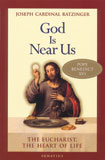
Take these quoted excerpts, from Pope Benedict’s book on the Eucharist entitled GOD IS NEAR US: The Eucharist, the Heart of Life,  and create a mosaic for yourself.

…the heart of all our creeds in our YES to Jesus Christ….p.12

…the Incarnation required acceptance….the Virgin was needed….p.13

“A body have you prepared for me.” Ps. 40 & Heb 10:5 ….the entire Gospel is contained within  this single statement….as the Fathers said: the Word has contracted to become small; to become a child…p.21

The Word, the Crucifixion, and the Resurrection…the three belong together. p.44

The Eucharist is much more than a meal; it cost a death to provide it. p.44

The Eucharist is a sacrifice, the presentation of Jesus Christ’s sacrifice on Cross p.44

God Himself gives to us, that we may give in turn. p.45

Christ identifies Himself with us to such an extent that our sins belong to Him and His being to us. p.50

The disciples had no need to look back on the Resurrection as something in the past: the Risen One is alive; that is why the day of Resurrection was…the day of His presence, the day He gathered them together, when they were gathered around Him. p.61

In place of the Temple, there is the Eucharist, since Christ is the true Pascal Lamb; everything that every took place in the Temple has been fulfilled in Him. p.63

Paul compares what happens in Holy Communion with the physical union between man & woman….adding, “He who is united to the Lord becomes one spirit (that is, shares a single new existence in the Holy Spirit) with him.  (1 Cor 6:17) p.77

Ratzinger quotes Augustine “…eat my flesh….you will not transform me and make me part of you; rather, I will transform you and make you part of me.” Confessions Bk 7,chpt.10:16   p.78

Communion is always a personal act…I enter into the Lord, who is communicating Himself to me.  Sacramental Communion must therefore always be also spiritual Communion. p.81

We are coming into contact with the living God…Augustine says: No one can receive Communion without first adoring. p.83

Communion and contemplation belong together; a person cannot communicate with another person without knowing him. p.97

God has put Himself in our Hands and into our hearts.  God is near. God knows us. God is waiting for us in Jesus Christ in the Blessed Sacrament. p.102

The more we stand for the Lord and before the Lord, the more we stand with one another, and our capacity to understand one another grows. p.110

The Eucharist is instrumental in the process by which Christ builds Himself a Body and makes us into one single Bread, on single Body. p.114

The Church is a Eucharistic fellowship…one people….one table…p.115

Christ is both the giver and the gift…. p.119

Ratzinger, Joseph GOD IS NEAR US.  Ignatius Press.

http://www.ignatius.com/Products/GIN-P/god-is-near-us.aspx

Right Thinking About Thinking

In 14 Book Corner on 2011/06/29 at 8:53 AM

Mortimer Adler was a philosopher and teacher who taught at the University of Chicago.  He set up the GREAT BOOKS series.

Here follow some of his thoughts from his book on ARISTOTLE FOR EVERYONE.  You might find some of his comments interesting and worthwhile.  They are not difficult for the average person to understand and can come in quite handy in dealing with our realities today.  At most, these excerpts will serve as a refresher of how you think in an age where thinking is becoming a rarity.

Definition of common sense: the notions that we have formed as a result of the common experiences we have in the course of our daily lives.

Personal prejudice: things we hold to be simply true because we want to believe them.  We have no rational grounds for believing them.  Instead, we are emotionally attached to them.

Prescriptive statements: order what you or I ought to do.

Thinking begins by asking WHY?  Ideas are the product of the mind’s activity in its effort to understand the world we experience through our senses.

Ideas are the raw materials out of which the mind forms judgments in which something is affirmed or denied.

Humans ask general questions and seek answers by observation and thought.

Thinking begins with the formation of ideas on the basis of information received by our senses.

Sensation: input form the exterior; ideas: output of the mind.

Thinking goes further; it RELATES the ideas it produces, joins, separates, sets one against another.

Reasoning or inference: only when one statement become the basis for asserting of denying another statement does the mind move up to the level of thought.  At this level, thinking involves giving reason for what we think: True or False? Logical or Illogical?

When a pair of contradictory statements are contradictory, both cannot be true, no both false.  One must be true and the other false.

When our answers do not consist of knowledge, they are just opinions.  The opinions we hold may be supported by reason or observation or without such support.

Productive thinking is thinking about things to be made.  Practical thinking, in contrast, is thinking about what is to be done.

Moral virtue is the habit  of making right choices.  The virtuous person is on who makes the right choices regularly,  time and time again, although not necessarily every single time.  Persons who are not temperate injure themselves by habitually making wrong choices.

Man (the rational thinking being) is as maker concerned with beauty; as doer he is concerned with good and evil; as knower he is concerned with truth.

The Muslim Reality and the Western Crisis

In 14 Book Corner on 2011/06/18 at 1:00 AM

In 1998 Cardinal Ratzinger was interviewed by Peter Seewald and made the following statement which alerted most Christians to the current religious peril.

“The great moral crisis of the Western World broke out in the 60’s &70’s. . . . In the face of the deep moral contradictions of the West and of its internal helplessness, combined with the sudden opposition by the new economic power of the Arab countries, the Islamic soul reawakened.  Islam believes that they are now somebody too; they know who they are; that their religion is holding its ground; we  no longer have one.

This is actually the feeling today of the Muslim world, what they believe: ‘The Western countries are no longer capable of preaching message of morality but have only knowhow to offer the world. That Christian religion has abdicated; that it really no longer exists as a religion; that the Christians no longer have a morality or a faith; all that’s left are a few remains of some modern ideas of enlightenment, while they have the religion that – stands the test.’

So the Muslims now have the consciousness that in reality Islam has remained in the end as the more vigorous religion and that they have something to say to the world, indeed, are the essential religious force of the future. Now there is a new pride. Thus a new zest, a new intensity about wanting to live Islam has awakened. This is its great power: They say: ‘We have a moral message that has existed without interruption since the prophets, and we will tell the World how to live it, whereas the Christians certainly can’t.”

The future pope concluded: “We must naturally come to terms with this inner power of Islam, which fascinates even academic circles.”

Cardinal Joseph Ratzinger in SALT OF THE EARTH: The Church at the end of the millennium (interview by Peter Seewald). pp. 243/244.

http://www.ignatius.com/Products/SOE-P/salt-of-the-earth.aspxT

The Eternal Son

In 14 Book Corner on 2011/06/12 at 6:00 AM

Excerpts from Guardini, Romano THE LORD

“None of the great things in human life spring from the intellect; every one of them issue from the heart and its love.”  p. 19

“Jesus did not ‘experience’ God; he was God; He ver at any given moment ‘became’ God; He was God from the start.”  p. 20

“The whole problem is a mystery, the sacred mystery of the relationship of the triune God to his Incarnate Son.  We can never penetrate it, and knowledge of this incapacity must dominate our every though and statement concerning Jesus’ life.”  p. 31

“Everything He did was done from the eternal; everything He experienced was caught up into the eternal.”  p. 42

“Jesus looms like a rescuing cliff above the tides of human suffering.”  p. 49

“Jesus walks through the flood of pain, and the power of God flows form Him like  a wave of human healing.”  p. 53

“Eternal revolt of the human heart against the bearer of its own salvation. . . . The real reason is never given; invariably it is this mysterious, inexplicable impulse of the fallen human heart revolting against the holiness that is God.”  p. 53

“The Spirit within Him has the power to heal – to heal from the root of the evil.”  p. 55

“One after another they appear: the lame, the halt, the blind – living witnesses of the healing power that radiates from the Son of God.”  p. 57

“The Lord warns us also to guard against ourselves, against the deeply rooted human traits of vanity, complacency and egotism…Not even before oneself should and act of charity be paraded or reveled it.  Send that inner, applauding spectator away, and let the act, observed only by God, stand on its own.”  p. 99

“What the Sermon on the Mount demands of us is . . . a beginning and a continuing, a rising again and plodding on after every fall.”  p. 107

“It is Satan who leads people to be irritated by truth and to harden their hearts to its sacred tidings.”  p.  135

“Christ the Intermediary is a sacred living artery thorough which divine purity and forgiveness flow; through the establishment of the Eucharist he becomes a permanent artery; supplying all generations with the supernatural abundance of divine life.”  p. 143

Guardini, Romano THE LORD.  Regnery Publishing Company.

/www.amazon.com/Lord-Romano-Guardini/dp/0895267144/ref=sr_1_1?ie=UTF8&qid=1307417186&sr=8-1

An Unbleached Image of the Lord

In 14 Book Corner on 2011/06/10 at 7:00 AM

To become truly human, we must become Christlike and we can only learn this by knowing Him and learning from Him.  In Romano Guardini’s meditative scriptural commentaries on the person of Jesus Christ, one can find as Guardini says terms “the realization that Christ forces upon us when He himself ‘interprets Scripture’ and our hearts start ‘burning within’.” (Preface)

Here follow some excerpts that I hope will lead you to read the enlightening portrait of Jesus Christ which Guardini paints for us:

“None of the great things in human life spring from the intellect; every one of them issue from the heart and its love.”  p. 18

“Questions can arise to trouble us, particularly as they are usually afflictions of the heart that have assumed intellectual form. ..there are profound questions that return after every supposed solution, mysteries whose intrinsic meaning, not solve but lived, increasingly clarify the faith of those who live them.”  p. 299

“Jesus looms like a rescuing cliff above the tides of human suffering.”  p. 49

“Jesus walks through the flood of pain, and the power of God flows form Him Iike a wave of human healing.”   p. 53

“…eternal revolt of the human heart against the bearer of its own salvation….The real reason is never given; invariably it is this mysterious, inexplicable impulse of the fallen human heart revolting against the holiness that is God.”  p. 53

“The Spirit within him has the power to heal – to heal from the root of the evil.”  p. 55

“Between God and man stands the barrier of sin….The Holy Spirit lowers that barrier of sin.”  p. 169

“The Lord warns us also to guard against ourselves, against the deeply rooted human traits of vanity, complacency and egotism…Not even before oneself should and act of charity be paraded or reveled it.  Send that inner, applauding spectator away, and let the act, observed only by God, stand on its own.”  p. 99

“What the Sermon on the Mount demands of us is…a beginning and a continuing, a rising again and plodding on after every fall.”  p. 107

“Christ the Intermediary is a sacred living artery thorough which divine purity and forgiveness flow; through the establishment of the Eucharist he becomes a permanent artery; supplying all generations with the supernatural abundance of divine life.”  p. 143

“Christ’s exhortations are founded neither on social nor ethical nor any other worldly motives.  We are told, simply, to forgive men as our Father in heaven forgives us.  He is the primary and real Pardoner and man is his child. Our powers of forgiveness are derived from His….love must become pardon when that neighbor trespasses against us, as we constantly trespass against God.”  p. 352

“Men have always known that something was wrong with human existence; that everywhere stupidity, injustice, deception and violence were at work. Consequently there was always the feeling that someday things must be set right and fulfilled.”  p. 393

“Jesus is exemplary because in Him Christian life begins.  He is its foundation.”  p. 423

Guardini, Romano THE LORD Regnery Gateway.

/www.amazon.com/Lord-Romano-Guardini/dp/0895267144/ref=sr_1_1?ie=UTF8&qid=1307417186&sr=8-1

Pascal sowed, Oznam watered, God gave the increase, and Nagai and Japan reaped.

In 14 Book Corner on 2011/06/09 at 8:40 AM

The thoughts of Blaise Pascal had a tremendous impact on the spiritual life of Takashi Nagai, the Japanese radiology pioneer,  nuclear scientist, convert and survivor of the atom bomb, who is venerated in Japan as a saint. Nagai was introduced to Pascal by a fellow academic, the Sorbonne Professor,  Frenchman Frederick Ozanam.

Nagai was impressed by Ozanam told him of his encounter with Andrè Ampère , the mathematician/physicist  discovered of electomagnetism.  praying on his knees in a church in the slums of Paris. Ozanam  had said to him: “Professor, I see you believe in prayer.”  Ampère replied: “Everyone has to pray.” Now Nagai understood Pascal’s words: “Don’t just study the Scriptures, pray them. . . . Only in Christ can the paradox of man’s wretchedness and his greatness be solved . . . living for the glory of God.”  Nagai came to see that it is prayer that gives vision, and that the mystery that is God, cannot be grasped like mathematics and science.  Takashi would become Japan’s Pascal.

From then on Nagai lived what he wrote with his brush: “The Son of God has graciously brought me to Nagasaki so that I can work for the Father’s glory.”  And, indeed, he did just that amidst the horrors of the atomic devastation in which he saw God’s Providence at work.

At the Requiem Mass for the eight thousand Catholics who died at Nagasaki on August 9, 1945, Nagai used hansai, the Japanese word for “holocaust”:  “The Christian flock of Nagaski was true to the Faith through  three centuries of persecution. . . . It prayed ceaselessly for a lasting peace.  Here was the one pure lamb that had to be sacrificed as hansai on His altar . . . so that many millions of lives might be saved. . . . Was not Nagasaki the chosen victim, the lamb without blemish, slain as a whole burnt offering on an altar of sacrifice, atoning for the sins of all the nations”  during the  war?  Nagai quoting Jobe said: “The Lord has given; the Lord has taken away. Blessed be the name of the Lord”, adding  Let us be thankful that Nagasaki was chosen for the whole burnt sacrifice!”

In a split second thousands had been killed, but even more had been injured and poisoned.  A victim of over-exposure to radiation through research, Nagai suffered from leukemkia.  However, this did not deter him from working and writing books that consoled  and healed his devastated people. He would say: “Our lives are of great worth if we accept with good grace the situation Providence places us in and go on living lovingly. . . . If all of us accept ourselves as we are, it is absolutely certain that a day will come when we can see how God’s plans have been accomplished, and precisely through our weakness. . . . If you make the vital decision to live humbly and lovingly, you will live fruitful lives and be happy.”

Takashi Nagai’s heroic and selfless sacrifices made him revered by his nation and his Emperor who came to visit him in his hut.  Famous people from the entire world came to visit the dying saint. His visit with Helen Keller confirmed his belief that suffering accepted gracefully purifies the human heart, and the experience of physical blindness sharpens spiritual vision.

If these culled thoughts and citations about Takashi Nagai have inspired you in light of Japan’s recent tragedy, please read A SONG FOR NAGASAKI by Paul Glynn, S.M. Ignatius Press.

http://www.ignatius.com/Products/SNAG-P/a-song-for-nagasaki.aspx

(See also post by that title in Book Corner.)

The Blessed Virgin Mary in the Koran

In 14 Book Corner on 2011/06/07 at 7:59 AM

Mary and the Moslems” is the title of a chapter in Fulton Sheen’s THE WORLD’S FIRST LOVE written in 1952, reprinted by Ignatius Press in 1996.  Here are various prophetic, and now timely, excerpts;

“The Christian West barely escaped destruction at the hands of the Muslims . . . at the present hour, the Muslims are beginning to rise again . . . the hatred of the Muslim countries against the West is becoming a hatred against Christianity itself.” p. 200

“There is still great danger that the  temporal power of Islam may return, and with it, the menace that it may shake off a West which has ceased to be Christian, and affirm itself as a great anti-Christian world power. . . . I belive that that Muslimism will eventually be converted to Christianity… through a summoning of the Muslims to a veneration of the Mother of God.” p.201

“The Qu’ran, which is the Bible for the Muslims, has many passages concerning the Blessed Virgin. First of all, the Qu’ran believes in her Immaculate Conception, and also in her Virgin Birth. The third chapter of the Qu’ran places the history of Mary’s family in a genealogy which goes back through Abraham, Noah, and Adam. . . . Both books describe the old age and the definite sterility of the mother of Mary. When, however, she conceives, the mother of Mary is made to say in the Qu’ran: “O Lord, I vow and I consecrate to you what is already within me.   Accept it from me.” When Mary is born, the mother says: “And I consecrate her with all of her posterity under thy protection, O Lord, against Satan!” p. 202

“…Moslem tradition  know the name of Joseph and has some familiarity with him. In this tradition, Joseph is made to speak to Mary, who is a virgin. As he inquired how she conceived Jesus without a father, Mary answered:  “Do you not know that God, when he created the wheat had no need of seed, and that God by his power made the trees grow without the help of rain? All that God had to do was to say, ‘So be it, and it was done’.”  p. 202

“The Qu’ran has also verses on the Annunciation, Visitation, and Nativity; 41 in chapter 19.” p. 202

“I believe that the Blessed Virgin chose to be known as ‘Our Lady of Fatima’ as a pledge and a sign of hope to the Muslim people, and as an assurance that they, who show her so much respect, will one day accept her divine Son too. . . . The very place where Our Lady appeared in 1917 bears a historical connection to Fatima, the daughter of Mohammed.”  p. 203

“Mary is the advent of Christ, bringing Christ to the people before Christ himself is born. . . . Because the Muslims have a devotion to Mary . . . Our Blessed Lady will carry the Muslims the rest of the way to her divine Son.”  p.204

Sheen, Fulton  THE WORLD’S FIRST LOVE. Ignatius Press.

http://www.ignatius.com/Products/CategoryCenter.aspx?SearchTerm=The+world’s+first+love