2cornucopias

Archive for the ‘14 Book Corner’ Category

Christopher Dawson, Master Historian

In 14 Book Corner on 2011/10/20 at 11:11 PM

Christopher Dawson was a unique historian, a meticulous scholar who possessed the imagination to present history in a rich and lively manner.  The author of an unbelievable number of books, he is perhaps the last in the line of the great “true” historiographers.

In the late 1950’s, I had the tremendous privilege of taking a graduate course entitled “THE SIX AGES OF CHRISTENDOM” presented by Christopher Dawson’s associate and editor, John J. Mulloy.  Christopher Dawson (1889-1970) was Harvard’s first Stillman Professor of Roman Catholic Studies. This course had a significant impact on my 36-year professional career of teaching college and high school history courses and echoed into my retirement career where I am still  teaching history from a Christian perspective.

Dawson’s  goal was to make us see that religion and religious belief are the cradle of all civilizations. His ideas are being recognized today as sound and essential to our understanding of our current realities.

Dawson traced the influence of religion on culture and civilization. His great concern was for the impact of Christianity in the development of Christendom (only recently replaced by the term Europe), and he was extremely aware of the advancing philosophy of secularization.

Dawson’s works echo his central belief that the Incarnation is the most important event in human history. The Christian needs to see history in terms of the Divine Will in order to interpret past events correctly. Dawson sought to have us see all events in their entire setting and in their proper relationship to each other.

Dawson wrote in his essay “The Christian View of History” that “for the Christian the doctrine of the Incarnation is not simply a theophany — a revelation of God to Man; it is a new creation — the introduction of a new spiritual principle which gradually leavens and transforms human nature into something new. The history of the human race hinges on this unique divine event which gives meaning to the whole historical process.”

Particularly in the class “Fathers, Doctors, Popes and Founders of Religious Orders”, I sought to highlight the same figures Dawson chose to demonstrate the power of the Christian faith to transform: St Augustine and St. Thomas Aquinas.  To that list, I added now Blessed John Henry Newman.  These men are models whom we need today in order to pass on the cultural heritage of Catholic Christendom to future generations.

Dawson presented Europe as a Christian creation. He wrote: “The essential thing is not to cram students with a complete knowledge of the history of Christian culture, but to introduce them to the subject, so that they will at least realize the existence of the whole, before they are irretrievably committed to a specialized study of the parts or of a particle of the part.”

Santayana wrote: “Those who do not know history are condemned to relive it.”  Dawson was clearly concerned about the Europeans’ loss of memory as well as the distortions of Christianity into totalitarian systems.

The fragmentation of Europe and the loss of the power of historical memory was already beginning it’s own steady tempo like that of Ravel’s “Bolero.” He was concerned that more and more Christians would discard their religious past and accept falsehoods, oversimplifications and distortions.

Dawson wrote: “I believe that the study of Christian culture is the missing link which it is essential to supply if the tradition of Western education and Western culture is to survive, for it is only through this study that we can understand how Western culture came to exist and what are the essential values for which it stands.”

In studying Dawson’s works, I recognized that the average Christian lacked knowledge of the Roman persecutions, the Muslim tsunami, the real richness of the Middle Ages, the politically profitable division of Christendom called the Reformation.  In addition, they lacked an understanding of the domino effect of discarding  first authority, then faith, and, finally, reason and with it the natural moral code implanted by the Creator in the soul of  every man.  So, with Dawson as my “mentor”, I also wanted Christians to know their past.  This was/is the task of my life as a professional historian.

In his essay “The Christian View of History ” Dawson states: “The Christian view covers the whole life of humanity on this planet and it ends only with the end of this world and of man’s temporal existence. It is essentially a theory of the interpretation of time and eternity: so that the essential meaning of history is to be found in the growth of the seed of eternity in the womb of time. For man is not merely a creature of the economic process– a producer and a consumer. He is an animal that is conscious of his mortality and consequently aware of eternity.”

The religious, moral, temporal and political histories revealed in Western Culture are a heritage of Western culture for every person.  No one can ignore traditions, yet understand the problems of today.

This brilliant convert to Catholicism wrote shortly before his death:  “We are living in a world that is far less stable than that of the early Roman Empire. There is no doubt that the world is on the move again as never before and that the pace is faster and more furious than anything that man has known before. But, there is nothing in this situation which should cause Christians to despair. On the contrary, it is the kind of situation for which their faith has always prepared them and which provides the opportunity for the fulfillment of their mission.”

Just as Christianity is essential to Europe, so the Catholic Church is essential to Christianity.  As the Roman Empire disintegrated, it was the Catholic Church that preserved the culture, and as we see the current disintegration of our world, it is no less crucial.  Today, there is a full-fledged rebellion against the moral principles of Western culture with the elevation of the individual’s conscience as opposed to the needs of society.  We must preserve Christian values, the dignity of the human person and the freedom of the individual from the “I am god” mentality, which rejects objective moral values as a guide.

Dawson, like Pope Benedict today, stressed the need for the Church to use the technological changes in the world for evangelization.  Dawson wrote in “The Movement of World Revolution” that all Christians need to advance the Church’s “universal mission to bring the Gospel of Christ to all nations.” The Catholic Church is the only body today in the world that defends human rights and the dignity of the human person, both essential factors in the preservation of our God-given Christian heritage.

On May 30, 2011 Pope Benedict addressed those members of the Pontifical Council for Promoting New Evangelization who will be holding a Synod in 2012.  He told them: “The crisis we are living through carries with it signs of the exclusion of God from peoples’ lives, a general indifference to the Christian faith, and even the intention to marginalize it from public life.”

This is a message that we as Christians must carry with knowledge, understanding and conviction and express it with courageous action in the evangelization of an apathetic modern society.

Recommended books by Christopher Dawson:

Christianity and European Culture

Christianity and the New Age

Dividing of Christendom

Dynamics of World History, edited by John J. Mulloy

Medieval Essays

Formation of Europe

Making of Europe: An Introduction to the History of European Unity

Modern Dilemna: The Problem of European Unity

Progress and Religion

Religion and Culture, the Gifford Lectures

Religion and the Rise of Western Culture

Understanding Europe   

See also: Dawson/Recommended Reading List in this same category (Book Corner) 

Books by Christopher Dawson

In 14 Book Corner on 2011/10/20 at 11:11 PM
Dynamics of World History
Christianity and European Culture
Religion and the Rise of Western Culture
The Formation of Christendom
Historical Realities of Christian Culture
Inquires into Religion and Culture
The Making of Europe
Understanding Europe
The Dviding of Christendom

The Kingdom of God

In 14 Book Corner on 2011/10/01 at 1:11 AM
Excerpt from “The Forty Days’ Teaching by Cardinal John Henry Newman in PRAYERS, VERSES AND DEVOTIONS. Ignatius Press.

My Lord Jesus, how wonderful were those conversations which You did have with Your disciples after your resurrection.   When You went with two of them to Emmaus.  You did explain all the prophecies which related to Yourself.  And You did commit to the Apostles the Sacraments in fulness, and the truths which it was Your will to reveal, and the principles and maxims by which Your Church was to be maintained and governed.

And thus You did prepare them against the day of Pentecost…when life and illumination was to be infused into them.  I will think over all You did say to them with a true and simple faith. The “kingdom of God” was truly Your sacred subject.  Let me never for an instant forget that You had established on earth a kingdom of Your own, that the Church is Your work, Your establishment, Your instrument; that we are under Your rule, Your laws and Your eye-that when the Church speaks You speak.

…let not the weakness of Your human representatives lead me to forget that it is You who speak and act through them.  It was just when You were going away, that then You  did leave this kingdom of Yours to take Your place on to the end of the world, to speak for You, as Your visible form, when Your Personal Presence, sensitive to man, was departing.  I will in true loving faith seeing You before me, teaching all the truths and laws of this kingdom to thy Apostles, and I will adore You, while in my thoughts I gaze upon them and listen to Your words.

I need you to teach me day by day, according to each day’s opportunities and needs….I need the mind of the Spirit, which is the mind of the holy Fathers, and of the Church….I need to be saved from originality of thought, which is not true if it leads away from you….Give me the gift of discriminating between true and false in all discourse of mind…My ears are dull, so that I cannot hear Your voice….You alone can quicken my hearing…cleanse and renew my heart….Give me the discernment to know Your voice from the voice of strangers….and answer me through my own mind.

The Spirit of the Oxford Movement

In 14 Book Corner on 2011/09/29 at 1:11 AM

The Spirit of the Oxford Movement

Excerpt from book review. 

Historian Christopher Dawson’s brief overview of the OM’s first seven or eight years is masterly. It rewards repeated reading. First written a hundred years after the Oxford Movement began, THE SPIRIT OF THE OXFORD MOVEMENT was almost unique in its day for flagging three facts.

The first fact is that the driving, almost demonic, force behind the Movement was the young Richard Hurrell Froude. Froude was the most gifted person whom John Henry Newman had ever met. Froude’s unceasing nagging had the effect, over time, of removing every last one of John Henry Newman’s inherited Protestant detestation of the Papacy. Without Froude, said Dawson, one could not have predicted that Newman would become a Roman Catholic Cardinal.

The second fact which Dawson convincingly and virtually uniquely among historians sketches is the impact of Calvinist theology on the young Newman. This theology John Henry imbibed from his Low Church Evangelistic parents and later at school from one or more teachers and from his reading in church history. Till the end of his days Newman, undisputed leader of the OM, firmly embraced Catholic views first learned under Calvinist auspices: the Majesty of God, the Incarnation and Predestination of the saints. As today’s Baptists and Presbyterians become aware of Newman’s abiding albeit critical Calvinism, they may join those Anglican/Episcopalians and Roman Catholics who see in the writings of Cardinal Newman a way to stitch up shattered Christian dogmatic unity.

Thirdly, Dawson illustrates at work within the microcosm of the soul and conscience of Newman an evolution which Newman presented in THE DEVELOPMENT OF CHRISTIAN DOCTRINE. There Newman argued that the one true form of orthodox Christianity, led by the Holy Spirit, will absorb all that is good in the world and cultures around it: Platonism, Aristotelianism, Protestantism, while rejecting what is untrue or harmful. Newman also believed that God gives each human person from birth the wherewithal to find Him, to transcend the limitations of his or her particular family or time in history, to respond to God’s voice echoing in conscience and to find the true religion or at least move in its direction under guidance from the Holy Spirit.

http://www.amazon.com/Spirit-Oxford-Movement-Newmans-History

Ratzinger Book Recommendations

In 14 Book Corner on 2011/08/31 at 11:11 PM

Books Books available through Ignatius Press:   http://www.ignatius.com/TabCenter/Books/Default.aspx

Papal Warning

In 14 Book Corner on 2011/08/24 at 11:11 PM

Here follows the famous statement made in 1998 by then Cardinal Ratzinger.  It alerted many Christians to the current religious peril.

“The great moral crisis of the Western World broke out in the sixties and seventies…in the face of the deep moral contradictions of the West and of its internal helplessness, combined with the sudden opposition by the new economic power of the Arab countries, the Islamic soul reawakened.

Islam believes that they are now somebody too; they know who they are; that their religion is holding its ground; we no have one any longer.

This is actually the feeling today of the Muslim world, what they believe: ‘The Western countries are no longer capable of preaching message of morality but have only knowhow to offer the world. That Christian religion has abdicated; that it really no longer exists as a religion; that the Christians no longer have a morality or a faith; all that’s left are a few remains of some modern ideas of enlightenment, while they have the religion that—stands the test.’

So the Muslims now have the consciousness that in reality Islam has remained in the end as the more vigorous religion and that they have something to say to the world, indeed, are the essential religious force of the future. Now there is a new pride. Thus a new zest, a new intensity about wanting to live Islam has awakened. This is its great power: They say: ‘We have a moral message that has existed without interruption since the prophets, and we will tell the World how to live it, whereas the Christians certainly can’t.’

We must naturally come to terms with this inner power of Islam, which fascinates even academic circles.”

Cardinal Joseph Ratzinger in SALT OF THE EARTH: The Church at the end of the millennium (interview by Peter Seewald). pp. 243/244. Ignatius Press.  http://www.ignatius.com/Products/SOE-P/salt-of-the-earth.aspx

A Marxist Atheist Who Became a Dominican Priest

In 14 Book Corner on 2011/08/19 at 9:11 AM

Recently in “The Core” publication, a supplement to the University of Chicago Magazine, I read the fascinating journey of Winston Norman Ashley, a 1937 graduate who is still working for God and is an example of the Catholic Apostolate.

This passionate leftist atheist became an active card-carrying Communist, labelling his formative years beliefs as “humanistic atheist.”  He joined the Great Books of the Western World Seminar started  by President Robert Hutchins and Mortimer Adler.  Ashley at first saw no problem in pursuing literature and radicalism until Thornton Wilder, the dramatist, pointed the contradiction out to him.

The Seminar reading and discussion of  St. Thomas Aquinas forced Ashley to think about God instead of Marxism and world revolution.  Of further influence was the lecture by Etienne Gilson in which the philosopher stated that one can prove the existence of God without faith but that no one believes in God without faith.  In continuing his study of Aquinas, Ashley found the intellectual challenge to his Marxism and atheist.  ” I was gradually convinced by my own reflections that Aquinas had provided a better case for theism than Marx or Darwin had provided against it.”

Where he originally sought a doctorate in political science, he now sought one in physics.  He also began to study Catholicism and was baptized in 1938.  The Socialist party expelled him.  He transferred to Notre Dame University, and in 1941 became a Dominican, taking the name of Benedict.  He was ordained in 1948.

As Fr. Benedict, he began his new career, teaching Thomistic philosophy at the Aquinas Institute.  Since 2003 Fr. Benedict has been an advisor to the Institute for Advanced Physics in Baton Rouge.  This institute was founded for the purpose of reconciling science and religion and rejecting a division between natural science and philosophy.  Additionally, Fr. Benedict serves on the advisory board of Lumen Christi Institute for Catholic Thought established by University of Chicago scholars.

Fr. Benedict is a marvelous example of cooperating with God’s grace as He transforms those, whom many would call obdurate.  He also demonstrates that the mind can remain vital and active in spite of an aging body.

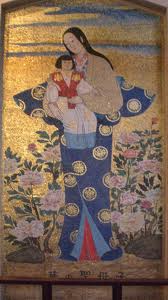
Cathedral of the Assumption, Nagasaki

In 14 Book Corner on 2011/08/14 at 9:11 AM

Dr.Nagai’s Funeral Oration for the 8000 Catholic Victims in front of destroyed Nagasaki  Cathedral  Nagasaki

On August 15…the whole world welcomed a day of peace. This day was also the great feast of the Assumption of the Virgin Mary. It is significant to reflect that Urakami Cathedral was dedicated to her. And we must ask if this convergence of events—the ending of the war and the celebration of her feast—was merely coincidental or if there was here some mysterious providence of God.

Is there not a profound relationship between the destruction of Nagasaki and the end of the war? Nagasaki, the only holy place in all Japan—was it not chosen as a victim, a pure lamb, to be slaughtered and burned on the altar of sacrifice to expiate the sins committed by humanity…

“… we have forgotten that we are children of God; we have believed in idols; we have disobeyed the law of love.  Joyfully we have hated one another; joyfully we have killed one another. And now at last we have brought this great and evil war to an end. But in order to restore peace to the world it was not sufficient to repent. We had to obtain Godʼs pardon through the offering of a great sacrifice….

Our church of Nagasaki kept the faith during four hundred years of persecution when religion was proscribed and the blood of martyrs flowed freely….Was it not, then, the one unblemished lamb that had to be offered on the altar of God? Thanks to the sacrifice of this lamb many millions who would otherwise have fallen victim to the ravages of war have been saved….. Eight thousand people, together with their priests, burning with pure smoke, entered into eternal life. All without exception were good people whom we deeply mourn…..

How happy are the pure lambs who rest in the bosom of God! Compared with them how miserable is the fate of us who have survived!  Japan is conquered. Urakami is totally destroyed. A waste of ash and rubble lies before our eyes. We have no houses, no food, no clothes. Our fields are devastated. Only a remnant has survived.

Why did we not die with them on that day, at that time, in this house of God? Why must we alone continue this miserable existence? It is because we are sinners. Ah! Now indeed we are forced to see the enormity of our sins! ….

“Blessed are those that mourn for they shall be comforted.” We must walk this way of expiation faithfully and sincerely. And as we walk in hunger and thirst, ridiculed, penalized,scourged, pouring with sweat and covered with blood, let us remember how Jesus Christ carried His cross to the hill of Calvary. He will give us courage “The Lord has given: the Lord has taken away. Blessed be the name of the Lord!’  Let us give thanks that Nagasaki was chosen for the sacrifice….

(From The Bells of Nagasaki by Takashi Nagai, Kodansha International, 1984, pp.106-110)

Voice from the Past for the Ears of the Present

In 14 Book Corner on 2011/08/03 at 9:22 PM

In 1891 Pope Leo XIII wrote his encyclical:  Rerum Novarum, regarding industrialization, capitalism and class differences. He staunchly defended the right to private property and the right to work, warning about the dangers of Marxism and irresponsible capitalism.  In encyclicals or other documents all subsequent popes have continued his teachings which are as applicable and essential today as much as they were then.

This man, whose wisdom and insights are still admired had also long been championed social issues.

But Rerum Novarum was not Leo’s first or only social encyclical. In fact, from the first In 1877 he had written another encyclical:  Sapientiae Christianae in which Pope Leo defined the duties of Catholics in civil society: that Catholics need to obey God, even if that brings them into conflict with civil authority particularly if the civil law clearly contradicts divine law saying clearly that “then, truly, to resist becomes a positive duty, to obey, a crime.”

This is a lesson our modern Catholic legislators are ignoring to the peril of their souls.    For today in particular, every where, laws are being instituted and supported that directly contradict divine law. Pope Leo made it very clear that  Catholics “should make a deep study of Catholic doctrine” and then fulfill their duty to defend the truth publicly. Had Pope Leo been listened to and followed, the disasters of the years since could have been avoided or at least mitigated; but now unthought of behavior is being not only condoned but encouraged and supported.

This might not have been the tragedy if the past fifty years had been an age of faith and tradition, but clearly it was the very opposite, an era of change and deep challenges to the most basic Catholic moral teaching. In the face of the sexual revolution and the rise of no-fault divorce, abortion, contraception, and overt homosexuality, indifference and retreat have been the default responses of most Catholics who cite “prudence” and a desire not to lose credibility with the world around them.

Like Leo, we should have no patience with silence. “To recoil before an enemy, or to keep silence when from all sides such clamors are raised against truth,” he warns, “is the part of a man either devoid of character or who entertains doubt as to the truth of what he professes to believe.” When those who know the truth are silent, the enemies of truth win, and a war is loss because of cowardice that could easily have been worn with the truth and courage of convictions.

Now that the battle is raging on all levels of society and in all means of communication, we have an opportunity to go into combat.  We must follow Christ and defend the truth regardless of cost.  We must exemplify our beliefs in words and actions and convey them to others clearly and with conviction.  It is the only charitable thing we can do for our neighbors who are being seduced by numerous sirens.

It would have been better if Leo’s injunctions had been heeded earlier, but it is never too late to do our part.

http://www.vatican.va/holy_father/leo_xiii/encyclicals/documents/hf_l-xiii_enc_15051891_rerum-novarum_en.html

http://www.vatican.va/holy_father/leo_xiii/encyclicals/documents/hf_l-xiii_enc_10011890_sapientiae-christianae_en.html

Journey to God

In 14 Book Corner on 2011/07/23 at 8:11 PM

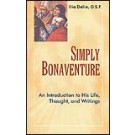
SIMPLY BONAVENTURE: Journey to Go,  as distilled by Delio, Ilia O.S.F.

We come from God, we exist as the image of God, and we are returning to God.

Bonaventure uses the metaphor of journey to indicate that the human desire for God is dynamic… It is a desire which impels one to search for God, and this desire, planted as a seed of grace, is already in the human person.

The human person  is not simply content with the totality of that which exists; rather, there is a longing for more, for something deeper, for God. The human person has an attraction for God.

…one cannot begin the journey to God unless one recognizes one’s poverty or radical dependence on God. Poverty is…an awareness of one’s utter dependency on God, a realization that all good things flow out of the goodness of God.

…the journey is not an intellectual exercise; it is not a “head trip” but a matter of the heart. The goal of the journey is happiness…..one cannot be happy unless the heart is centered on God.

…one of the greatest obstacles….is that the human heart is hardened by sin. The “hardened” self-centered heart must become a natural, loving heart, centered in God. Transformation of the heart, however, can only come about through a relationship with God…..prayer is the mother and source of the journey to God – because prayer is an openness and deepening of one’s life in God’s life.

…one cannot enter into oneself unless Christ be the mediator….the path to true knowledge is that Christ is the way, the truth and the life. Devotion to Christ is pivotal in the journey to God; how one relates to Christ will influence how one completes the journey. Devotion to Christ means a total turning to God, not simply with one’s mind but with one’s heart and soul as well….accepting Christ as person and developing a personal relationship with Christ ultimately opens us up to the mystery of God. (John 1:18)

Christ is the source of grace by which the soul is purified, illumined and perfected. As one enters more deeply into relationship with Christ, the divine image is reformed and restored in its likeness to God.

….the more God-like the soul becomes by grace, the more clearly it sees the truth of things….one’s inner life becomes more orderly and peaceful….when our feelings, thought and emotions are rightly ordered to God, then we start to line in a new, virtuous way that follows the example of Christ….the soul’s journey to God is thoroughly Christocentric since Christ is the beginning, middle an end of the journey….it cannot be made apart from the imitation of Christ.

http://www.newcitypress.com/simply-bonaventure.html