2cornucopias

Archive for the ‘13 History’ Category

John Henry Newman 1801-1890

In 13 History on 2011/09/29 at 1:11 AM


John Henry Newman, the most illustrious of Anglican converts was constantly quoted in the writing of the theological documents of Vatican II (a continuation of Vatican I , which Newman had attended as a Cardinal). Perhaps, in our lifetime we will see him named a Doctor of the Church.

In an attempt to lead the Anglican divines to deeper commitment to God, he sought a “Via Media” in Anglicanism (a middle point between Catholicism and extreme Protestantism) for he believed Anglicanism lay at equidistant from Catholic Rome and Calvinist Geneva.  He sought to restore the primitive Church to England.

Believing that Anglicanism stood for the Fathers, whose teachings the Book of Common Prayer handed down, Newman went to the primary sources, the Early Church Fathers.

In his APOLOGIA PRO VITA SUA, he wrote: “I looked into the mirror, and saw myself an Arian.”  Suddenly the Via Media disappeared.  Shocked, Oxford’s leading divine, began his journey home to the Catholic Church. Consequently, a great religious revival know as the Oxford movement began; he was its guide, philosopher, and martyr.

As a young man, Newman was the only one in his family that really believed the doctrine of the Trinity.  He could support each verse of the Athanasian Creed with texts from Scripture, despite his mother’s being a Calvinist, the indifference of his father and the Deism and Atheism of his brothers.

In 1824 he was ordained and became the Vicar of St. Mary’s, the Oxford University’s church.  From its pulpit he delivered his famous “Parochial Sermons.” They were not controversial, and there is little in them to which Catholic theologians would object.

He and some friends lived together at Littlemore in monastic seclusion. He was the one Englishman of that era who upheld the ancient creed with a knowledge that only theologians possess, a Shakespearean force of style and a saintly fervor.

With immense dedication he composed the “Essay on the Development of Christian Doctrine,” in which he explained the apparent variations of Catholic Church dogma to which he formerly objected.

When Newman was received into the Church, his life, which would span almost ninety years, was divided in half: the more dramatic first half as an Anglican divine; and the second half he would spend under suspicion from one side or another, having his plans thwarted and his motives misconstrued.

In 1846, Newman was ordained.  Pope Leo XIII approved his establishing in England the Oratory of St. Philip Neri.  Eventually, he was made a Cardinal, and this unique elevation was hailed by the entire English nation and Catholics worldwide.

Three landmark items are worth noting:
1. His famous sermon, “The Second Spring” has a rare an delicate beauty. His “Dream of Gerontius” is Dante-like.
2. His becoming the Catholic apologist in a time of Agnosticism.
3. His immense correspondence, much of which is yet to be published.

See The Spirit of the Oxford Movement by Christopher Dawson in Book Corner category.

9/11

In 13 History on 2011/09/10 at 12:00 AM

9/11 has historically been of great importance to the Moslem world.  Many of their battles have been fought on that date.

On 9/11/1683 the Battle of Vienna took place.  It was over in a fragment of a day.

A Moslem goal was to take the Vienna, the Imperial seat of the Holy Roman Empire.  Having failed in their horrendous Siege of Vienna 1529  the Islamic forces  turned to the Mediterranean only to be defeated at  the naval battle of Lepanto 10/7/1571  by Don Juan of Austria whose flag-ship had an image of Our Lady of Guadalupe.

Preceding the battle, Sultan Mehmed IV had sent this message to the Holy Roman Emperor Leopold: “We order you to await us in your city of residence, Vienna, so that we can decapitate you.  We will eliminate you and your followers. Children and adults will equally be exposed to the most atrocious tortures before being finished off in the most ignominious way imaginable.”

Leopold had minimal forces, but Jan Sobieski of Poland came to his aid.  Sobieski’s  horsemen wore huge wings that made frightening sounds as they galloped.  Thinking them avenging angels, the Moslems fled in terror, leaving everything behind.  The battle was over in 3 hours!

Emperor Leopold adapted Julius Caesar’s  “I came, I saw, I conquered”  to “Veni, Vidi, Dei Vinci”  “I came, I saw, God conquered.”

See Category: Historical Tid-Bits for entry: Bagels, Croissants, Capuchino and Shish-Kebobs.

The Pebble in the Pond is Still Rippling

In 13 History on 2011/08/12 at 7:00 AM
In a previous post entitled “Ironies of History”, I wrote the following to which I wish to add a few more thoughts:

Excerpt from my previous post:
“Saint Francis de Sales said to the young cleric, Richelieu, “My son, leave Versailles and return to your parish and be a good priest.”  However, Richelieu succumbed to the pomp of the court of Versailles.  As he grew in power and wealth, Richelieu was powerfully impressed by a simple cleric called Vincent de Paul.  When Richelieu died, he left all his fortune to St. Vincent de Paul to feed the poor.  St. Vincent’s soup kitchens in Paris fed 20,000 persons a day, all of whom were starving veterans of the Thirty Years’ War, in which Catholic Cardinal Richelieu, putting his power before God, had given aid to the Protestant forces to defeat the Catholic forces.  Question: Do you think he bought himself a ticket a heaven?”

Additional thoughts:
When Richelieu and St. Vincent de Paul met in 1619, Richelieu was a bishop, seething with ambition.  By 1622 Richelieu was back in court and active in intrigues and politics.  By 1624 he was prime minister of France.

His unwavering goal, no matter what the cost, was always to make France the greatest power in the world, supplanting Spain.  And achieve it, he did.  It was Cardinal Richelieu who set France on the course of absolutism that eventually triggered the tsunami of the French Revolution.  Having first met his goal of making the king absolute and then centralizing the government in the hands of the king, he then proceeded to achieve his third and final goal: the weakening the Hapsburg monarchy, which ruled the Holy Roman Empire and Spain. In accomplishing this last goal, however, Richelieu did irreparable damage to the Church.

The seventh edition of the Encyclopedia Britannica states that the Protestant Reformation was the work of the Princes in Germany and one prince in England.

In England, Henry the Eighth made himself the Head of the Catholic Church because of his lust for Anne Boleyn.  However, in the Holy Roman Empire, the protestant movement was the work of the princes who lusted after absolute power in their individual fiefs and, therefore, wished to weaken the Catholic Holy Roman Emperor.  Lutheranism was their means of doing so.

In the first three phases of the Thirty Years War, the Catholic Holy Roman Emperor and the Catholic forces had successfully defeated the Protestant forces.  Deliberately, Richelieu sent aid to the Protestant forces.  They defeated the three-time victorious Empire forces, leaving the Holy Roman Empire divided into Catholic and Lutheran camps.  This division subsequently prevented the unification of Germany into one nation until 1871.

Balance of Power is the name given to the ensuing activity of the nations jockeying for position.  Henry Kissinger, Secretary of State during the Nixon administration, wrote his Doctoral Dissertation on this topic and saw himself as a type of Metternich, the Austrian Prime Minister who presided over the Congress of Vienna which tried to undo the damage of the French Revolution and the Napoleon Era by returning to the days of absolutism and maintaining that status quo.

In a way, one can say that Richelieu threw into the pond the pebble that caused ripples of revolution: the French Revolution and its backlash, the Napoleon Era.  And, these ripples of revolution turned into waves of protest, dividing Christendom into Catholic and Protestant pools.  These waves of protest have continued until present, lashing at Protestant Christians, who have divided and continue to divide themselves into thousands of denominations.  That little pebble started a ripple: a ripple that has led to political instability, religious division and, ultimately, moral impotence.

A Film to See

In 13 History on 2011/08/02 at 10:09 PM
A movie is being made of the unique life of Charlie Petrizzo.  Some of you might remember him from last year’s class on Fathers and Doctors of the Church. http://www.charliesscars.com
Charlie Petrizzo has faced death twice in his life. Just before his 5th birthday he ran into the street to catch a ball and was hit by a car. The accident almost killed him. It left him in a coma for a while, and then with temporary paralysis. He had to have emergency brain surgery and was in the hospital for months of recovery afterwards.Unfortunately for Charlie, that was not the end of his troubles. His mother said that he was always accident-prone, but she never suspected that when he was only 15 she would be praying for his survival from yet another accident. Charlie was working a summer job painting a house and lost control of an aluminum ladder. It bounced around and hit the power lines, electrocuting him with 36,000 volts of electricity.With 70% of his body was badly burned, Charlie was lucky to survive. Many surgeries later, and months in the hospital, he slowly recovered. Today his injuries still cause many problems in his day-to-day life, but that hasn’t stopped him from achieving more than most people.Despite his health, Charlie worked his way up the corporate ladder to a lofty position with a large national bank. His success was well earned, but he found that he was lacking something important in life. When his mother died he decided to be inspired by the caring example she set in her life and do something that would make a difference in the world instead of his bank account.He left his high-paying job and started a foundation called Project 2 Heal combining two of his passions, dogs and healing. Charlie breeds and trains Labrador Retrievers to work as skilled companion dogs for children with special needs and he donates them to families who need them…at his own expense.

Part of his donation efforts involves sending puppies to ICAN, the Indiana Canine Assistance Network for training. ICAN’s dogs are training in prisons, by prisoners. Charlie discovers that one of the prisoners is responsible for killing a 12-year-old girl in Indiana, in one of America’s most gruesome murder cases. Charlie’s whole world is hanging in the balance while he tries to decide if Project 2 Heal should continue donating dogs to the prison for training.


Reforming Saints

In 13 History on 2011/07/31 at 9:24 PM

During the years immediately following the Council of Trent, several religious orders were systematically reformed: Franciscans, Cistercians, Carthusians and Carmelites.  King Philip II of Spain supported the reforms.

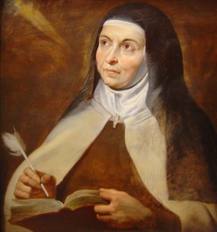
The leading lights of these movements for the Carmelites were St. Teresa of Avila and St. John of the Cross, both of whom have been pronounced Doctors of the Church. St. Teresa’s personality was a unusual combination of merry charm, steel spine but above all transcendent, goodness and holiness.  Teresa soon restored many to proper obedience.

During these days, Pope St. Pius V’s great concern for the peoples of the New World led him to ask the youthful king of Portugal to protect the converted Indians from the scandalous abuses of the Portuguese soldiers. In order to improve the status of the converts within the Christian community, he recommended that natives be prepared for the priesthood, which unfortunately was not done despite Brazil being the country with the highest population of Catholics at all times.

Slaughter in a Sicilian Church

In 13 History on 2011/07/28 at 1:11 AM

While Barbarians were at a primitive level of society, they nevertheless had sharp minds which gleaned knowledge from their surroundings and from their observations of what they saw and pondered.  Norsemen, having traveled southeastward on the arteries of rivers like the Volga, often found themselves in Byzantium.  Having attended the liturgy at St. Sophia, they left impressed with the grandeur and beauty of Christian worship.

Yet, at times they turned this experience into a ruse for conquest.  A brigade of Norsemen sought to take a Sicilian town, but its formidable walls frustrated their efforts.  So, they developed a clever scheme.  One of the leaders approached the townsmen and asked permission to hold a burial service in their church to commend their chieftain to God in the Christian manner as they had observed in Constantinople.  Permission was granted on the condition the funeral retinue would enter unarmed.

The large chieftain was brought in lying in an open wooden coffin and placed in the center of the main aisle of the church.  Then, began the long liturgical ritual.  Suddenly, towards the end of the ceremony, the corpse catapults from his coffin to the horror and confusion of the townspeople.  The chieftain, precisely drugged into catatonia, had been laid on a bed of swords.  Now, his men quickly drew swords from under where the ‘corpse’ laid and decimated the congregation.

Orange Pope?

In 13 History on 2011/07/26 at 11:11 AM

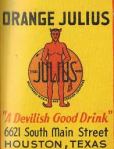
Pope Julius became very impatient with Michelangelo’s slow progress in the completion of the frescoes on the Sistine Chapel ceiling and harassed him daily.  The exasperated genius got his revenge by immortalizing the pesky pope by placing his face on a small little devil.  So, next time you treat yourself to an Orange Julius…..

St. Bonaventure 1221-1274

In 13 History on 2011/07/06 at 7:10 PM

Little is known of Bonaventure’s early life.  He was quite young when he entered the Franciscans.  He studied in Paris under the famous Alexander of Hales who founded the renowned Franciscan School.

In 1248 Bonaventure was already a Master teacher, and he lectured at the university with great success for many years.  However, jealous secular professors campaigned against religious teachers like the Dominicans and Franciscans and for years academia in Paris was in turmoil.  Rome reestablished both religious orders right to teach and both Bonaventure and Thomas Aquinas received doctoral degrees.

At age 36 Bonaventure, who had been elected Minister General of the Friars Minor, was having to deal vigorously with internal dissensions between the Spiritual and the Relaxed factions among the Friars, striking at both extremes.  While the Spiritual demanded a literal observance of the original Rule, especially in regard to poverty, the Relaxed were introducing innovations and relaxing the rule in general.With great devotion to the Virgin Mary, he began the practice of singing a Mass every Saturday throughout the order in honor of the Blessed Virgin.

Acceding to requests, Bonaventure composed his “Office of the Passion” during the early steps of the canonizing of King St. Louis, who had been his good friend.The humble Bonaventure was created Cardinal in 1273 despite his protests.   When the papal messengers brought him his cardinal’s hat they found Bonaventure washing dishes.  Bonaventure asked them to hang it on a nearby tree until his hands were free pick it up!

The Pope commissioned Bonaventure to prepare the questions for discussion for the Fourteenth Ecumenical Council which opened at Lyons the following year.  Although the Pope presided at the council, he left deliberation direction to Bonaventure. While this council was still in session, both Bonaventure and Thomas died.Bonaventure  was revered by all who knew him because of his pure character.

Alexander of Hales said that Bonaventure appeared to have escaped the curse of Adam’s sin. The people of Lyons chose Bonaventure as their special patron. A unique tribute had already been given to him by Dante in his “Divina Comedia” where Dante placed him in Paradise.Bonaventure was fusion of piety and deep learning amply reflected in all his writings.  A prolific writer on a great variety of religious topics, particularly philosophy and theology, both of which show him a faithful disciple of St. Augustine.  His influence carried to subsequent councils of the Church: Vienna (1311), Constance (1417), Basle (1435), Florence (1438) and Trent (1546).

Bonaventure’s influence in the Church continued into modern times.  In his Apologia, John Henry Newman states that his works had a critical effect on some of the definitions of dogma and at the Vatican Council (1870), entire sentences from his writings were included in the decrees concerning papal supremacy and infallibility.

Bonaventure’s exegetical works are considered a reservoir of thoughts, particularly his commentaries on the Books of Ecclesiastes and Wisdom and on the Gospels of St. Luke and St. John.  Nearly five hundred of his sermons are available today.  Most of them were taken down by his listeners to whom we are grateful for having preserved them for us.

In addition to all his philosophical and theological writings, Bonaventure wrote many inspirational works for the development of the spiritual life.

Thomas Aquinas, his good friend, and Bonaventure were two luminaries of their times; Bonaventure being a prolific writer while overwhelmed with other numerous duties unlike his friend, Aquinas, who was able to dedicate his entire life of scholarship.

Sing with Aquinas on This Corpus Christ Sunday

In 13 History on 2011/06/22 at 11:27 PM

Dying Pope Urban IV instituted the feast of Corpus Christi and commissioned Thomas Aquinas to write a liturgy which Catholic worshipers through the centuries have treasured.

The Corpus Christi liturgy includes the sequence “Lauda Sion,” the Vesper hymn “Pange Lingua” and concludes with the “Tantum Ergo.”  For Morning Prayers he wrote “Salutaris Hostia.”

Listen to a few of these pieces:

“Panis Angelicus” composed by Cesar Frank and performed by Renee Fleming:
http://www.youtube.com/watch?v=1a11YheB2zM

“Ave Verum Corpus” by Mozart performed by a soprano with organ:
http://www.youtube.com/watch?v=fy1WpsVPMkk

“Pange Lingua Gloriosi Corporis Mysterium” – Eucharistic Prayer Of St Thomas Aquinas:  “Tantum Ergo” is the last two stanzas.
http://www.youtube.com/watch?v=N0HG41V9Vxc

“Adoro Te Devote”:
http://www.youtube.com/watch?v=WMK5MnZaoks

“O Salutaris Hostia”:
http://www.youtube.com/watch?v=Xx33NiZO8Lc

As a child, Thomas kept asking his professors the same question over and over:  “Sir, Who is God?  Please explain to me what is God?”  Eventually, he concluded that knowing God was, more than anything else, a spiritual attempt.  Seek the truth by praying with humble and contrite heart.

Thomas’ family was related to the Holy Roman Emperors and the Kings of Aragon, Castile and France.  At the age of five his training was begun by the Benedictine monks of Monte Cassino. At the age twelve he was sent to the University of Naples because the Abbot wrote to Thomas’ father that a boy of such talents should not be left in obscurity.

Having surpassed his teachers at Naples, he was sent on to train in logic and natural science.  No matter what the subject matter was, Thomas could represent whatever he learned with greater clarity and depth than his professors.

At age 18 he entered the order of St. Dominic.  His mother had him kidnapped and imprisoned in a fortress for two years during which his sister sent him books on the Holy Scriptures, Aristotle’s Metaphysics and the “Sentences” of Peter Lombard.

“The Books of Sentences” is a compilation of Biblical texts and an exegesis of Biblical passages with relevant passages from the Church Fathers and many medieval thinkers on every aspect of Christian theology. It is the first major attempt to arrange the material in a systematic order and to reconcile them where they appeared to defend different viewpoints.

Eventually freed by being lowered in a basket, Thomas was sent by the Dominicans to be examined by the Pope who forbade any interference to his vocation which now had his blessing.

In Cologne he was placed under the renowned Dominican, St. Albert the Great.  Thomas’ humility and silence were often misinterpreted as signs of dullness.  Albert, having heard Thomas defend a difficult thesis brilliantly, said:  “We call this young man a dumb ox, but his bellowing in doctrine will one day resound throughout the world.”

In 1245 Albert was sent to Paris, and Thomas accompanied him as a student.  Everyone was more more anxious to hear Thomas than Albert whom Thomas surpassed in accuracy, clarity, succinctness and power of demonstration, as well as in knowledge.  His appointment to the University of Paris began his famous teaching career which attracted the attention both of the professors and students.  His life now was one essentially of praying, preaching, teaching and writing.

In his inaugural lecture as master at the University of Paris in 1256, Thomas said that teachers should lead lives that would “illumine the faithful by their preaching, enlighten student by their teaching and defend the faith by their disputations against errors.”  Thomas certainly lived what he believed and said.  Vatican II recommends that the faithful obtain a deeper understanding of the mysteries of the Faith through St. Thomas’ writings.

His duties at the University consisted principally in explaining the “Sentences” of Peter Lombard which eventually led Thomas to write his chief work: the “SUMMA THEOLOGICA.”  While working on this major opus, Thomas simultaneously wrote twelve extraordinary commentaries on Aristotleʼs major books, all in a period of six years.

His powerful mind never rested. During a banquet given by the King of France, all of a sudden Thomas pounded his fist on the table, crying out: “That settles it.”  The King sent for his secretary to write down Thomas’ insight.

Throughout his relatively short but brilliant career as a master teacher and writer on theology and philosophy, Aquinas had the enthusiastic support of the Popes and the King of France.

Paris saw Thomas as belonging to her, but everyone was eager to learn from his teaching.  Thomas, therefore, went from one major university to another (eight in all) and writing with one desire: a consuming zeal to explain and defend Christian truth.  The world is grateful that he refused becoming archbishop of Naples; had he done so, the “Summa Theologica” probably would not have been written.

During Lent of 1273, Thomas Aquinas delivered a series of 59 sermons on charity, the Commandments, the Apostles Creed, the Our Father & the Hail Mary.

Almost the entire population of Naples went to hear his sermons every day.  That same year in Naples, he completed his treatise on the Eucharist. That December, Thomas ceased to write.  His studies and writings had led him to such a closeness to God that all he had written seemed nothing in comparison.  Thomas began to prepare for his death.  However,  he was ordered to attend the Council of Lyons.  On his way there, he struck his head on a tree branch and died shortly after.

Thanks to his deep knowledge of classical philosophy and the Church Fathers, Thomas devised a harmonious synthesis between faith and reason.  There is no doubt why he is considered to have the ablest mind in the history of Christendom. His intellectual synthesis has stood for centuries despite attacks by hostile or misguided minds.

Pope Leo XIII in his Encyclical, “Eternal Father” on the restoration of Christian philosophy, declared Aquinas “the prince and master of all Scholastic doctors” and declared him patron of all Catholic universities, academies, colleges and schools throughout the world.

Titian Red

In 13 History on 2011/06/14 at 7:55 AM

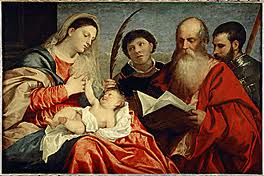
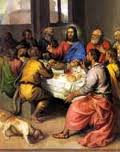
Lipstick and film companies have spent a fortune trying to duplicate the hue of the unique red color that characterizes  Titian’s paintings.  One clue that has not yielded results is that as a very young boy Titian used to make his younger sister collect flowers from the meadows in her apron. This diligent little assistant would separate them by colors.  Thus, she prepared his palette.  The precocious artist would then press the flowers against dilapidated walls, staining them permanently.  Many a decrepit building became the canvas for a painting of a beautiful Madonna.

You have to see an original Titian in order to see Titian red.  No medium has  suitably duplicated it.  The images here are poor proximities of his work using his red.  To see the original is an unforgettable experience.