2cornucopias

Archive for the ‘07 Observations’ Category

Questions About Marriage

In 07 Observations on 2012/04/25 at 9:15 AM

Following are a few answers  to some commonly asked questions about the definition of marriage:

What is marriage?
Marriage is the lifelong partnership of mutual and exclusive fidelity between a man and a woman ordered by its very nature to the good of the spouses and the procreation and education of children. The bond of marriage is indissoluble – that is, it lasts “until death do us part.” At the heart of married love is the total gift of self that husband and wife freely offer to each other. Because of their sexual difference, husband and wife can truly become “one flesh” and can give to each other “the reality of children, who are a living reflection of their love”.

Marriage between a baptized man and a baptized woman is asacrament. This means that the bond between husband and wife is a visible sign of the sacrificial love of Christ for his Church. As a sacrament, marriage gives spouses the grace they need to love each other generously, in imitation of Christ.

Why can’t marriage be “redefined” to include two men or two women?
The word “marriage” isn’t simply a label that can be attached to different types of relationships. Instead, “marriage” reflects a deep reality – the reality of the unique, fruitful, lifelong union that is only possible between a man and a woman. Just as oxygen and hydrogen are essential to water, sexual difference is essential to marriage. The attempt to “redefine” marriage to include two persons of the same sex denies the reality of what marriage is. It is as impossible as trying to “redefine” water to include oxygen and nitrogen.

What is sexual difference?
Sexual difference is the difference of man to woman and woman to man. It affects a person at every level of his or her existence: genetically, biologically, emotionally, psychologically, and socially. Sexual difference is an irreducible difference. It is unlike any other difference we experience, because it – and only it – allows for the total personal union between husband and wife that is at the heart of marriage. The difference between men and women is for the sake of their union with each other. It is what makes spousal union possible.

Isn’t marriage just about love and commitment between two people?
Of course love and commitment are important for marriage – as they are for many relationships. But marriage is unique because the commitment it calls for is better described as communion, where “the two become one flesh” (Gen 2:24). Only a man and a woman in marriage can become a “one flesh” communion. The unity of husband and wife is so intimate that from it can come a “third,” the child – a new life to be welcomed and raised in love. No other relationship, no matter how loving or committed, can have this unique form of commitment – communion – that exists in marriage, between a husband and a wife.

What’s the difference between a husband and wife who can’t have children, and two persons of the same sex, who also can’t have children?
Only a man and a woman, as husband and wife, can enter into the two-in-one-flesh communion of persons. Only a man and a woman are able to conceive a child through each other. That is to say, only a man and a woman can be joined so intimately that their bodies work together in the common task of procreation. Even when a husband and wife do not in fact conceive a child (due to infertility, age, and so on), their sexual acts are still the kind of acts by which children are naturally conceived. In contrast, two persons of the same sex may be perfectly healthy, but will never be able to enter a one-flesh communion and thus unite in such a way that a child is conceived.

Why is a child meant to have both a father and a mother?
The fact is, every single child, without exception, does have a mother and a father. Sexual difference between a husband and wife is necessary to conceive a child. But its importance does not end there. Men and women bring unique gifts to the shared task of parenting, that is, of fathering and mothering. Only a woman can be a mother. Only a man can be a father. Each contributes in a distinct and unique way to the formation of children, helping them to understand their identity as male or female. Respecting a child’s dignity means affirming his or her need for – and right to – a mother and a father.

What about single parents? These families lack a father or a mother, just like households headed by two men or two women.
A child is meant to be raised by his or her own, married father and mother. But there are times when, due to family tragedies or other unfortunate circumstances, this ideal cannot be realized. The Church acknowledges the difficulties faced by single parents and seeks to support them in their often heroic response to meet the needs of their children. There is a big difference, however, between dealing with the unintended reality of single parenthood and approving the formation of “alternative families” that deliberately deprive a child of a father or a mother, such as arrangements headed by two men or two women. Undesired single parenthood can still witness to the importance of sexual difference by acknowledging the challenges faced by single parents and their children due to the lack of a father or mother. In contrast, arrangements of two men or two women are incapable of such witness and present motherhood and fatherhood as disposable. These arrangements of themselves contradict the conjugal and generative reality of marriage and are never acceptable. Children deserve to have their need for a father and a mother respected and protected in law.

Reprinted with permission from the ©US Catholic Bishops Conference: CommDept@usccb.org

More detailed information available at: http://usccb.org/issues-and-action/marriage-and-family/marriage/promotion-and-defense-of-marriage/frequently-asked-questions-on-defense-of-marriage.cfm#m3

Congregation for the Doctrine of the Faith Has a New Domain

In 07 Observations on 2012/03/16 at 10:20 AM

Vatican City, 16 March 2012 (VIS) – The Congregation for the Doctrine of the Faith has opened a new domain (www.doctrinafidei.va) within the official website of the Holy See. In this way, the congregation hopes to facilitate the consultation of its documents which, having the express approbation of the Holy Father, participate in his ordinary Magisterium as the Peter’s Successor. Attentive reception of these texts is important for all members of the faithful and in particular for those who are engaged in theological and pastoral work.

The major documents are available in eight languages: Latin, French, English, Italian, Portuguese, Spanish, German and Polish. Certain documents are also available in Hungarian, Slovak, Czech, and Dutch. There is a general list of all the texts organised chronologically, and three subgroups of these texts, divided into doctrinal, disciplinary and sacramental documents.

The new domain also presents information on the Congregation’s series “Documenti e Studi”, which are individual printed volumes presenting a major document of the Congregation together with commentaries by noted theologians. There is also a description of the volumes containing the proceedings of various symposia organised by the Congregation in recent years, as well as speeches and other contributions by cardinal prefects.

A communique by the congregation published this morning explains how “wider distribution of the teaching of the Congregation for the Doctrine of the Faith is necessary in today’s world. The documents of the congregation which have been published since the time of Vatican Council II … deal with significant questions for the life and mission of the Church and give important doctrinal responses to the challenges of our times. … The Congregation for the Doctrine of the Faith is convinced that the enhanced availability of these documents will be of significant value in communicating the teaching of the Church to people throughout the world”.

The old domain address of the Congregation for the Doctrine of the Faith remains active within the official website of the Holy See.

THIS IS WHAT YOU WILL SEE WHEN YOU CLICK ON THE SITE:  WWW.DOCTRINAFIDEI.VA

The Holy See

Menu

Search
The Roman Curia Congregations


Congregation for the Doctrine of the Faith

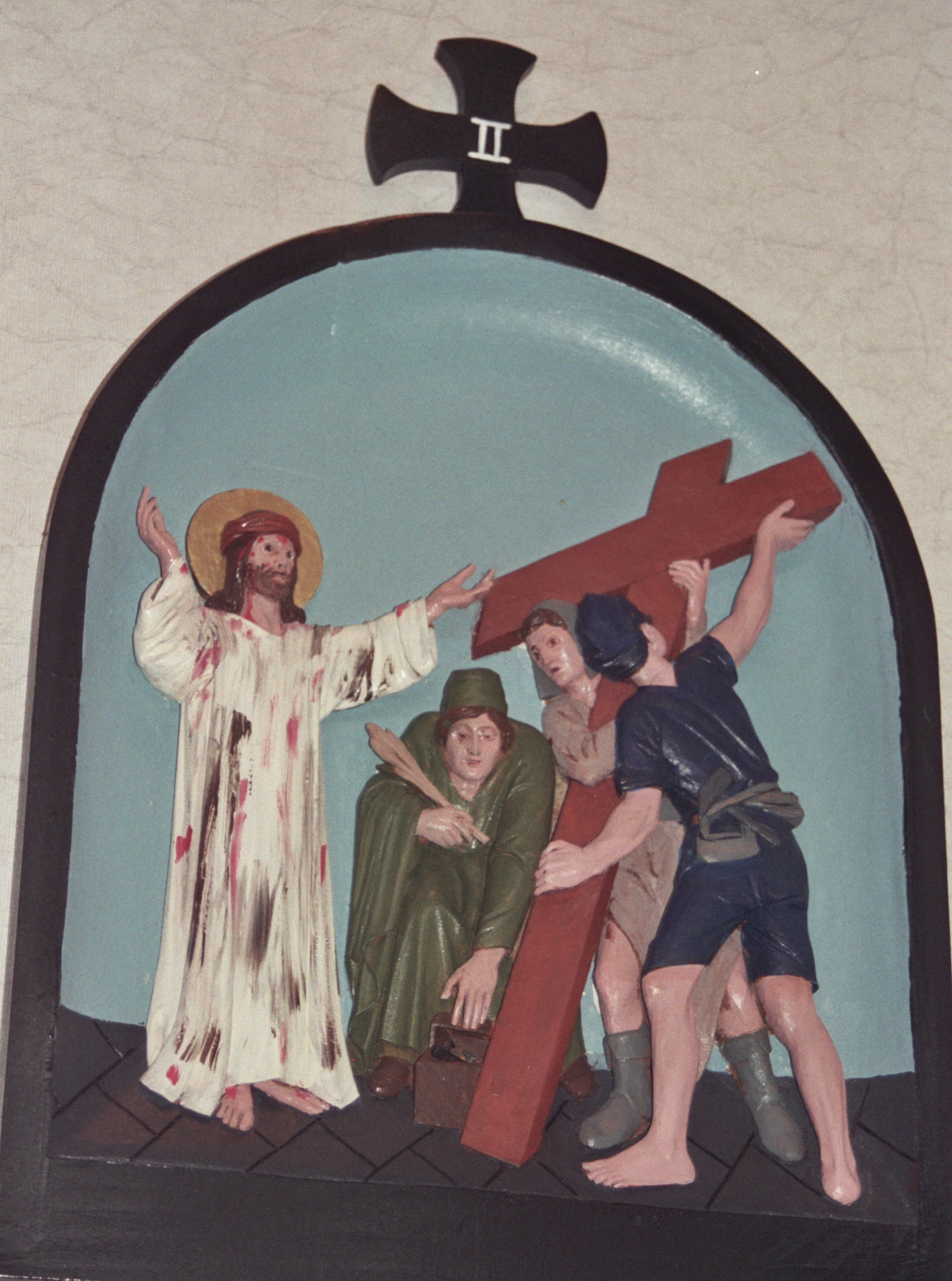
The Stations of the Cross at St. Vincent de Paul’s Church

In 07 Observations on 2012/03/15 at 9:11 AM

Mind’s Eye: Restoration Insights: Jacqueline Duick lovingly and meditatively restored the Stations of the Cross at St. Vincent de Paul Church in Charlotte, North Carolina.  The project took over 200 hours during a period of three months.   Having restored them twice before, this time she showed them in color so that more details would be visible.

On the white seamless garment worn by Our Lord, Jackie showed blood and dirt as He progressed on His way with the Cross.  She commented that while there have been many traumatic events in history, the Crucifixion is the most recognizable since the beginning of time.  With the Crucifixion of Jesus Christ, The Son of God, true God and true man, the gates of heaven were opened to us. He died so that we would live eternally.

She also depicted a background of cloudless blue sky, giving the appearance of a lovely day. People often are attracted to watch the punishment of others and may have thought it is a beautiful  day to watch a Crucifixion.  To some it was pure entertainment, others, were compassionate and believed Jesus was the Messiah.  Seeing the staining of His white robe as He laboriously made His way to death saddened them, particularly the women and children who wept for Him for what child does not weep when it sees its mother crying.

The restoration of each station brought new insights which she lodged in her heart and later shared.  Here are some of many thoughts she shared:

I see Jesus in my mind at that frightful time. He has just been praying in the garden.  There is a concerned look about Him as He waits in anticipation of what is to come.

I see them coming in the distance being led by a common man for the rest of them are soldiers.  He awaits their arrival but holds fast and steady because He knows why they are coming.  Judas betrays Jesus with a kiss on the cheek. The soldiers descend upon him Him with cruelty in their hearts and minds, not realizing that He is the greatest King the world will ever know. They mock Him with a crown of thorns. They take Him to be judged for crimes not committed, but He endures all this because now is His time.  He will sacrifice Himself for a greater cause our salvation. So savagely He is beaten, spat upon, and cursed; they do not know of His heavenly mission on this earth.  How  can He endure all that horror and pain is beyond any of us. They have made Him a cross He must carry to add to His humiliation. This wooden cross has been made for Him upon which He is to spend His final hours.

All have deserted Him but His Mother, Mary, and the disciple,  John who is only sixteen but has great courage. They follow to be near Jesus  as He carries His cross.

He is given help but not out of pity, but because the soldiers do not want Him to die along the way.  Finally, some one takes pity and wipes His blood-stained and battered face; the soldiers interfere because there is no time to rest and  force Him on to His destination.

Now I see the final place of torture as the soldiers prepare His body by dislocating His shoulder so His hands can be nailed to the cross. Next, spikes nail His feet to the cross: a tree, which He had lovingly created, is part of His final torture. The soldiers lift  and drop the cross into the hole in the ground, creating added pain for Jesus.

His Mother, Mary, and the disciple,  John are at the foot of the cross hoping their presence and love they show may give her Son some peace of mind. As I watch Mary’s pain during this murder, it is hard to believe a mother could endure this horrid torture. After enduring three hours on the cross, in the hot sun, He completes the mission the Father in heaven sent Him to earth to accomplish: the salvation of souls. At three, the a night sky marks the death of Jesus. He died for me because of my sins, and lifts that burden from me. He paid a debt I could not pay.

His name is Jesus, the Son of God and He watches over me. One day when my life is over He will reach out His hand and pull me into a heavenly embrace to show me again how much He loves me.  As my mind returns to the present, I realize the gift that has been given to me and I pray I can help others feel this great love.

Pope Warns Against the Power of Finance and of the Media

In 07 Observations on 2012/02/24 at 9:11 AM

Vatican City, 16 February 2012 (VIS)

Benedict XVI pronounced a “lectio divina” on the passage from the Letter of St. Paul to the Romans in which the Apostle invites the faithful not to conform to this world but to transform themselves and renew their minds in order to discern the will of God, “the good and acceptable and perfect”.

“We can reflect upon the Church today”, he said in his off-the-cuff remarks. “There is much talk about the Church of Rome, many things are said. Let us hope that people also talk about our faith. Let us pray to God that it may be so”.

The Pope then went on to refer to the force of evil which, in today’s world, also emerges “in two great powers which are good and useful in themselves but easily open to abuse: the power of finance and the power of the media. Both are necessary, both are useful, but so subject to misuse that they often go against their true goals”.

Today “we see how the world of finance can dominate mankind. Possession and appearance dominate and enslave the world. … Finance is no longer a tool to promote well being and to support the life of man, but a force that oppresses him, one which almost has to be worshipped”. The Pontiff called on his audience not to conform to this power. “Be non conformists. What counts is not possession but existence”, he said. Christians must not bow to this power, but use it as “as a means, with the freedom of the children of God”.

Turning then to consider the question of public opinion, Benedict XVI highlighted how “we have a great need of information, knowledge about the truth of the world; but there is a power of appearance which in the end counts even more than reality itself”. Appearance “overlies the truth and becomes more important. Man no longer pursues the truth but wants above all to appear”. Here too “there is a Christian non conformism. … We want not appearance but truth, and this will give us true freedom”.

“Christian non conformism redeems us and restores us to truth. Let us pray to the Lord that He may help us to be free in this non conformism, which is not against the world but is authentic love for the world”.


Copyright © Vatican Information Service Vatican City

Forgiving Love Mother Teresa

In 07 Observations on 2012/01/26 at 9:11 AM

The other day, a man, a journalist, asked me a strange question. He asked me, “Even you, do you have to go to confession?” I said, “Yes, I go to con­fession every week.” And he said, “Then God must be very demanding if you have to go to confession.”

And I said, “Your own child sometimes does some­thing wrong. What happens when your child comes to you and says, ‘Daddy, I am sorry’? What do you do? You put both of your arms around your child and kiss him. Why? Because that’s your way of telling him that you love him. God does the same thing. He loves you tenderly.” Even when we sin or make a mistake, let’s allow that to help us grow closer to God. Let’s tell Him humbly, “I know I shouldn’t have done this, but even this failure I offer to you.”

If we have sinned or made a mistake, let us go to Him and say, ”I’ m sorry! I repent.” God is a forgiving Father. His mercy is greater than our sins. He will forgive us.

Blessed Mother Teresa of Calcutta

In What Type of Soil Are You Rooted In?

In 07 Observations on 2011/09/24 at 10:00 AM

In contemplating the Parable of the Sower, one could liken the various soils to the phases of human life, from childhood to the mature years, much in the following manner:

The hard soil:  A time in which there is not a depth of understanding . . . CHILDHOOD.

The shallow soil:  A period of time during which truth and substance can be snatched away or replaced by the superficial . . . THE TEEN YEARS.

The “tangled-up” soil:  That time of life in which truth gets lost in clutter, activity and the pursuit of what may not be worthwhile . . .  ADULTHOOD.

The good soil:  The time of life when God slows a person down to assess life from His point of view . . . MATURITY (the Golden Years).

The first three could, unfortunately, last a lifetime; however, the last phase, the best phase, could begin early if one cooperates with God’s Grace.  To seek a maturity of soul in one’s youth is ideal.  Just be careful not become as the popular singer Rosemary Clooney describes in one of her songs “old at twenty-three.”

When we read the Word of God in Holy Scripture, we should always ask ourselves:

1. What does this passage mean?

2. How does this passage relate to Christ?

3. How does this passage apply to me?

In asking ourselves this last question, we should try to follow a process of thinking that includes:

1. Knowledge:  Gathering information from what we read or hear.

2. Understanding:  Understanding the information or principles in what we read or hear.

3. Application:  Internalizing that information or those principles . . . simply put, making them personal.

Then, we can advance to:

4. Analysis:  Pulling the information apart to investigate it, look at it, study it and contemplate it.

5. Synthesis:  Putting the information or principles back together and incorporating them with what we already know and understand . . . internalizing them so that we can move to the last phase in the process.

6. Evaluation:  Making intellectual and moral decisions based upon our understanding of the newly acquired facts, principles or truths.

No study of the Holy  Scriptures is complete until we’ve reached the phase of evaluation in which we’ve gathered, meditated upon and internalized Truth and allow it to impact how we think, behave and react.

It is in that last phase of human maturation that we can truly reflect on all that we’ve learned and observed in our lives and see how God has planted truth in our hearts and has nurtured that Truth through the Grace of the Sacraments to grow our souls to maturity . . . to transform them and prepare them to bear eternal fruit.

Learn to “see” God again

In 07 Observations on 2011/09/23 at 10:00 AM

“You may ask me: ‘But, does God exist? And if He exists does He really concern Himself with us? Can we reach Him?’ It is, indeed, true that we cannot place God on the table, we cannot touch Him or pick Him up like an ordinary object. We must rediscover our capacity to perceive God, a capacity that exists within us. We can get some idea of the greatness of God in the greatness of the Cosmos. We can use the world through technology because the world is built in a rational way; and in the great rationality of the world we can get some idea of the Creator Spirit from which it comes; in the beauty of creation we can get some idea of the beauty, the greatness and the goodness of God. In Holy Scripture we hear the words of eternal life; they do not simply come from men, they come from Him and in them we hear His voice. Finally, we may also catch some glimpse of God through meeting people who have been touched by Him. I am not just thinking of the great (of Paul, Francis of Assisi or Mother Teresa), I am thinking of the many simple people about whom nobody speaks. Yet when we meet them they emanate some quality of goodness, sincerity and joy, and we know that God is there and that He also touches us.Let us commit ourselves to seeing God again, to becoming people who bring the light of hope into the world, a light that comes from God and that helps us to live”.

Copyright © Vatican Information Service Vatican City

What is this practice of Adoration?

In 07 Observations on 2011/09/16 at 1:11 AM

Adoration of the Blessed Sacrament – An Introduction

If you have a really good friend, or if you are married, then you know what it takes to be in a relationship with someone. Two of the most important things you can do to deepen your friendship is to spend time together, and to talk with each other frequently.

The best friend and the love of our souls is Jesus Christ. Yet many of us suffer from a feeling that we don’t really know who Jesus is, or we don’t feel like we have a personal relationship with Him. Jesus is more like a figure from a history book to us, or some mysterious God-man who we know we have obligations to, yet we don’t really feel anything in our hearts towards Him.

Adoration: The Answer to Deepening our Relationship With Christ

The solution to this personal struggle is to deepen your relationship with Jesus. Just as you would with any human friend or your spouse, you have to make a decided effort to get to know Him better. You have to spend time with Him, and speak with Him often. In other words, you need to spend time in prayer.

Eucharistic Adoration is the best way we have on this earth to spend a long time in quiet conversation with Jesus. You’ll recall that just before Jesus physically left the apostles and ascended to the Father, he reassured them, “And behold, I am with you always, until the end of the age.” (Matthew 28:20) This statement is fulfilled in the reality of Jesus’ Real Presence in the Eucharist, in the hands of the priest at Mass each day, reserved in the tabernacles in the heart of our churches, and right before our very eyes in Eucharistic Adoration.

“Feel the Love” in Adoration of the Blessed Sacrament

What sets Eucharistic Adoration apart from other forms of prayer is that we are able to be in the same room with Him present in the Blessed Sacrament, the Eucharist. Though veiled under the appearance of bread, in reality we are gazing on His Sacred Heart, and the love that radiates from the little white host in the monstrance (the beautiful stand which holds the host behind glass for the adorer to see) is transforming. Sitting or kneeling in the presence of Jesus in this way could be called “Son-bathing.” Like the rays of sunshine that warm our skin, the rays of His love touch our souls and provide healing, reassurance, comfort, strength… whatever it is we need in this life to help us live according to God’s will so we can one day live with Him forever in Heaven.

Get More Out of Mass – Adore the Blessed Sacrament Outside of Mass!

The ultimate highlight of our life as Catholics is when we receive the Eucharist at Mass. It is at that moment when we are most intimately in communion with God, experiencing a taste of Heaven, a foreshadowing of what it will be like when by God’s grace we one day enter into the life that never ends with the Holy Trinity. But is your experience at Mass a little chilly? Does it leave you with something to be desired? Are distractions getting between you and a true experience of communion?

St. Augustine said, “No one partakes of this Flesh before he has adored it.” The experience of receiving Communion is so brief. To make the most of that fleeting moment, prepare yourself to receive Him by spending time in Adoration. Adoring the Blessed Sacrament heightens our senses to perceive the Real Presence, the Real Jesus. After receiving Him at Mass, spend time in prayer in His Presence, reflecting on the gift you have received, asking Him to transform your life through the power of the Eucharist. He is waiting for you in the tabernacle, or in the monstrance in Perpetual Adoration chapels or at special times of Eucharistic Adoration.

Everyone’s Welcome at Eucharistic Adoration

For a non-Catholic who is attracted to the majesty and tradition of the Catholic Church, it is a form of suffering to not be able to receive Communion. Eucharistic Adoration can provide a great source of consolation if you are discerning about or are in the process of converting to Catholicism. In Eucharistic Adoration you can find a quiet and sacred place to pray. And though you are unable to receive the Eucharist , you can make a spiritual communion to unite yourself with our Eucharistic Lord. This is especially meaningful when you are praying in His Real Presence in Adoration of the Blessed Sacrament.

The Eucharist Changes Hearts

As our current Holy Father wrote when he was still Cardinal Ratzinger,

The adoration of the Lord in the sacrament is also an education in sensitizing our conscience. ‘Christ comes into the hearts of our brothers and sisters and visits their consciences.’ When the conscience becomes dulled, this lets in the violence that lays waste the world. Anyone who gazes upon the face of the Lord, which the servants of the Sanhedrin and Pilate’s servants have spat upon, which they have slapped and covered with spittle, will see in his face the mirror of our violence, a reflection of what sin is, and their conscience will be purified in the way that is the precondition for every social reform, for every improvement in human affairs. For the reform of human relationships rests in the first place on a reinforcement of moral strength (God is Near Us: The Eucharist, the Heart of Life, p. 98).

All you have to do is turn on the news to discover why prayer before Jesus in the Blessed Sacrament is so desperately needed. Pope John Paul II said in a Eucharistic Congress in 1993, “the … surest and the most effective way of establishing peace on the face of the earth is through the great power of Perpetual Adoration of the Blessed Sacrament.” Blessed Mother Teresa of Calcutta said, “If people spent an hour a week in Eucharistic adoration, abortion would be ended.” The power of the Eucharist to change hearts is documented around the world in places where the Eucharist is adored.

Whatever reason brings you into the Real Presence of Jesus in the Blessed Sacrament, rest assured that Jesus does want to meet you there. Have you ever been “asked out” on such an important date as the one you are called to by the Sacred Heart of Jesus?

Copyright 2006 Darcy Bunn, MTS for Saint Peter Catholic Church. Stevens Point, Wisconsin.  Permission for non-profit use is granted. Please include this notice when you publish or print this article on Adoration of the Blessed Sacrament.

Challenge of the Media

In 07 Observations on 2011/09/10 at 12:00 AM

“We live in an epoch which puts a premium on sincerity.  And yet , our era has become known as the time of impostors, of falsehood and lying.  Among others, the list of impostors includes those member of the press, who spread scandalous indiscretions and slanderous insinuations, appeal to people’s lowest instincts, gradually corrupting their moral sense.  To the press one could add movies, radio, television.  These instruments useful in themselves, when handled by shrewd operators bombard people with sound and colors and hidden persuasion, which is all the more effective because of being hidden.  Such media are capable of little by little making the best fathers hated by their children, of making white seem black and vice versa.  This is how the habits of thought and the customs of people are being transformed today.  Whenever possible, we should use the means of communication to give sound doctrine to society as a whole.

We should stress those ideas which have a transcendental  importance for social progress: the defense of life from its conception; the dignity of the family and of the person; social justice; the right to work, due concern for the weakest members of society….In many cases we can communicate these ideals without difficulty…by writing a Letter to the Editor, by making telephone calls, by participating in opinion polls or on radio programs.  These means are available to us for showing our approval of a program or an article that either reinforces fundamental human morality or fails to do so.”

Illustrissimi by Albino Luciani  (Pope John Paul I)

The New Victims of Discrimination.

In 07 Observations on 2011/09/09 at 6:06 AM

By Linda Granzow

I recently attended the movie, “The Help”, which is set in Jackson, Mississippi at the height of civil rights unrest. Pitting a young white woman, Skeeter, whose conscience is finally opened to the reality of the discrimination against blacks, against her long-time friend, Hilly, whose lifestyle and aspirations hinge on the status quo, the author portrays the intense division that occurred in this country when people began to question and fight for what was right, not what was merely legal.

It is difficult to watch the way injustices can be committed against a particular group of human beings just because of race or religion or identity. At the time, it was “legal” to discriminate against blacks and to treat them as something less than fully human. When we look back at that time period, we are appalled that something like that could have ever been tolerated—that a cultural and societal mindset could have ever trumped the natural law of the dignity of every human person. Barbaric acts of torture and murder were committed by one group of human beings against another. This is also what happened in Nazi Germany against the Jews and in Rwanda against the Tutsis and this is the same action that has been happening since the early 1970’s against unborn babies.

It is “legal” in this country to discriminate against an unborn baby and withhold the basic civil right to life, treating the baby as something less than fully human. Whether living inside or outside of the mother’s womb, a baby is a human person. Even so, a cultural and societal mindset currently exists that trumps the natural law of the dignity of every human person. Barbaric acts of torture and murder are committed at the whim of one person against another, and what could be more appalling or unnatural than for a mother to commit this act against her own child? It contradicts the very nature of motherhood in which a mother would do anything to protect or save her child from danger.

Someday, people will look back at this time period and will be appalled that something like this was ever tolerated. During the 1960’s, it took great courage by whites and blacks alike to break the societal mindset and fight for the civil rights of the black people. It will take great courage now to break the current cultural mindset and fight for the civil rights of the unborn. The intense division in this country will continue until the consciences of more people are finally opened to the reality of abortion and they unite to reverse what is merely  “legal” in a fight for what is right.