2cornucopias

Posts Tagged ‘Eucharist’

Christmas: Eternity Enters into Confines of Time and Space

In 06 Scripture & Theology on 2011/12/24 at 9:11 AM

 VATICAN CITY, 21 DEC 2011 (VIS) – “The greeting on everyone’s lips during this period is ‘Merry Christmas! Happy Christmas Holidays!’. Let us ensure that, also in our modern societies, this exchange of good wishes does not lose its profound religious significance, and the feast does not become overshadowed by external factors”, said Benedict XVI.

“With the Christmas liturgy the Church introduces us into the great Mystery of the Incarnation”, the Pope told faithful gathered in the Paul VI Hall. “Christmas, in fact, is not simply the anniversary of the birth of Jesus, it is the celebration of a Mystery which has marked and continues to mark the history of man: God came to dwell amongst us, He became one of us. … During Midnight Mass on Christmas Night we will intone these words in the responsorial Psalm: ‘Today the Saviour is born for us’. … By indicating that Jesus is born ‘today’, the liturgy underlines that His birth touches and permeates all of history. … Of course, the redemption of humankind took place at a specific and identifiable moment of history: in the event of Jesus of Nazareth. But Jesus is the Son of God … Who became flesh. Eternity entered into the confines of time and space, making it possible to meet Him ‘today’. … When, in liturgical celebrations, we hear or pronounce the phrase: ‘Today the Saviour is born for us’, we are not using an empty conventional expression, what we mean is that ‘today’, now, God is giving us the possibility to recognise and accept Him, as did the shepherds of Bethlehem, so that He can also be born into and renew our lives”.

Reflecting on the birth in Bethlehem in the light of the Paschal Mystery because, Pope Benedict said, “both Christmas and Easter are feasts of redemption. Easter celebrates redemption as a victory over sin and death. It marks the culminating moment when the glory of the Man-God shines like the light of day. Christmas celebrates redemption as the entry of God into history, when He became man in order to bring man to God. It marks, so to speak, the starting point when the first light of dawn begins to appear”.

“Even the seasons of the year in which these two great feasts fall, at least in some areas of the world, can help us understand this aspect. Easter coincides with the beginning of spring when the sun triumphs over the cold and the fog and renews the face of the earth. Christmas comes at the very beginning of winter when the light and heat of the sun are unable to awaken nature, covered in a shroud of cold under which, nonetheless, life is pulsating”.

“At Christmas we encounter the tenderness and love of God Who is attentive to our weakness and sin, and lowers Himself to our level. … Let us live this Christmastime with joy. … Above all, let us contemplate and experience this Mystery in the celebration of the Eucharist, which is the heart of Christmas. There Jesus is truly present, the true Bread descended from heaven, the true Lamb sacrificed for our salvation. I wish all of you and your families a truly Christian Christmas. May the exchange of greetings on that day be an expression of our joy in knowing that God is near us, and that He wishes to follow the journey of life with us”.

Copyright © Vatican Information Service Vatican City        VIS 20111221 (690)

“The greatest gift of God to man”

In 01 Daily Meditations on 2011/09/15 at 1:01 AM
When you receive him, tell him: Lord, I hope in you: I adore you, I love you, increase my faith. Be the support of my weakness: You, who have remained defenceless in the Eucharist so as to be the remedy for the weakness of your creatures. (The Forge, 832)

I will not surprise anyone if I say that some Christians have a very poor concept of the holy Mass. For them it is a purely external rite, if not a mere social convention. This is because our poor hearts are capable of treating the greatest gift of God to man as routine. In the Mass, in this Mass that we are now celebrating, the most Holy Trinity intervenes, I repeat, in a very special way. To correspond to such great love, we must give ourselves completely, in body and in soul. We hear God, we talk to him, we see him, we taste him. And when words are not enough, we sing, urging our tongue — Pange, lingua! — to proclaim to all mankind the greatness of the Lord.

To “live” the holy Mass means to pray continually, and to be convinced that, for each one of us, this is a personal meeting with God. We adore him, we praise him, we give thanks to him, we atone for our sins, we are purified, we experience a unity with Christ and with all Christians. (Christ is passing by, 87-88)

Benedict XVI It is Necessary to Restore the Primacy of God in the World

In 06 Scripture & Theology on 2011/09/14 at 6:00 AM

 In his homily (if 9/11, the Holy Father referred to the Gospel narrative of the bread from heaven. The reaction of Jesus’ disciples, many of whom abandoned Him at that time is, he said, similar to our own resistance before “the total gift Christ makes of Himself. Because welcoming this gift means losing ourselves, allowing ourselves to be absorbed and transformed to the point of living in Him”.

Our difficulty lies in the fact that “we often confuse freedom with a lack of constraints, with the conviction that we can do everything alone, without God Who is seen as a restriction to our freedom, But this illusion soon turns to disappointment, creating disquiet and fear”.

Some ideologies leave God to one side, or simply tolerate Him as a private choice which should not interfere with public life. They seek to organise society on the foundation of the economy and the force of power. However, said the Pope, “history has dramatically shown us” the failure of attempts to ensure material well being and peace while ignoring God and His revelation.

For this reason, “it is the primacy of God which we must, first and foremost, restore in our world and our lives, because it is this primacy which allows us to rediscover the truth of who we are; and it is in knowing and following the will of God that we discover our own good”.

The Eucharist, a source for positive social development.  The starting point for the restoration of the primacy of God must be the Eucharist, in which “God gives Himself to us, so as to open our lives to Him”.  Eucharistic communion “supports and transforms daily life”. Moreover, the history of the Church is replete with saints “whose lives are an eloquent sign of how, from communion with the Lord, from the Eucharist, there arises a new and intense sense of responsibility at all levels of community life, a positive form of social development which focuses on human beings, especially the poor, the sick and the needy”.

“Eucharistic spirituality is, then, the true antidote to the selfishness and egoism that often characterise daily life”. Likewise, it is “the heart of an ecclesial community that knows how to overcome divisions and conflicts, and to make use of its various charisms and ministries, placing them all at the service of the unity of the Church”.

Eucharistic spirituality is also the path by which to restore dignity to man and, therefore, “to the work he does, at the same time seeking to conciliate work with a time for rest and for the family, and to overcome the insecurity of precarious work and the problems of unemployment”.  “There is nothing that is truly human that cannot be fully experienced in the Eucharist”, the Holy Father concluded. “May daily life, then, become a place for spiritual development, so as to experience the primacy of God in all circumstances”.

Vatican Information Service, Holy See Press Officehttp://www.visnews-en.blogspot.com/

‘He made Himself food, He became Bread”

In 01 Daily Meditations on 2011/09/08 at 1:11 AM
He was the greatest madman of all times. What greater madness could there be than to give oneself as he did, and for such people? It would have been mad enough to have chosen to become a helpless Child. But even then, many wicked men might have been softened, and would not have dared to harm him. So this was not enough for him. He wanted to make himself even less, to give himself more lavishly. He made himself food, he became Bread. Divine Madman! How do men treat you? How do I treat you? (The Forge, 824)

Think of the human experience of two people who love each other, and yet are forced to part. They would like to stay together forever, but duty — in one form or another — forces them to separate. They are unable to fulfil their desire of remaining close to each other, so man’s love — which, great as it may be, is limited — seeks a symbolic gesture. People who make their farewells exchange gifts or perhaps a photograph with a dedication so ardent that it seems almost enough to burn that piece of paper. They can do no more, because a creature’s power is not so great as its desire.

What we cannot do, our Lord is able to do. Jesus Christ, perfect God and perfect man, leaves us, not a symbol, but a reality. He himself stays with us. He will go to the Father, but he will also remain among men. He will leave us, not simply a gift that will make us remember him, not an image that becomes blurred with time, like a photograph that soon fades and yellows, and has no meaning except for those who were contemporaries. Under the appearances of bread and wine, he is really present, with his body and blood, with his soul and divinity. (Christ is passing by, 83)

Ratzinger Book Recommendations

In 14 Book Corner on 2011/08/31 at 11:11 PM

Books Books available through Ignatius Press:   http://www.ignatius.com/TabCenter/Books/Default.aspx

Do You Know Jesus?

In 07 Observations on 2011/07/20 at 11:11 AM

Often, this question is posed directly and suddenly by well-meaning individuals who love Jesus Christ to determine the state of another’s relationship with Him.

Like many, I’m asked this question often.  My reply is: “Absolutely!  I receive Him, Body and Blood, Soul and Divinity, every Sunday in Communion.  Can you think of a more intimate union than that?”

So, how do I know this is true, that Jesus Christ is truly present in Holy Communion, Body and Blood, Soul and Divinity?  It’s right in the Scriptures.

First, the writer of Corinthians presents the case for Christ’s presence in Holy Communion throughout several passages of Corinthians.  He writes in I Cor. 11: 23-27: “For I received from the Lord what I also delivered to you, that the Lord Jesus on the night when he was betrayed took bread, 24 and when he had given thanks, he broke it, and said, ‘This IS my body which is for you. Do this in remembrance of me.’ 25 In the same way also the cup, after supper, saying, ‘This cup IS the new covenant in my blood. Do this, as often as you drink it, in remembrance of me.’ 26 For as often as you eat this bread and drink the cup, you proclaim the Lord’s death until he comes. 27 Whoever, therefore, eats the bread or drinks the cup of the Lord in an unworthy manner will be guilty of profaning the body and blood of the Lord.”

He then goes on to explain in 1 Cor.15:3 that “it was attested to us by those who heard him” meaning the Apostles at the Last Supper.  The Apostles confirmed the veracity of the words of Jesus Christ at the Last Supper and proclaimed His message of  salvation in the Gospels: in Matthew 26:26-29, in Mark 14:22-25 and in Luke 22:19-20.

Each Gospel account captures the words of Our Lord, the Eternal Word of God, when He says: ”This IS my body.”  He doesn’t say, “This is like my body” or “This symbolizes my body.”  He says, “This IS my body.”

The writer of Corinthians continues in I Cor. 1: 21: “For since, in the wisdom of God, the world did not know God through wisdom, it pleased God through the folly of what we preach to save those who believe. 22 For Jews demand signs and Greeks seek wisdom, 23 but we preach Christ crucified, a stumbling block to Jews and folly to Gentiles, 24 but to those who are called, both Jews and Greeks, Christ the power of God and the wisdom of God.

And, 1 Cor. 15 :1, he admonishes: “Now I would remind you, brethren, in what terms I preached to you the gospel, which you received, in which you stand, 2 by which you are saved, if you hold it fast–unless you believed in vain. 3 For I delivered to you as of first importance what I also received, that Christ died for our sins in accordance with the scriptures, 4 that he was buried, that he was raised on the third day in accordance with the scriptures, 5 and that he appeared to Cephas, then to the twelve. 6 Then he appeared to more than five hundred brethren at one time, most of whom are still alive, though some have fallen asleep. 7 Then he appeared to James, then to all the apostles. 8 Last of all, as to one untimely born, he appeared also to me.”

So, how do I know that Jesus Christ is truly present with us in Holy Communion?  Through the Word of God, the Eternal Word, Jesus Christ Himself . . . to him be Glory, Praise and Honor forever.

Construct a Eucharist Mosaic

In 14 Book Corner on 2011/07/01 at 11:11 AM


If you look closely at the Rose Window in the Cathedral of Notre Dame in Paris, you will observe that is it a composite of colored fragments of glass inset in such a manner that their colors blend into each other while remaining separate.

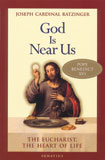
Take these quoted excerpts, from Pope Benedict’s book on the Eucharist entitled GOD IS NEAR US: The Eucharist, the Heart of Life,  and create a mosaic for yourself.

…the heart of all our creeds in our YES to Jesus Christ….p.12

…the Incarnation required acceptance….the Virgin was needed….p.13

“A body have you prepared for me.” Ps. 40 & Heb 10:5 ….the entire Gospel is contained within  this single statement….as the Fathers said: the Word has contracted to become small; to become a child…p.21

The Word, the Crucifixion, and the Resurrection…the three belong together. p.44

The Eucharist is much more than a meal; it cost a death to provide it. p.44

The Eucharist is a sacrifice, the presentation of Jesus Christ’s sacrifice on Cross p.44

God Himself gives to us, that we may give in turn. p.45

Christ identifies Himself with us to such an extent that our sins belong to Him and His being to us. p.50

The disciples had no need to look back on the Resurrection as something in the past: the Risen One is alive; that is why the day of Resurrection was…the day of His presence, the day He gathered them together, when they were gathered around Him. p.61

In place of the Temple, there is the Eucharist, since Christ is the true Pascal Lamb; everything that every took place in the Temple has been fulfilled in Him. p.63

Paul compares what happens in Holy Communion with the physical union between man & woman….adding, “He who is united to the Lord becomes one spirit (that is, shares a single new existence in the Holy Spirit) with him.  (1 Cor 6:17) p.77

Ratzinger quotes Augustine “…eat my flesh….you will not transform me and make me part of you; rather, I will transform you and make you part of me.” Confessions Bk 7,chpt.10:16   p.78

Communion is always a personal act…I enter into the Lord, who is communicating Himself to me.  Sacramental Communion must therefore always be also spiritual Communion. p.81

We are coming into contact with the living God…Augustine says: No one can receive Communion without first adoring. p.83

Communion and contemplation belong together; a person cannot communicate with another person without knowing him. p.97

God has put Himself in our Hands and into our hearts.  God is near. God knows us. God is waiting for us in Jesus Christ in the Blessed Sacrament. p.102

The more we stand for the Lord and before the Lord, the more we stand with one another, and our capacity to understand one another grows. p.110

The Eucharist is instrumental in the process by which Christ builds Himself a Body and makes us into one single Bread, on single Body. p.114

The Church is a Eucharistic fellowship…one people….one table…p.115

Christ is both the giver and the gift…. p.119

Ratzinger, Joseph GOD IS NEAR US.  Ignatius Press.

http://www.ignatius.com/Products/GIN-P/god-is-near-us.aspx

A question you need to answer.

In 07 Observations on 2011/06/29 at 3:09 PM

In 1970 I saw a large triptych in Zurich, which had been painted on the wall of an old building.

Under each of the figures were the words you see under the pictures below of Martin Luther, John Calvin and Christ. All were dressed as priests holding up a host and a chalice.  Christ was in the center.  Under the three captions, the artist had written in large bold letters: WHO IS RIGHT?


“This is like my body; this is like my blood.”

“This is a symbol of my body; this is a symbol of my blood.”

“This is my Body; this is my Blood.”

Jesus Christ did what no other person ever did or could: He left Himself behind for us in His greatest miracle of all, the Eucharist, made possible by His Redemption, made possible by His Incarnation, made possible by the Fiat the new Eve, made possible by I Am Who Am.

We find the words of Jesus, Himself bearing testimony to His Eternal Presence in the Eucharist, in these New Testament passages:

“I am the bread of life; he who comes to me shall not hunger, and he who believes in me shall never thirst. But I said to you that you have seen me and yet do not believe. All that the Father gives me will come to me; and him who comes to me I will not cast out.  For I have come down from heaven, not to do my own will, but the will of him who sent me; and this is the will of him who sent me, that I should lose nothing of all that he has given me, but raise it up at the last day. For this is the will of my Father, that every one who sees the Son and believes in him should have eternal life; and I will raise him up at the last day.”  John 6:35-40

“Truly, truly, I say to you, he who believes has eternal life. I am the bread of life.  Your fathers ate the manna in the wilderness, and they died.  This is the bread which comes down from heaven, that a man may eat of it and not die.  I am the living bread which came down from heaven; if any one eats of this bread, he will live for ever; and the bread which I shall give for the life of the world is my flesh.” John 6: 47-51

“For I received from the Lord what I also delivered to you, that the Lord Jesus on the night when he was betrayed took bread, and when he had given thanks, he broke it, and said, “This is my body which is for  you. Do this in remembrance of me.” In the same way also the cup, after supper, saying, “This cup is the new covenant in my blood. Do this, as often as you drink it, in remembrance of me.” 1 Cor. 11: 23-25

Fr. Gabriel Carvajal’s farewell sermon at St. Vincent de Paul Church

In 07 Observations on 2011/06/28 at 12:03 AM

What makes this sanctuary and the sanctuary of every Catholic Church different from any other church in Charlotte and, for that matter, the world? Why is there a Tabernacle behind this altar and why is there always a red votive light next to it? What happens at the moment of consecration during every Mass? Why is the host held in such veneration and adoration every moment of the day throughout the world. Each of us know the answer to these questions, but I have one more:

The Eucharist, our Living God, is the greatest gift we have as Catholics and He is present to us every moment of the every day. What better way to celebrate our faith, a true gift from God.

How man of us and how many of our fellow Catholics truly and honestly believe that within that consecrated host is the body, blood, soul and divinity of our Savior, Jesus Christ? What an enormous gift we have, and what an unbelievable honor we enjoy as we are able to receive him every day or every week at Mass.

The Solemnity of the body and Blood of the Lord is given to us as a yearly reminds us of the awesome Gift we celebrate that is the Eucharist. It reminds us to reverence this Gift.

But someone can say: “Father, why all this emphasis on the Eucharist? All this talk is not very ecumenical. Christians of other faiths might be offended if we keep speaking about the Eucharist. We have to admit it; many Catholics themselves don’t see a value in the weekly reception of communion. Many are more concerned with being signed with ashes at the beginning of Lent than with receiving communion. Don;t you think that you should really tone it down?”

That is exactly what the disciples said to Jesus at the conclusion of the great discourse on the Eucharist in the sixth chapter of John: “This teaching is too difficult. People are leaving us.” Jesus responded: “And are you going too?” Peter’s answer to this is our statement of faith: “Where are we to go, Lord? You have the words of eternal life.”

The beliefs of others of different Christian denominations who do not acknowledge Christ in the Eucharist are to be respected. But we are not respecting others if we hedge on our own faith. In fact, if we hedge on our faith, particularly our faith in the Eucharist, we are insulting others. We are saying: “I don’t think you have enough character to respect my faith, so I’ll tone it down for you.”

No, let’s be who we are. We are Catholics. And let’s exalt in that which makes us uniquely Catholic, the great awesome gift of the the Eucharist The Solemnity of the Body and Blood of the Lord reminds us of who we are; who is present in the tabernacles of our churches, and what we are doing when we receive communion. May God bless each and every on of you. Amen

1Cor.10:16-17; JN 6:51-58 The Body and Blood of the Lord.  Delivered June 26, 2011. Printed on this post with his permission

Solemnity of the Most Holy Body and Blood of Christ by Fr. Reid

In 05 Homilies by Fr. Reid on 2011/06/23 at 11:11 PM

• With today’s feast of Corpus Christi, we are quickly coming to the end of that time of year in which we celebrate so many of the important mysteries of our Catholic faith.

• Last week we honored our Lord as a Trinity of Persons: Father, Son and Holy Spirit, and in so doing we called to mind that our Lord is not an abstract concept or an uncaring or unknowable God. Rather, as Father, Son and Holy Spirit, our Lord exists as a Communion of Love.

• In fact, God’s very nature is love. He is Love Itself, and as His creatures created in His image and likeness, we are called to be love in the world, and to enter into this Communion of Love for all eternity. This is what God desires for us.

• That our one Lord exists as a Trinity of Persons is one of the central tenets of our Catholic faith, because the mystery of the Trinity is the mystery of God in Himself, and therefore it is the source of all the other mysteries of our faith.

• Indeed, the mysteries of our faith do not exist in a vacuum. They are all interconnected and build upon and support one another. Moreover, the mysteries of our faith all flow from and point to this fundamental reality that we see in the Holy Trinity: that God is love.

• And the mystery of our faith that we commemorate today, the Most Holy Body and Blood of Christ, is certainly no exception!

• As I just mentioned, at the heart of the Mystery of the Most Holy Trinity is love. Love is God’s very nature; it’s His essence. And each of the three persons of the Holy Trinity show forth God’s love in a particular way, and we see this in the feasts of the Church.

• Two weeks ago we celebrated Pentecost, the feast of the coming of the Holy Spirit. In this feast we are reminded of the great love the Holy Spirit has for us, which is shown by the fact that He has come to us to guide and bring us peace.

• Pentecost reminds us that the Holy Spirit is our Advocate and our Comforter. He is the Spirit of Power that renews us and strengthens us for a life of holiness and virtue.

• Pentecost also brings to completion the Easter Season, which commemorates the particular love of Jesus Christ, who loves us so much that He suffered and died a very cruel and agonizing death on the cross in order that we might be saved from our sins.

• In the great celebration of Easter we are reminded not only of the great love Jesus showed us by dying on the cross, but also the love He has showed for us in rising from the dead so that we, too, might be raised up on the Last Day.

• And last week on the Solemnity of the Holy Trinity our readings reminded us of the abiding love God the Father has for His people, which has been shown by the tremendous ways He has manifested His power in human history.

• Today, as we honor our Lord’s Most Holy Body and Blood, we come to an ever greater understanding of the tremendous love our Lord has for us, for in this mystery of our faith we come to see once again that our Lord will go to any length necessary to help us achieve the end for which we have been created: complete union with Him.

• It is God’s great desire that we be in intimate union with Him, that we be joined to Him as a man is joined to his wife, which is why we refer to the Church as the Bride of Christ.

• In order words, God desires that we have a covenantal relationship with Him. A covenant is a binding agreement in which two parties join themselves together in mutual love and fidelity; it is an agreement to give one’s very self for the sake of the other.

• Our readings today speak of the sacrificial offerings the Israelites of old made to our Lord in order to obtain forgiveness for their sins and to enter into a covenant with the Lord.

• To signify this covenant, our first reading tells us that Moses sprinkled the people with the blood of sacrificed bulls, saying: “This is the blood of the covenant that the Lord has made with you.”

• In contrast our second reading from Hebrews tells of how Christ effected a new and eternal covenant. As the great high priest, Christ offers a new and unblemished sacrifice: His very self. In so doing He enters into the sanctuary of Heaven to obtain eternal redemption for all.

• Lastly in the Gospel we hear Mark’s account of the Last Supper where Christ initiates the new covenant with the words: “This is my blood of the covenant, which will be shed for many.”

• Unlike the flesh and blood of sacrificed bulls which merely symbolized the covenant and the forgiveness of sins – a covenant that was broken over and over again, the Body and Blood of Christ actually creates a new and everlasting covenant that cannot be broken.

• As if it were not enough for our Lord to offer His very body and blood on the cross at Calvary some 2000 years ago, today’s feast teaches us that He loves us so much that He wishes to renew this covenantal action with us even daily!

• Not content to simply suffer, die and rise again for our redemption, Jesus Christ wanted also

to leave us a memorial of His death and resurrection. Indeed, He wanted to leave us His very body and blood as real food and real drink.

• Thus it is that He gave us the gift of the Eucharist, His very Body and Blood, at the Last Supper. And to be sure, this is not just any gift. The Eucharist, my friends, is the very gift of salvation!

• And it’s in part because of this understanding that we have of the Eucharist that the Church obliges Catholics to attend Mass every Sunday and on holy days of obligation. The Church obliges us to go to Mass so that we can receive this gift of salvation!

• Whenever we receive Holy Communion worthily, we are saved! God’s saving grace is given to us in that moment: our venial sins are wiped away, we are strengthened against future mortal sins, and we grow in spiritual communion with our Lord.

• There is power in the Eucharist: the power to heal us, to forgive our sins, to convert us, to save us. For it is not just bread and wine that we receive in the Eucharist: it is really and truly our Lord’s Body, Blood, Soul and Divinity!

• My dear friends, our Lord is Love Itself. Jesus is Love Incarnate. And He wishes to share His very self with us in a covenantal relationship that is forged in our baptism and is consummated in Holy Communion.

• As we come forward today once again to receive the incomparable gift of the Eucharist, let us pray that we may always receive the Body and Blood of Christ worthily, so that we may become more like Him Whom we worship.

Copyright 2009 by Reverend Timothy S. Reid

Reverend Reid is pastor of St. Ann’s Catholic  Church in Charlotte, NC