2cornucopias

Posts Tagged ‘Christ’

Pope Benedict on the Subject of the Prayer of Christ

In 06 Scripture & Theology on 2011/12/16 at 9:55 AM

The Pope recently began a new preaching cycle which centers on the subject of the prayer of Christ which, he said, was “like a hidden canal irrigating His life, relationships and actions, and guiding Him with increasing firmness to the total gift of self, in keeping with the loving plan of God the Father”.

One particularly significant moment of prayer followed the Baptism of Jesus in the Jordan. This, the Pope noted, poses a query as to why Jesus, Who was without sin, should have chosen to submit Himself to John’s Baptism of penance and conversion. John the Baptist himself raised the question, saying “I need to be baptised by you, and do you come to me?”. The Holy Father explained how “by emerging Himself in the Jordan River, Jesus … expressed His solidarity with people who recognise their sins, who chose to repent and change their lives. He helps us to understand that being part of the people of God means entering into a new life, a life in conformity with God. By this gesture Jesus anticipated the cross, beginning His active life by taking the place of sinners, bearing the weight of the sin of all humankind on His shoulders”.

By praying after His Baptism, Jesus demonstrates His intimate bond with the Father, “experiencing His paternity and apprehending the demanding beauty of His love. Speaking to God, Jesus receives confirmation of His mission”, with the words that resound from on high: “This is my son, the Beloved” and with the descent of the Holy Spirit upon Him. “Through prayer”, the Pope said, “Jesus lives in uninterrupted contact with the Father in order to achieve His project of love for mankind”. It is in this profound union with the Father that Jesus made the move for the hidden life of Nazareth to His public ministry.

Jesus’ prayer had its roots in His family, deeply attached to the religious tradition of the People of Israel, but its “most profound and essential origin is in the fact that He is the Son of God, in a unique relationship with God the Father”. In the Gospel narratives “the setting for Jesus’ prayers always stands at the crossroads between the traditions of His people and the novelty of a personal and unique rapport with God. The ‘deserted place’ to which He often retired, the ‘mountain’ He ascended to pray and the ‘night’ which gave Him solitude, all recall phases of God’s revelation in the Old Testament and indicate the continuity of His plan of salvation”.

“Jesus’ prayer enters into all stages of His ministry and into every day of His life. It is not interrupted by fatigue. Quite the contrary, the Gospels make it clear that Jesus was wont to spend part of the night in prayer, … and when the decisions to be taken become more urgent and complex, His prayer becomes longer and more intense”.

“Contemplating Jesus’ prayer, we should ask ourselves how we pray”, said Benedict XVI, “and how much time we dedicate to our relationship with God”. In this context he highlighted “the importance of the prayerful reading of Holy Scripture. … Listening, meditating and remaining in silence before the Lord is an art we learn through constant practice”, he said.

“Christians are today called “to be witnesses of prayer, because our world often remains closed to the divine, to the hope which leads to the encounter with God. Through profound friendship with Jesus, by living in Him and with Him as children of the Father, through faithful and constant prayer, we can open ourselves to heaven and God. Indeed, by following the paths of prayer, … we can also help others to follow them”.

In conclusion, the Holy Father exhorted the faithful “to maintain an intense relationship with God, to pray, not intermittently but constantly and faithfully, so as to illuminate our lives as Jesus taught us. And let us ask Him to help us communicate with those around us, with those whom we meet on our journey, transmitting to them the joy of meeting the Lord, light of life”.


Copyright © Vatican Information Service Vatican City                                                                   VIS 20111130 (730)
“The greatest gift of God to man”

In 01 Daily Meditations on 2011/09/15 at 1:01 AM
When you receive him, tell him: Lord, I hope in you: I adore you, I love you, increase my faith. Be the support of my weakness: You, who have remained defenceless in the Eucharist so as to be the remedy for the weakness of your creatures. (The Forge, 832)

I will not surprise anyone if I say that some Christians have a very poor concept of the holy Mass. For them it is a purely external rite, if not a mere social convention. This is because our poor hearts are capable of treating the greatest gift of God to man as routine. In the Mass, in this Mass that we are now celebrating, the most Holy Trinity intervenes, I repeat, in a very special way. To correspond to such great love, we must give ourselves completely, in body and in soul. We hear God, we talk to him, we see him, we taste him. And when words are not enough, we sing, urging our tongue — Pange, lingua! — to proclaim to all mankind the greatness of the Lord.

To “live” the holy Mass means to pray continually, and to be convinced that, for each one of us, this is a personal meeting with God. We adore him, we praise him, we give thanks to him, we atone for our sins, we are purified, we experience a unity with Christ and with all Christians. (Christ is passing by, 87-88)

‘He made Himself food, He became Bread”

In 01 Daily Meditations on 2011/09/08 at 1:11 AM
He was the greatest madman of all times. What greater madness could there be than to give oneself as he did, and for such people? It would have been mad enough to have chosen to become a helpless Child. But even then, many wicked men might have been softened, and would not have dared to harm him. So this was not enough for him. He wanted to make himself even less, to give himself more lavishly. He made himself food, he became Bread. Divine Madman! How do men treat you? How do I treat you? (The Forge, 824)

Think of the human experience of two people who love each other, and yet are forced to part. They would like to stay together forever, but duty — in one form or another — forces them to separate. They are unable to fulfil their desire of remaining close to each other, so man’s love — which, great as it may be, is limited — seeks a symbolic gesture. People who make their farewells exchange gifts or perhaps a photograph with a dedication so ardent that it seems almost enough to burn that piece of paper. They can do no more, because a creature’s power is not so great as its desire.

What we cannot do, our Lord is able to do. Jesus Christ, perfect God and perfect man, leaves us, not a symbol, but a reality. He himself stays with us. He will go to the Father, but he will also remain among men. He will leave us, not simply a gift that will make us remember him, not an image that becomes blurred with time, like a photograph that soon fades and yellows, and has no meaning except for those who were contemporaries. Under the appearances of bread and wine, he is really present, with his body and blood, with his soul and divinity. (Christ is passing by, 83)

Benedict XVI “Upon this rock I will build my Church”

In 06 Scripture & Theology on 2011/08/22 at 11:11 AM

The Lord directly questioned the Twelve: “But who do you say that I am?”. Peter spoke enthusiastically and authoritatively on behalf of them all: “You are the Christ, the Son of the living God”. This solemn profession of faith the Church continues to repeat since then.

Today too, we long to proclaim with an innermost conviction: “Yes, Jesus, you are the Christ, the Son of the living God!”. Let us do so in the awareness that Christ is the true “treasure” (Mt 13,44) for whom it is worth sacrificing everything; he is the friend who never abandons us for he knows the most intimate expectations of our hearts. Jesus is the “Son of the living God”, the promised Messiah who came down to earth to offer humanity salvation and to satisfy the thirst for life and love that dwells in every human being. What an advantage humanity would have in welcoming this proclamation which brings with it joy and peace!

“You are the Christ, the Son of the living God”. Jesus answers Peter’s inspired profession of faith: “You are Peter, and on this rock I will build my Church, and the powers of death shall not prevail against it. I will give you the keys of the Kingdom of Heaven”. This is the first time that Jesus speaks of the Church, whose mission is the actuation of God’s great design to gather the whole of humanity into a single family in Christ. Peter’s mission, and that of his Successors, is precisely to serve this unity of the one Church of God formed of Jews and pagans of all peoples; his indispensable ministry is to ensure that she is never identified with a single nation, with a single culture, but is the Church of all peoples – to make present among men and women, scarred by innumerable divisions and conflicts, God’s peace and the renewing power of his love. This, then, is the special mission of the Pope, Bishop of Rome and Successor of Peter: to serve the inner unity that comes from God’s peace, the unity of those who have become brothers and sisters in Jesus Christ.

Libreria Editrice Vaticana

Journey to God

In 14 Book Corner on 2011/07/23 at 8:11 PM

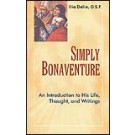
SIMPLY BONAVENTURE: Journey to Go,  as distilled by Delio, Ilia O.S.F.

We come from God, we exist as the image of God, and we are returning to God.

Bonaventure uses the metaphor of journey to indicate that the human desire for God is dynamic… It is a desire which impels one to search for God, and this desire, planted as a seed of grace, is already in the human person.

The human person  is not simply content with the totality of that which exists; rather, there is a longing for more, for something deeper, for God. The human person has an attraction for God.

…one cannot begin the journey to God unless one recognizes one’s poverty or radical dependence on God. Poverty is…an awareness of one’s utter dependency on God, a realization that all good things flow out of the goodness of God.

…the journey is not an intellectual exercise; it is not a “head trip” but a matter of the heart. The goal of the journey is happiness…..one cannot be happy unless the heart is centered on God.

…one of the greatest obstacles….is that the human heart is hardened by sin. The “hardened” self-centered heart must become a natural, loving heart, centered in God. Transformation of the heart, however, can only come about through a relationship with God…..prayer is the mother and source of the journey to God – because prayer is an openness and deepening of one’s life in God’s life.

…one cannot enter into oneself unless Christ be the mediator….the path to true knowledge is that Christ is the way, the truth and the life. Devotion to Christ is pivotal in the journey to God; how one relates to Christ will influence how one completes the journey. Devotion to Christ means a total turning to God, not simply with one’s mind but with one’s heart and soul as well….accepting Christ as person and developing a personal relationship with Christ ultimately opens us up to the mystery of God. (John 1:18)

Christ is the source of grace by which the soul is purified, illumined and perfected. As one enters more deeply into relationship with Christ, the divine image is reformed and restored in its likeness to God.

….the more God-like the soul becomes by grace, the more clearly it sees the truth of things….one’s inner life becomes more orderly and peaceful….when our feelings, thought and emotions are rightly ordered to God, then we start to line in a new, virtuous way that follows the example of Christ….the soul’s journey to God is thoroughly Christocentric since Christ is the beginning, middle an end of the journey….it cannot be made apart from the imitation of Christ.

http://www.newcitypress.com/simply-bonaventure.html

“With Him there is no possibility of failure”

In 01 Daily Meditations on 2011/07/18 at 9:16 AM

“I can do all things in him who strengthens me.” With him there is no possibility of failure, and this conviction gives rise to the holy “superiority complex” whereby we take on things with a spirit of victory, because God grants us his strength. (The Forge, 337)

If you’re not struggling, it’s no use telling me that you are really trying to become more closely identified with Christ, to know him and love him. When we set out seriously along the royal highway, that of following Christ and behaving as children of God, we soon realize what awaits us: the Holy Cross. We must see it as the central point upon which to rest our hope of being united with Our Lord.

Let me warn you that the program ahead is not an easy one. It takes an effort to lead the kind of life Our Lord wants… We will, however, discover our own meanness and selfishness, the sting of sensuality, the useless, ridiculous smack of pride, and many other failings besides: so very many weaknesses. But are we to give in to discouragement? Not at all. Together with St Paul, let us tell Our Lord, ‘I am well content with these humiliations of mine, with the insults, the hardships, the persecutions, the times of difficulty I undergo for Christ; for when I am weakest, then I am strongest of all’…

I am convinced that unless I look upward, unless I have Jesus, I will never accomplish anything. And I know that the strength to conquer myself and to win comes from repeating that cry, ‘I can do all things in him who strengthens me,’ words which reflect God’s firm promise not to abandon his children if they do not abandon him. (Friends of God, 212-213)

A question you need to answer.

In 07 Observations on 2011/06/29 at 3:09 PM

In 1970 I saw a large triptych in Zurich, which had been painted on the wall of an old building.

Under each of the figures were the words you see under the pictures below of Martin Luther, John Calvin and Christ. All were dressed as priests holding up a host and a chalice.  Christ was in the center.  Under the three captions, the artist had written in large bold letters: WHO IS RIGHT?


“This is like my body; this is like my blood.”

“This is a symbol of my body; this is a symbol of my blood.”

“This is my Body; this is my Blood.”

Jesus Christ did what no other person ever did or could: He left Himself behind for us in His greatest miracle of all, the Eucharist, made possible by His Redemption, made possible by His Incarnation, made possible by the Fiat the new Eve, made possible by I Am Who Am.

We find the words of Jesus, Himself bearing testimony to His Eternal Presence in the Eucharist, in these New Testament passages:

“I am the bread of life; he who comes to me shall not hunger, and he who believes in me shall never thirst. But I said to you that you have seen me and yet do not believe. All that the Father gives me will come to me; and him who comes to me I will not cast out.  For I have come down from heaven, not to do my own will, but the will of him who sent me; and this is the will of him who sent me, that I should lose nothing of all that he has given me, but raise it up at the last day. For this is the will of my Father, that every one who sees the Son and believes in him should have eternal life; and I will raise him up at the last day.”  John 6:35-40

“Truly, truly, I say to you, he who believes has eternal life. I am the bread of life.  Your fathers ate the manna in the wilderness, and they died.  This is the bread which comes down from heaven, that a man may eat of it and not die.  I am the living bread which came down from heaven; if any one eats of this bread, he will live for ever; and the bread which I shall give for the life of the world is my flesh.” John 6: 47-51

“For I received from the Lord what I also delivered to you, that the Lord Jesus on the night when he was betrayed took bread, and when he had given thanks, he broke it, and said, “This is my body which is for  you. Do this in remembrance of me.” In the same way also the cup, after supper, saying, “This cup is the new covenant in my blood. Do this, as often as you drink it, in remembrance of me.” 1 Cor. 11: 23-25