2cornucopias

Archive for the ‘13 History’ Category

Russian Orthodox Patriarch Kirill re Pope Benedict XVI

In 13 History on 2013/03/03 at 11:11 AM

It is the Patriarch Kirill fervent hope that the next to occupy the Chair of Peter will follow Pope Benedict’s relationship to the Orthodox churches.

Moscow

(Zenit.org) |

 g_image.php

In a farewell message to the Pope Emeritus published Friday in English at the official Web site of the Russian Church’s Department of External Church Relations, Kirill expresses his “fraternal love in Christ and respect.”

He speaks of Benedict XVI’s decision to step down as one of simplicity and humility.

“We have always held dear your consistent position characterized by [an] uncompromising stand in the questions of faith and commitment to the living church tradition. In an age when the ideology of all-permissiveness and moral relativism tries to force moral values out of people’s life, you boldly raised your voice in the defense of the Gospel’s ideal, the lofty dignity of human beings and their calling to freedom from sin,” the patriarch wrote.

Kirill said he remembered “with warmth” the meetings the two had before Joseph Ratzinger was elected Pope. Many hoped that Benedict XVI would be able to meet with Patriarch Kirill during his pontificate.

Though a meeting never happened, Kirill suggested that Benedict XVI brought the Churches closer.

“In the years of your pontificate, a good development was given to relations between our Churches who bear a great responsibility for common witness to [the] Crucified and Risen Christ in the modern world,” he said.

“I sincerely hope that good and confidential relations established with your active participation will develop under your successor,” the patriarch added.

“Kindly accept my heartfelt wishes of good health, many years of life and God’s help in your life devoted to prayer and in your theological work,” he concluded. “‘Now the God of hope fill you with all joy and peace’ (Rom. 15:13).”

(March 04, 2013) © Innovative Media Inc.

Pope Benedict XVI’s Final General Audience: “I asked God to enlighten me to make the right decision, not for my own good, but for the good of the Church.

In 13 History on 2013/02/28 at 12:00 AM

Vatican City, 27 February 2013 (VIS) – Today, Benedict XVI celebrated his last general audience. In St. Peter’s Square, crowded with tens of thousands of people wishing to bid him farewell, the Pontiff said: “Thank you for coming in such large numbers to this, my last general audience. Thank you, I am truly moved! And I see the Church is alive! I think we also have to thank the Creator for the beautiful weather that He is giving us now, even in winter.”

Following is the entire text of the Holy Father’s words.

“Like the Apostle Paul in the Biblical text that we have heard, I feel in my heart that I have to especially thank God who guides and builds up the Church, who plants His Word and thus nourishes the faith in His People. At this moment my heart expands and embraces the whole Church throughout the world and I thank God for the ‘news’ that, in these years of my Petrine ministry, I have received about the faith in the Lord Jesus Christ and for the love that truly circulates in the Body of the Church, making it to live in the love and the hope that opens us to and guides us towards the fullness of life, towards our heavenly homeland.”

“I feel that I am carrying everyone with me in prayer in this God-given moment when I am collecting every meeting, every trip, every pastoral visit. I am gathering everyone and everything in prayer to entrust it to the Lord: so that we may be filled with the knowledge of His will through all spiritual wisdom and understanding in order to live in a manner worthy of the Lord and His love, bearing fruit in every good work (cf. Col 1:9-10).”

“At this moment I have great confidence because I know, we all know, that the Gospel’s Word of truth is the strength of the Church; it is her life. The Gospel purifies and renews, bearing fruit, wherever the community of believers hears it and welcomes God’s grace in truth and in love. This is my confidence, this is my joy.”

“When, on 19 April almost eight years ago I accepted to take on the Petrine ministry, I had the firm certainty that has always accompanied me: this certainty for the life of the Church from the Word of God. At that moment, as I have already expressed many times, the words that resounded in my heart were: Lord, what do You ask of me? It is a great weight that You are placing on my shoulders but, if You ask it of me, I will cast my nets at your command, confident that You will guide me, even with all my weaknesses. And eight years later I can say that the Lord has guided me. He has been close to me. I have felt His presence every day. It has been a stretch of the Church’s path that has had moments of joy and light, but also difficult moments. I felt like St. Peter and the Apostles in the boat on the See of Galilee. The Lord has given us many days of sunshine and light breezes, days when the fishing was plentiful, but also times when the water was rough and the winds against us, just as throughout the whole history of the Church, when the Lord seemed to be sleeping. But I always knew that the Lord is in that boat and I always knew that the boat of the Church is not mine, not ours, but is His. And the Lord will not let it sink. He is the one who steers her, of course also through those He has chosen because that is how He wanted it. This was and is a certainty that nothing can tarnish. And that is why my heart today is filled with gratitude to God, because He never left—the whole Church or me—without His consolation, His light, or His love.”

“We are in the Year of Faith, which I desired precisely in order to strengthen our faith in God in a context that seems to relegate it more and more to the background. I would like to invite everyone to renew their firm trust in the Lord, to entrust ourselves like children to God’s arms, certain that those arms always hold us up and are what allow us to walk forward each day, even when it is a struggle. I would like everyone to feel beloved of that God who gave His Son for us and who has shown us His boundless love. I would like everyone to feel the joy of being Christian. In a beautiful prayer, which can be recited every morning, say: ‘I adore you, my God and I love you with all my heart. Thank you for having created me, for having made me Christian…’ Yes, we are happy for the gift of faith. It is the most precious thing, which no one can take from us! Let us thank the Lord for this every day, with prayer and with a coherent Christian life. God loves us, but awaits us to also love Him!”

“It is not only God who I wish to thank at this time. A pope is not alone in guiding Peter’s barque, even if it is his primary responsibility. I have never felt alone in bearing the joy and the weight of the Petrine ministry. The Lord has placed at my side so many people who, with generosity and love for God and the Church, have helped me and been close to me. First of all, you, dear Brother Cardinals: your wisdom, your advice, and your friendship have been precious to me. My collaborators, starting with my secretary of state who has accompanied me faithfully over the years; the Secretariat of State and the whole of the Roman Curia, as well as all those who, in their various areas, serve the Holy See. There are many faces that are never seen, remaining in obscurity, but precisely in their silence, in their daily dedication in a spirit of faith and humility, they were a sure and reliable support to me. A special thought goes to the Church of Rome, my diocese! I cannot forget my Brothers in the episcopate and in the priesthood, consecrated persons, and the entire People of God. In my pastoral visits, meetings, audiences, and trips I always felt great care and deep affection, but I have also loved each and every one of you, without exception, with that pastoral love that is the heart of every pastor, especially the Bishop of Rome, the Successor of the Apostle Peter. Every day I held each of you in prayer, with a father’s heart.”

“I wish to send my greetings and my thanks to all: a pope’s heart extends to the whole world. And I would like to express my gratitude to the Diplomatic Corps accredited to the Holy See, which makes the great family of Nations present here. Here I am also thinking of all those who work for good communication and I thank them for their important service.”

“At this point I would also like to wholeheartedly thank all of the many people around the world who, in recent weeks, have sent me touching tokens of concern, friendship, and prayer. Yes, the Pope is never alone. I feel this again now in such a great way that it touches my heart. The Pope belongs to everyone and many people feel very close to him. It’s true that I receive letters from the world’s notables—from heads of states, from religious leaders, from representatives of the world of culture, etc. But I also receive many letters from ordinary people who write to me simply from their hearts and make me feel their affection, which is born of our being together with Christ Jesus, in the Church. These people do not write to me the way one would write, for example, to a prince or a dignitary that they don’t know. They write to me as brothers and sisters or as sons and daughters, with the sense of a very affectionate family tie. In this you can touch what the Church is—not an organization, not an association for religious or humanitarian ends, but a living body, a communion of brothers and sisters in the Body of Jesus Christ who unites us all. Experiencing the Church in this way and being able to almost touch with our hands the strength of His truth and His love is a reason for joy at a time when many are speaking of its decline. See how the Church is alive today!”

“In these last months I have felt that my strength had diminished and I asked God earnestly in prayer to enlighten me with His light to make me make the right decision, not for my own good, but for the good of the Church. I have taken this step in full awareness of its seriousness and also its newness, but with a profound peace of mind. Loving the Church also means having the courage to make difficult, agonized choices, always keeping in mind the good of the Church, not of oneself.”

“Allow me here to return once again to 19 April, 2005. The gravity of the decision lay precisely in the fact that, from that moment on, I was always and for always engaged by the Lord. Always—whoever assumes the Petrine ministry no longer has any privacy. He belongs always and entirely to everyone, to the whole Church. His life, so to speak, is totally deprived of its private dimension. I experienced, and I am experiencing it precisely now, that one receives life precisely when they give it. Before I said that many people who love the Lord also love St. Peter’s Successor and are fond of him; that the Pope truly has brothers and sisters, sons and daughters all over the world and that he feels safe in the embrace of their communion; because he no longer belongs to himself but he belongs to all and all belong to him.”

“’Always’ is also ‘forever’–there is no return to private life. My decision to renounce the active exercise of the ministry does not revoke this. I am not returning to private life, to a life of trips, meetings, receptions, conferences, etc. I am not abandoning the cross, but am remaining beside the Crucified Lord in a new way. I no longer bear the power of the office for the governance of the Church, but I remain in the service of prayer, within St. Peter’s paddock, so to speak. St. Benedict, whose name I bear as Pope, will be a great example to me in this. He has shown us the way for a life that, active or passive, belongs wholly to God’s work.”

“I also thank each and every one of you for the respect and understanding with which you have received this important decision. I will continue to accompany the Church’s journey through prayer and reflection, with the dedication to the Lord and His Bride that I have tried to live every day up to now and that I want to always live. I ask you to remember me to God, and above all to pray for the Cardinals who are called to such an important task, and for the new Successor of the Apostle Peter. Many the Lord accompany him with the light and strength of His Spirit.”

“We call upon the maternal intercession of Mary, the Mother of God and of the Church, that she might accompany each of us and the entire ecclesial community. We entrust ourselves to her with deep confidence.”

“Dear friends! God guides His Church, always sustaining her even and especially in difficult times. Let us never lose this vision of faith, which is the only true vision of the path of the Church and of the world. In our hearts, in the heart of each one of you, may there always be the joyous certainty that the Lord is beside us, that He does not abandon us, that He is near and embraces us with His love. Thank you.”

VIS 130227

Text of Pope Benedict’s Humble Resignation

In 13 History on 2013/02/11 at 9:56 AM

Dear Brothers, I have convoked you to this Consistory, not only for the three canonizations, but also to communicate to you a decision of great importance for the life of the Church.

After having repeatedly examined my conscience before God, I have come to the certainty that my strengths, due to an advanced age, are no longer suited to an adequate exercise of the Petrine ministry.

I am well aware that this ministry, due to its essential spiritual nature, must be carried out not only with words and deeds, but no less with prayer and suffering.

However, in today’s world, subject to so many rapid changes and shaken by questions of deep relevance for the life of faith, in order to govern the bark of Saint Peter and proclaim the Gospel, both strength of mind and body are necessary, strength which in the last few months, has deteriorated in me to the extent that I have had to recognize my incapacity to adequately fulfill the ministry entrusted to me.

For this reason, and well aware of the seriousness of this act, with full freedom I declare that I renounce the ministry of Bishop of Rome, Successor of Saint Peter, entrusted to me by the Cardinals on 19 April 2005, in such a way, that as from 28 February 2013, at 20:00 hours, the See of Rome, the See of Saint Peter, will be vacant and a Conclave to elect the new Supreme Pontiff will have to be convoked by those whose competence it is.

Dear Brothers, I thank you most sincerely for all the love and work with which you have supported me in my ministry and I ask pardon for all my defects.

And now, let us entrust the Holy Church to the care of Our Supreme Pastor, Our Lord Jesus Christ, and implore his holy Mother Mary, so that she may assist the Cardinal Fathers with her maternal solicitude, in electing a new Supreme Pontiff.

With regard to myself, I wish to also devotedly serve the Holy Church of God in the future through a life dedicated to prayer.

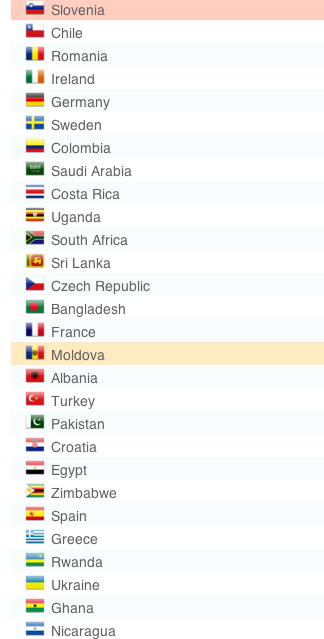
Nations of the World That Accessed This Post Regularly

In 13 History on 2013/01/05 at 9:00 AM
Plus 24 others I could not squeeze in using this format.  b

The WordPress.com stats helper monkeys prepared a 2012 annual report for this blog.

Here’s an excerpt:

600 people reached the top of Mt. Everest in 2012. This blog got about 5,800 views in 2012. If every person who reached the top of Mt. Everest viewed this blog, it would have taken 10 years to get that many views.

Click here to see the complete report.

Is America Exceptional? Part I

In 13 History on 2012/11/09 at 9:45 AM

Is America Exceptional?

NORMAN PODHORETZ served as editor-in-chief of Commentary magazine from 1960-1995. He was a Pulitzer Scholar at Columbia University, earning his bachelor of arts degree in 1950. He also holds bachelor’s and master’s degrees from Cambridge University, England, where he was a Fulbright Scholar and a Kellett Fellow. In addition, he has a bachelor’s degree in Hebrew Literature from the Jewish Theological Seminary. He has written for most major American periodicals and is the author of twelve books, including My Love Affair With Americaand Why Are Jews Liberals?

The following is adapted from a speech delivered on September 20, 2012, in Washington, D.C., at Hillsdale College’s third annual Constitution Day Dinner.

ONCE UPON A TIME, hardly anyone dissented from the idea that, for better or worse, the United States of America was different from all other nations. This is not surprising, since the attributes that made it different were vividly evident from the day of its birth. Let me say a few words about three of them in particular.

First of all, unlike all other nations past or present, this one accepted as a self-evident truth that all men are created equal. What this meant was that its Founders aimed to create a society in which, for the first time in the history of the world, the individual’s fate would be determined not by who his father was, but by his own freely chosen pursuit of his own ambitions. In other words, America was to be something new under the sun: a society in which hereditary status and class distinctions would be erased, leaving individuals free to act and to be judged on their merits alone. There remained, of course, the two atavistic contradictions of slavery and the position of women; but so intolerable did these contradictions ultimately prove that they had to be resolved—even if, as in the case of the former, it took the bloodiest war the nation has ever fought.

Secondly, in all other countries membership or citizenship was a matter of birth, of blood, of lineage, of rootedness in the soil. Thus, foreigners who were admitted for one reason or another could never become full-fledged members of the society. But America was the incarnation of an idea, and therefore no such factors came into play. To become a full-fledged American, it was only necessary to pledge allegiance to the new Republic and to the principles for which it stood.

Thirdly, in all other nations, the rights, if any, enjoyed by their citizens were conferred by human agencies: kings and princes and occasionally parliaments. As such, these rights amounted to privileges that could be revoked at will by the same human agencies. In America, by contrast, the citizen’s rights were declared from the beginning to have come from God and to be “inalienable”—that is, immune to legitimate revocation.

As time went on, other characteristics that were unique to America gradually manifested themselves. For instance, in the 20th century, social scientists began speculating as to why America was the only country in the developed world where socialism had failed to take root. As it happens, I myself first came upon the term “American exceptionalism” not in Alexis de Tocqueville’s Democracy in America, where it has mistakenly been thought to have originated, but in a book by the sociologist Seymour Martin Lipset, who used it in connection with the absence in America of a strong socialist party. More recently I have discovered that the term may actually have originated with Joseph Stalin, of all people, who coined the term in the same connection but only in order to dismiss it. Thus, when an American Communist leader informed him that American workers had no intention of playing the role Marx had assigned to the worldwide proletariat as the vanguard of the coming socialist revolution, Stalin reputedly shouted something like, “Away with this heresy of American exceptionalism!” And yet Stalin and his followers were themselves exceptional in denying that America was exceptional in the plainly observable ways I have mentioned. If, however, almost everyone agreed that America was different, there was a great deal of disagreement over whether its exceptionalism made it into a force for good or a force for evil. This too went back to the beginning, when the denigrators outnumbered the enthusiasts.

At first, anti-American passions were understandably fuelled by the dangerous political challenge posed to the monarchies of Europe by the republican ideas of the American Revolution. But the political side of anti-Americanism was soon joined to a cultural indictment that proved to have more staying power. Here is how the brilliant but volatile historian Henry Adams—the descendent of two American presidents—described the cultural indictment as it was framed in the earliest days of the Republic:

In the foreigner’s range of observation, love of money was the most conspicuous and most common trait of the American character . . . . No foreigner of that day—neither poet, painter, or philosopher—could detect in American life anything higher than vulgarity . . . . Englishmen especially indulged in unbounded invective against the sordid character of American society . . . . Contemporary critics could see neither generosity, economy, honor, nor ideas of any kind in the American breast.

In his younger days, Adams defended America against these foreign critics; but in later life, snobbishly recoiling from the changes wrought by rapid industrialization following the Civil War, he would hurl the same charge at the America of the so-called Gilded Age.

We see a similar conflict in Tocqueville. Democracy in America was mainly a defense of the country’s political system and many of its egalitarian habits and mores. But where its cultural and spiritual life was concerned, Tocqueville expressed much the same contempt as the critics cited by Henry Adams. The Americans, he wrote, with “their exclusively commercial habits,” were so fixated “upon purely practical objects” that they neglected “the pursuit of science, literature, and the arts,” and it was only their proximity to Europe that allowed them “to neglect these pursuits without lapsing into barbarism.” Many years later, another Frenchman, Georges Clemenceau, went Tocqueville one better: “America,” he quipped, “is the only nation in history which miraculously has gone from barbarism to decadence without the usual interval of civilization.”

The main reason for the enduring power of the cultural critique was its fervent embrace, beginning in the late 19th century, by the vast majority of the writers, artists, and intellectuals who followed Tocqueville. And so it still goes in 2012, when the putative materialism and crassness of American life are harped upon in movies, television shows, novels, volumes of social criticism, and op-ed pieces too numerous to count.

Like Tocqueville and the foreigners cited by Henry Adams, moreover, these more recent works attribute this crassly philistine attitude to the love of money and “the exclusively commercial habits” that went with it—in other words, to the species of freedom that has done more than anything else ever invented to lift masses of people out of poverty and that would later be known as capitalism. America, these critics were declaring, was exceptional all right—exceptionally bad, or even downright evil.

On the other hand, there have always been defenders of American exceptionalism as a vital force for good. Thus, several decades before switching sides, Henry Adams charged America’s foreign critics with blindness to the country’s amazing virtues. Whereas, Adams wrote, European philosophers and poets could see only rapacity and vulgarity here, the poorest European peasants could discern that “the hard, practical money-getting American democrat was in truth living in a world of dream” and was “already guiding Nature with a kinder and wiser hand than had ever yet been felt in human history.” It was this dream, Adams went on to say, that beckoned to the poor of the old world, calling upon them to come and share in the limitless opportunities it offered—opportunities unimaginable anywhere else.

For a long time now, to speak personally, I have taken my stand with the young Adams, to whom America was exceptionally good, against his embittered older self, to whom it had become exceptionally bad. In my own younger days, I was on the Left, and from the utopian vantage point to which leftism invariably transports its adherents, it was the flaws in American society—the radical 1960s trinity of war, racism, and poverty—that stood out most vividly. It rarely occurred to me or my fellow leftists to ask a simple question: Compared to what is America so bad?

From our modern perspective, much more was wrong with Periclean Athens, or the Italy of the Medicis, or England under the first Queen Elizabeth, or 19th-century Russia under the Romanovs. But this has not disqualified them from being universally ranked among the highest points of human civilization and achievement. After more than 40 years of pondering the question “Compared to what?” I have come to believe with all my heart that the United States belongs on that exalted list. It is true that we have not earned a place on it, as the others mainly did, by our contribution to the arts. Yet it is worth pointing out that even in the sphere of the arts, we have not done too badly. To speak only of literature, names like Walt Whitman, Mark Twain, Edith Wharton, Robert Frost, and many others attest that we have, in fact, done far better than might generally have been expected of a nation conceived primarily to achieve other ends. These ends were social, political, and economic, and it is in them that we have indeed excelled the most.

We have excelled by following our Founding Fathers in directing our energies, as our Constitution exhorts us to do, to the preservation of the blessings of liberty to ourselves and our posterity, as well as to the pursuit of happiness tacitly understood by the Declaration of Independence to require prosperity as a precondition. (In his original draft of the Declaration, of course, Jefferson used the word “property” instead of “pursuit of happiness.”) By remaining faithful in principle—and to a considerable extent in practice—to the ideas by which the Founders hoped to accomplish these ends, we and our forebears have fashioned a country in which more liberty and more prosperity are more widely shared than among any other people in human history. Yes, even today that holds true, despite policies unfaithful both to the letter and to the spirit of the traditional American system that have resulted in a series of political and economic setbacks.

Is America Exceptional? Part II

In 13 History on 2012/11/09 at 9:40 AM

So far as liberty is concerned, until recently no one but libertarians have been arguing that we were insufficiently free in the United States. If anything, some conservatives, dismayed by such phenomena as the spread of pornography and sexual license, thought that we had too much freedom for our own good. But thanks to modern liberalism’s barely concealed hostility to the free market, not to mention the threat posed by Obamacare to religious and economic freedom, many conservatives are now echoing these libertarian arguments, if in a milder form.

Judging by what they say and the policies they pursue, modern liberals are not all that concerned about liberty. What they really care about, and what they assign a higher value to, is economic equality (as reflected in the now famous phrase, “spread the wealth around”). Yet here is what the late Daniel Patrick Moynihan wrote in 1976 about this very issue in connection with the redistributionist ideology then regnant at the United Nations:

And equality . . . what is the record? The record was stated most succinctly by an Israeli socialist who told William F. Buckley, Jr. that those nations which have put liberty ahead of equality have ended up doing better by equality than those with the reverse priority . . . . This is our case. We are of the liberty party, and it might surprise us what energies might be released were we to unfurl those banners.

Four years later, Ronald Reagan came along to unfurl those banners. And just as Moynihan predicted, the result was the release of new political and economic energies that reversed the political and economic decline of the Carter years and that led to our victory in the Cold War.

Of course, the party of liberty Moynihan was talking about was the United States of America and the party of economic equality was the socialist countries of what was then called the Third World. But within America today, an analogous split has opened up, with the Republicans constituting the party of liberty and the Democrats more and more becoming the party of redistribution. Hence the Democrats never stop claiming that the rich are failing to pay their fair share of taxes. Yet after surveying the numbers, the economist Walter Williams of George Mason University asks an excellent question: “What standard of fairness dictates that the top ten percent of income earners pay 71 percent of the federal income tax burden while 47 percent of Americans pay absolutely nothing?” To which an editorial in the Wall Street Journal replies: “There is nothing fair about confiscatory tax policy that reduces growth, denies opportunity, and keeps more people in poverty.”

Then too there is the assumption, blithely accepted by the party of economic equality, that the gap between rich and poor—or even between the rich and the middle class—self-evidently amounts to a violation of social justice. Yet far from being self-evident, this assumption stems from a highly questionable concept of social justice—one that rules out or minimizes the role played by talent, character, ambition, initiative, daring, work, and spirit in producing unequal outcomes in “the pursuit of happiness.”

Furthermore, both the assumption and its correlative concept of social justice run counter to the American grain. As study after study has shown, and as the petering out of the Occupy Wall Street movement has recently confirmed, what Tocqueville observed on this point in the 1830s remains true today: Americans, unlike Europeans, he wrote, “do not hate the higher classes of society” even if “they are not favorably inclined toward them . . . .” Which is to say that most Americans are not prone to the envy of the rich that eats away at their self-appointed spokesmen on the Left.

Nor are most Americans subject to the accompanying passion for economic egalitarianism that made for the spread of socialism in other countries. What explains the absence of that levelling passion is that it has been starved by the opportunities America has afforded millions upon millions to better their lot and the advantage they have been free to take of those opportunities—which in turn explains how unprecedented and unmatched levels of prosperity have been created here and how they have come to be shared more widely here than anywhere else.

Tocqueville also put his finger on a second and related reason for the persistence of this particular feature of American exceptionalism: “The word poor is used here in a relative, not an absolute sense. Poor men in America would often appear rich in comparison with the poor of Europe.” A story I was once told by a Soviet dissident provides an amusing illustration. It seems that the Soviet authorities used to encourage the repeated screening of The Grapes of Wrath, a movie about the Great Depression-era migration of starving farmers from the Dust Bowl to California in their broken-down pickups. But contrary to expectation, what Soviet audiences got from this film was not an impression of how wretched was the plight of the poor in America. Instead they came away marvelling that in America, “even the peasants own trucks.”

Tocqueville further observed that in America, “the poor, instead of forming the immense majority of the nation, as is always the case in aristocratic communities, are comparatively few in number, and the laws do not bind them together by the ties of irremediable and hereditary penury.”

As the great economist and social critic Thomas Sowell has demonstrated time and again, it is still the case that the poor in America “are comparatively few in number.” And except for the black underclass—whose size is generally estimated at somewhere between two and ten percent of the black community and whose plight has thus far resisted every attempt at alleviation over the past 50 years—it is also true that penury in the United States is neither irremediable nor hereditary. As Sowell shows, of those who live on the next rung of the economic ladder, more of whom are white than black, only three percent get stuck in the bottom fifth of the income distribution for more than eight years.

Elaborating on Sowell’s analyses, the economist Mark Perry writes:

In the discussions on income inequality and wage stagnation, we frequently hear about the “top 1%” or the “top 10%” or the “bottom 99%” and the public has started to believe that those groups operate like closed private clubs that contain the exact same people or households every year. But the empirical evidence . . . tells a much different story of dynamic change in the labor market—people and households move up and down the earnings quintiles throughout their careers and lives. Many of today’s low-income households will rise to become tomorrow’s high-income households, and some will even eventually be in the “top 10%” or “top 1%.” And many of today’s “top 1%” or top income quintile members are tomorrow’s middle or lower class households, reflecting the significant upward and downward mobility in the dynamic U.S. labor market.

No such mobility can be found in any of the member countries of the European Union, or anywhere else for that matter. Even in the dismal economic state our nation has fallen into today, it is still exceptional where the degree and the distribution of prosperity are concerned. But to this, modern liberals are willfully blind.

With all exceptions duly noted, I think it is fair to say that what liberals mainly see when they look at America today is injustice and oppression crying out for redress. By sharp contrast, conservatives see a complex of traditions and institutions built upon the principles that animated the American Revolution and that have made it possible—to say yet again what cannot be said too often—for more freedom and more prosperity to be enjoyed by more of its citizens than in any other society in human history. It follows that what liberals—who concentrate their attention on the relatively little that is wrong with America instead of the enormous good embodied within it—seek to change or discard is precisely what conservatives are dedicated to preserving, reinvigorating, and defending.

A similar divide separates liberals and conservatives as to the role America has played in world affairs. Consider the many apologies President Obama has issued for the misdeeds of which he imagines Americans have been guilty in our relations with other countries in general and the Muslim world in particular. Never mind that the United States has spilled blood and treasure to liberate and protect many millions of people from the totalitarian horrors first of Nazism and then of Communism, and that since 9/11 we have spilled yet more blood and treasure fighting against Islamofascism, the totalitarian successor to Nazism. And as to the Muslim world in particular, never mind that, as the columnist Mona Charen puts it, “of the last six wars in which the United States was involved (Kuwait, Bosnia, Kosovo, Afghanistan, Iraq and Libya), four were undertaken to rescue Muslims and the other two (Afghanistan and Iraq) had the side benefit of liberating Muslims —to what end remains an open question.”

In spite of all this, the liberal community seems to think that the rest of the world would be better off without the United States, or at least with it following the policy of “leading from behind.” Admittedly there are paleoconservatives like Pat Buchanan and libertarians like Ron Paul who agree on this point, but most conservatives do not believe that a radical diminution of American power and influence would be good for us or for the world.

Shortly before the election of 2008, then-candidate Obama declared that his election would usher in “a fundamental transformation of America.” The desirability of such a transformation—which would entail the wiping away of as many more traces of American exceptionalism as it will take to turn this country into a facsimile of the social-democratic regimes of western Europe—is the issue at the heart of our politics today. And in the long run, I hope and trust, Americans will reject such a transformation, and elect instead to return to the principles that have made this nation so exceptional—yes, exceptional—a force for good both at home and abroad.


Copyright © 2012 Hillsdale College. The opinions expressed in Imprimis are not necessarily the views of Hillsdale College.  “Reprinted by permission from Imprimis, a publication of Hillsdale College.”

Blasphemy and Free Speech – Part III

In 13 History on 2012/10/27 at 9:11 AM

The encroachment of de facto blasphemy restrictions in the West threatens free speech and the free exchange of ideas. Nor will it bring social peace and harmony. As comedian Rowan Atkinson warns, such laws produce “a veneer of tolerance concealing a snake pit of unaired and unchallenged views.” Norway’s far- reaching restrictions on “hate speech” did not prevent Anders Behring Breivik from slaughtering over 70

people because of his antipathy to Islam: indeed, his writings suggest that he engaged in violence because he believed that he could not otherwise be heard.

In the Muslim world, such restrictions enable Islamists to crush debate. After Salman Taseer, the governor of Punjab, was murdered early last year by his bodyguards for opposing blasphemy laws, his daughter Sara observed: “This is a message to every liberal to shut up or be shot.” Or in the words of Nasr Abu-Zayd, a Muslim scholar driven out of Egypt: “Charges of apostasy and blasphemy are key weapons in the fundamentalists’ arsenal, strategically employed to prevent reform of Muslim societies, and instead confine the world’s Muslim population to a bleak, colourless prison of socio-cultural and political conformity.”

President Obama should put an end to discussion of speech with the OIC. He should declare clearly that in free societies, all views and all religions are subject to criticism and contradiction. As the late Abdurrahman Wahid, former president of Indonesia, the world’s largest Muslim country, and head of Nahdlatul Ulama, the world’s largest Muslim organization, wrote in his foreword to Silenced, blasphemy laws

. . . narrow the bounds of acceptable discourse. . . not only about religion, but also about vast spheres of life, literature, science, and culture in general. . . . Rather than legally stifle criticism and debate— which will only encourage Muslim fundamentalists in their efforts to impose a spiritually void, harsh, and monolithic understanding of Islam upon all the world—Western authorities should instead firmly defend freedom of expression. . . .

America’s Founders, who had broken with an old order that was rife with religious persecution and warfare, forbade laws impeding free exercise of religion, abridging freedom of speech, or infringing freedom of the press. We today must do likewise.

Paul Marshall is a senior fellow at the Hudson Institute’s Center for Religious Freedom. He has published widely in newspapers and magazines, including the New York Times, the Wall Street Journal, the Washington Post, First Things, The New Republic, and The Weekly Standard. He is the author or editor of more than 20 books on religion and politics, including Their Blood Cries Out, Religious Freedom in the World, and Blind Spot: When Journalists Don’t Get Religion. Most recently he is the co-author, with Nina Shea, of Silenced: How Apostasy and Blasphemy Codes are Choking Freedom Worldwide.

The preceding was adapted from a lecture delivered at Hillsdale College’s Allan P. Kirby, Jr. Center for Constitutional Studies and Citizenship in Washington, D.C., on February 3, 2012.

Copyrighted 2012 Hillsdale College

Reprinted with permission

Blasphemy and Free Speech – Part II

In 13 History on 2012/10/26 at 9:11 AM

Muslim reformers cannot escape being attacked even in the West. In 2006, a group called Al-Munasirun li Rasul al Allah emailed over 30 prominent reformers in the West, threatening to kill them unless they repented. Among its targets was Egyptian Saad Eddin Ibrahim, perhaps the best known human rights activist in the Arab world. Another was Ahmad Subhy Mansour, an imam who was imprisoned and had to flee Egypt, in part for his arguments against the death penalty for apostasy. The targets were pronounced “guilty of apostasy, unbelief, and denial of the Islamic established facts” and given three days to “announce their repentance.” The message included their addresses and the names of their spouses and children.

Mimount Bousakla, a Belgian senator and daughter of Moroccan immigrants, was forced into hiding by threats of “ritual slaughter” for her criticism of the treatment of women in Muslim communities and of fundamentalist influences in Belgian mosques. Turkish-born Ekin Deligoz, the first Muslim member of Germany’s Parliament, received death threats and was placed under police protection after she called for Muslim women to “take off the head scarf.”

But the story gets worse. Western governments have begun to give in to demands from the Saudi-based OIC and others for controls on speech.

In Austria, for instance, Elisabeth Sabbaditsch-Wolf has been convicted of “denigrating religious beliefs” for her comments about Mohammed during a seminar on radical Islam. Canada’s grossly misnamed “human rights commissions” have hauled writers—including Mark Steyn, who teaches as a distinguished fellow in journalism at Hillsdale College—before tribunals to interrogate them about their writings on Islam. And in Holland and Finland, respectively, politicians Geert Wilders and Jussi Hallaaho have been prosecuted for their comments on Islam in political speeches.

In America, the First Amendment still protects against the criminalization of criticizing Islam. But we face at least two threats still. The first is extra-legal intimidation of a kind already endemic in the Muslim world and increasing in Europe.

In 2009, Yale University Press, in consultation with Yale University, removed all illustrations of Mohammed from its book by Jytte Klausen on the Danish cartoon crisis. It also removed Gustave Doré’s 19th-century illustration of Mohammed in hell from Dante’s Inferno. Yale’s formal press statement stressed the earlier refusal by American media outlets to show the cartoons, and noted that their “republication…has repeatedly resulted in violence around the world.”

Another publisher, Random House, rejected at the last minute a historical romance novel about Mohammed’s wife, Jewel of Medina, by American writer Sherry Jones. They did so to protect

“the safety of the author, employees of Random House, booksellers and anyone else who would be involved in distribution and sale of the novel.”

The comedy show South Park refused to show an image of Mohammed in a bear suit, although it mocked figures from other religions. In response, Molly Norris, a cartoonist for the Seattle

Weekly, suggested an “Everybody Draw Mohammed Day.” She quickly withdrew the suggestion and implied that she had been joking. But after several death threats, including from Al-Qaeda, the FBI advised her that she should go into hiding—which she has now done under a new name.

In 2010, Zachary Chesser, a young convert to Islam, pleaded guilty to threatening the creators of South Park. And on October 3, 2011, approximately 800 newspapers refused to run a “Non Sequitur” cartoon drawn by Wiley Miller that merely contained a bucolic scene with the caption “Where’s Muhammad?”

Many in our media claim to be self-censoring out of sensitivity to religious feelings, but that claim is repeatedly undercut by their willingness to mock and criticize religions other than Islam. As British comedian Ben Elton observed: “The BBC will let vicar gags pass, but they would not let imam gags pass. They might pretend that it’s, you know, something to do with their moral sensibilities, but it isn’t. It’s because they’re scared.”

The second threat we face is the specter of cooperation between our government and the OIC to shape speech about Islam. A first indication of this came in President Obama’s Cairo speech in 2009, when he declared that he has a responsibilty to “fight against negative stereotypes of Islam whenever they appear.” Then in July of last year in Istanbul, Secretary of State Clinton co-chaired—with the OIC—a “High-Level Meeting on Combating Religious Intolerance.” There, Mrs. Clinton announced another conference with the OIC, this one in Washington, to “exchange ideas” and discuss “imple- mentation” measures our government might take to combat negative stereotyping of Islam. This would not restrict free speech, she said. But the mere fact of U.S. government partnership with the OIC is troublesome. Certainly it sends a dangerous signal, as suggested by the OIC’s Secretary-General, Ekmeleddin Ihsanoglu, when he commented in Istanbul that the Obama administration stands “united” with the OIC on speech issues.

The OIC’s charter commits it “to com- bat defamation of Islam.” Its current action plan calls for “deterrent punishments” to counter “Islamophobia.” In 2009, an official OIC organ, the “International Islamic Fiqh [Jurisprudence] Academy,” issued fatwas calling for speech bans, including “international legislation,” to protect “the interests and values of [Islamic] society.” The OIC does not define what speech should be outlawed, but the repressive practices of its leading member states speak for themselves.

The conference Secretary Clinton announced in Istanbul was held in Washington on December 12-14, 2011, and was closed to the public, with the “Chatham House Rule” restricting the participants (this rule prohibits the identification of who says what, although general content is not confidential). Presentations reportedly focused on America’s deficiencies in its treatment of Muslims and stressed that the U.S. has something to learn in this regard from the other delegations—including Saudi Arabia, despite its ban on Christian churches, its repression of its Shiite population, its textbooks teaching that Jews should be killed, and the fact that it beheaded a woman for sorcery on the opening day of the conference.

Continued

Blasphemy and Free Speech by Paul Marshall, Hudson Institute – Part I

In 13 History on 2012/10/25 at 9:11 AM

A growing threat to our freedom of speech is the attempt to stifle religious discussion in the name of preventing “defamation of” or “insults to” religion, especially Islam. Resulting restrictions represent, in effect, a revival of blasphemy laws.

Few in the West were concerned with such laws 20 years ago. Even if still on some statute books, they were only of historical interest. That began to change in 1989, when the late Ayatollah Khomeini, then Iran’s Supreme Leader, declared it the duty of every Muslim to kill British-based writer Salman Rushdie on the grounds that his novel, The Satanic Verses, was blasphemous. Rushdie has survived by living his life in hiding. Others connected with the book were not so fortunate: its Japanese translator was assassinated, its Italian translator was stabbed, its Norwegian publisher was shot, and 35 guests at a hotel hosting its Turkish publisher were burned to death in an arson attack.

More recently, we have seen eruptions of violence in reaction to Theo van Gogh’s and Ayaan Hirsi Ali’s film Submission, Danish and Swedish cartoons depicting Mohammed, the speech at Regensburg by Pope Benedict XVI on the topic of faith, reason, and Hillsdale College: Pursuing TruTH • defending liberTy sinCe 1844

religious violence, Geert Wilders’ film Fitna, and a false Newsweek report that the U.S. military had desecrated Korans at Guantanamo. A declaration by Terry Jones—a deservedly obscure Florida pastor with a congregation of less than 50—that he would burn a Koran on September 11, 2010, achieved a perfect media storm, combining American publicity-seeking, Muslim outrage, and the demands of 24 hour news coverage. It even drew the attention of President Obama and senior U.S. military leaders. Dozens of people were murdered as a result.

Such violence in response to purported religious insults is not simply spontaneous. It is also stoked and channeled by governments for political purposes. And the objects and victims of accusations of religious insults are not usually Westerners, but minorities and dissidents in the Muslim world. As Nina Shea and I show in our recent book Silenced, accusations of blasphemy or insulting Islam are used systematically in much of that world to send individuals to jail or to bring about intimidation through threats, beatings, and killings.

The Danish cartoons of Mohammed were published in Denmark’s largest newspaper, Jyllands-Posten, in September 2005. Some were reproduced by newspapers in Muslim countries in order to criticize them. There was no violent response. Violence only erupted after a December 2005 summit in Saudi Arabia of the Organization of the Islamic Conference—now the Organization of Islamic Cooperation (OIC). The summit was convened to discuss sectarian violence and terrorism, but seized on the cartoons and urged its member states to rouse opposition. It was only in February 2006—five months after the cartoons were published—that Muslims across Africa, Asia, and the Mideast set out from Friday prayers for often violent demonstrations, killing over 200 people.

The highly controlled media in Egypt and Jordan raised the cartoon issue so persistently that an astonishing 98 percent of Egyptians and 99 percent of Jordanians—knowing little else of Denmark—had heard of them. Saudi Arabia and Egypt urged boycotts of Danish products. Iran and Syria manipulated riots partly to deflect attention from their nuclear projects. Turkey used the cartoons as bargaining chips in negotiations with the U.S. over appointments to NATO. Editors in Algeria, Jordan, India, and Yemen were arrested—and in Syria, journalist Adel Mahfouz was charged with “insulting public religious sentiment”—for suggesting a peaceful response to the controversy. Lars Vilks’ later and more offensive 2007 Swedish cartoons and Geert Wilders’ 2008 film Fitna led to comparatively little outcry, demonstrating further that public reactions are government-driven.

Repression based on charges of blasphemy and apostasy, of course, goes far beyond the stories typically covered in our media. Currently, millions of Baha’is and Ahmadis— followers of religions or interpretations that arose after Islam—are condemned en masse as insulters of Islam, and are subject to discriminatory laws and attacks by mobs, vigilantes, and terrorists. The Baha’i leadership in Iran is in prison, and there is no penalty in Iran for kill- ing a Baha’i. In Somalia, al Shebaab, an Islamist group that controls much of that country, is systematically hunting down and killing Christians. In 2009, after allegations that a Koran had been torn,

a 1,000-strong mob with Taliban links rampaged through Christian neighbor- hoods in Punjab, Pakistan’s largest province, killing seven people, six of whom, including two children, were burned alive. Pakistani police did not intervene.

Throughout the Muslim world, Sunni, Shia, and Sufi Muslims may be persecuted for differing from the version of Islam promulgated by locally hegemonic religious authorities. Saudi Arabia represses Shiites, especially Ismailis. Iran represses Sunnis and Sufis. In Egypt, Shia leaders have been imprisoned and tortured.

In Afghanistan, Shia scholar Ali Mohaqeq Nasab, editor of Haqooq-i-Zen magazine, was imprisoned by the govern- ment for publishing “un-Islamic” articles that criticized stoning as a punishment for adultery. Saudi democracy activists Ali al-Demaini, Abdullah al-Hamed, and Matruk al-Faleh were imprisoned for using “un-Islamic terminology,” such as “democracy” and “human rights,” when calling for a written constitution. Saudi teacher Mohammed al-Harbi was sentenced to 40 months in jail and 750 lashes for “mocking religion” after discussing the Bible in class and making pro-Jewish remarks. Egyptian Nobel prize winner in literature Naguib Mahfouz reluctantly abandoned his lifelong resistance to censorship and sought permission from the clerics of Al-Azhar University to publish his novel Children of Gebelawi, hitherto banned for blasphemy. Mahfouz subse- quently lived under constant protection after being stabbed by a young Islamist, leaving him partly paralyzed.

After Mohammed Younas Shaikh, a member of Pakistan’s Human Rights Commission, raised questions about Pakistan’s policies in Kashmir, he was charged with having blasphemed in one of his classes. In Bangladesh, Salahuddin

Choudhury was imprisoned for hurting “religious feelings” by advocating peaceful relations with Israel. In Iran, Ayatollah Boroujerdi was imprisoned for arguing that “political leadership by clergy” was contrary to Islam, and cleric Mohsen Kadivar was imprisoned for “publishing untruths and disturbing public minds” after writing Theories of the State in Shiite Jurisprudence, which questioned the

legal basis of Ayatollah Khomeini’s view of government. Other charges brought against Iranians include “fighting against God,” “dissension from religious dogma,” “insulting Islam,” “propagation of spiritual liberalism,” “promoting pluralism,” and, my favorite, “creating anxiety in the minds of … Iranian officials.”

Continued

Individual, Community, and State: How to Think About Religious Freedom – Part I

In 13 History on 2012/10/19 at 9:11 AM

Matthew J. Franck
The Witherspoon Institute

Individual, Community, and State: How to Think About Religious Freedom

MATTHEW J. FRANCK is the director of the William E. and Carol G. Simon Center on Religion and the Constitution at the Witherspoon Institute and professor emeritus of political science at Radford University. He received his B.A. from Virginia Wesleyan College and his M.A. and Ph.D. from Northern Illinois University. A regular contributor to the Washington PostFirst Things, and National Review, he is the author of Against the Imperial Judiciary: The Supreme Court vs. the Sovereignty of the People and Strict Scrutiny: Sense and Nonsense on the Supreme Court (forthcoming).
The following is adapted from a lecture delivered at Hillsdale College on September 11, 2012, during a conference on “The Supreme Court: History and Current Controversies.”

THERE IS A GROWING awareness among Americans that religious freedom in our country has come under sustained pressures. In the public square where freedom of religion meets public policy, it becomes clearer all the time that there is a high price to be paid for being true to one’s conscience. This is no tale of Chicken Little—although a chain of chicken sandwich restaurants based in Atlanta is part of the story. Let me give you a few examples.

In our universities, those citadels of toleration, we find that toleration can be sharply limited. At the Hastings College of Law in San Francisco, the student chapter of the Christian Legal Society was denied any status on the campus because it would not abandon its requirement that members commit themselves to traditional Christian norms regarding sexual morality. The U.S. Supreme Court, in a 5-4 ruling in 2010, held that the student group’s rights were not violated by a “take all comers” policy. Following this lead, Vanderbilt University has rewritten its student organizations policy and effectively chased every traditionally Christian student group off campus, denying them regular access to campus facilities. And at the University of Illinois, an adjunct professor of religion, hired to teach a course on Catholicism, was let go because a student complained about his patient explanation of the Catholic Church’s natural law teachings on human sexuality. (He was later restored to his teaching duties, but at the expense of the Newman Center, not on the state payroll.)

In our states and localities, we see other kinds of pressures. Authorities in Washington state and Illinois have attempted to force pharmacists, against their conscience, to dispense “morning after” pills when other pharmacists short distances away make these abortifacients available. New York City has barred church congregations—and them alone—from using public school buildings outside school hours. In New Mexico, a Christian wedding photographer was fined for violation of a state “human rights act” because she refused to take the business of a same-sex couple who claimed to want her services at their civil union ceremony. And in Massachusetts, Illinois, San Francisco, and the District of Columbia, the adoption and fostering agencies of Catholic Charities have been shuttered because they will not place children with same-sex couples, as the local authorities demand.

In our courts, we see the First Amendment turned on its head or simply disregarded, in active hostility to the place of religion in our public life. The U.S. Seventh Circuit Court recently ruled that a Wisconsin public high school could not rent space for its annual graduation exercises in a local church, lest it be seen as “endorsing” religion and “coercing” its students to view Christianity in a positive light. In 2010, Judge Vaughn Walker of the U.S. District Court in San Francisco ruled that Proposition 8, preserving marriage in the California constitution as the union of one man and one woman, was unconstitutional. He held that the affinity between traditional religion and the moral case against same-sex marriage was reason enough to strike down the popular referendum, and went so far as to say that religious doctrines holding homosexual acts to be sinful are in themselves a form of “harm” to gays and lesbians. In this he followed the lead of the Iowa Supreme Court, which held in 2009 that the state’s law restricting marriage to a man and a woman was an expression of a religious viewpoint, and for that reason unconstitutional.

Finally, we have listened to Obama administration officials, including the President and the Secretary of State, speak of “freedom of worship” as though it marked the full extent of freedom of religion. The President famously spoke at the University of Notre Dame’s commencement in 2009, but in that speech, he treated religious opinions that disagree with his views on abortion and other social issues as fundamentally irrational, and thus to be relegated to the private sphere and ruled out of order in our public debates. Having succeeded in persuading Congress to repeal the “Don’t Ask, Don’t Tell” policy for the military, the administration has been strongly opposed to legislation that would protect the conscience rights of chaplains and other service-men and women who continue to hold and to express the view, on religious grounds, that sexual relations are morally permitted only in a marriage between a man and a woman. In the recent term of the Supreme Court, the administration’s lawyers took the position that there should be no “ministerial exception” on religious-freedom grounds, for employers such as religious schools, from federal anti-discrimination laws. Church schools and other religious institutions, they argued, have only as much protection as non-religious groups do on “freedom of association” grounds—as though the religion clause of the First Amendment added no ground whatsoever for a unique religious freedom claim. In the best religious freedom news of the year, the administration lost this case 9-0 in the Supreme Court, which held that the Obama Justice Department’s view was “remarkable,” “untenable,” and “hard to square with the text of the First Amendment itself.”

And of course there is the infamous Health and Human Services “contraception mandate,” the cause of the most pointed confrontation in recent memory between a presidential administration and major figures in America’s religious communities. Under the HHS mandate, an administrative rule authorized by the 2010 Affordable Care Act, every employer with more than 50 employees must provide group health insurance that includes, in the category of preventive medicine for women, no-cost coverage of sterilization services and FDA-approved prescription contraceptives—including those that are better understood as abortifacients because they can act to destroy embryos rather than merely prevent conception. A narrow exemption was included for religious employers that are non-profit, exist to inculcate “religious values,” and primarily employ and serve members of their own religious community. This meant that while churches and other houses of worship would be exempted, countless religious schools, universities, hospitals, and charitable institutions would not. Under pressure, the administration has promised a future “accommodation” for a broader range of religious institutions, with an ill-defined “safe harbor” until the new arrangement becomes effective in August 2013. At that time, these institutions’ employees would still be entitled to the same “preventive services,” but with insurers rather than employers responsible for the costs. Some religious institutions, such as the University of Notre Dame, are self-insured for their employee health plans, and there is no sign yet regarding how their situation could be addressed. And who can be fooled by the promise that insurance companies rather than employers are paying for the coverage, and that employers will somehow have clean hands in a three-cornered contractual relationship in which these services are guaranteed?

It is no wonder that the U.S. Catholic bishops formed an Ad Hoc Committee for Religious Liberty last year; and that they published a major statement on religious freedom in March; and that they organized a “Fortnight for Freedom” to pray for religious liberty in June and July. Recognizing the threat to themselves as well, particularly in the mandated coverage of abortifacient pharmaceuticals, a number of evangelical Protestant institutions have joined in the litigation against the HHS mandate, while Jewish, Mormon, and Muslim leaders have joined in formal protests. There are, at last count, 28 separate lawsuits pending in federal courts around the country, involving more than 80 separate plaintiffs.

Perhaps the most interesting case involves, not a religious school, hospital, or charity, but Hercules Industries of Colorado, a private company that makes heating and air conditioning equipment. Its sole owners are the Newlands, a family of Catholics who object to providing the mandated coverage to their employees, against the dictates of their conscience as informed by their faith. The argument of the Obama Justice Department in the case is astonishing. It is that no one can claim, on behalf of an incorporated business he owns, any right of religious freedom or conscience that can trump a requirement of the law. Period. The members of the Newland family may have religious scruples, but the business they own cannot be conducted in accord with those scruples. Once individuals opt for incorporation of a business, they lose the freedom of religion so far as the actions of that corporation are concerned. Luckily, a federal judge in Colorado has entered a preliminary injunction barring enforcement of the HHS mandate against Hercules Industries while litigation continues. But the all-out character of the administration’s disregard for claims of conscience is a grave portent of things to come.