2cornucopias

Archive for the ‘07 Observations’ Category

St. Ireneaus and the Knowledge of God by Rev. Robert A. Connor

In 07 Observations on 2013/06/14 at 12:00 AM

St. Irenaeus (130 -200 a.d.) is important for his works defending the Catholic faith against the errors of the Gnostics. He is also epistemologically important for our consideration today because he introduces us into an experiential knowledge of God. In the reading of today’s breviary, he says, “The glory of God gives life; those who see God receive life. For this reason God, who cannot be grasped, comprehended or seen allows himself to be seen, comprehended and grasped by men, that he may give life to those who see and receive him. It is impossible to live without life, and the actualization of life comes from participation in God, while participation in God is to see God and enjoy his goodness.

“Men will therefore see God if they are to live; through the vision of God they become immortal and attain to God himself. As I have said, this was shown in symbols by the prophets: God will be seen by men who bear his Spirit and are always waiting for him coming….


“The Word… revealed God to men and presented men to God. He safeguarded the invisibility of the Father to prevent man from treating God with contempt and to set before him a constant goal toward which to make progress. On the other hand, he revealed God to men and made him visible in many ways to prevent man from being totally separated from God and so cease to be. Life in man is the glory of God; the life of man is the vision of God.” 


With the “dictatorship of relativism” that obtains today because of the hegemony of only one level of experience – sensation – , God cannot be known intellectually because he cannot be sensed. Or, if we can know Him, the knowledge is trivial and irrelevant as in “abstract.” John Paul II had affirmed that God can be known on another level of experience – i.e. on the level of the being of the “I” in the moral moment of self-determination. This moral act is the act of faith or any act in which the self is given to another in love. Importantly, then Cardinal Joseph Ratzinger commented:“God in Karol Wojtyla is not only thought but also experienced. The pope expressly opposes the limitation of the concept of experience which occurred in Empiricism; he points out that the form of experience elaborated in the natural sciences are no less real and important: moral experience, human experience, religious experience (34). But this experience is, of course, also reflected upon and verified in its rational content…. The central core of Wojtyla’s philosophy lies in the fact that he does not accept the separation of thought and existence which typifies the modern era. Descartes, says the pope, severed thinking from existing and identified this isolated thought with reason itself: I think, therefore I am. But is not thought which determines existence, but existence which determines thought (38).”

To experience being on this level of the subject is to experience being as imaging God as a triple self-transcendence, i.e., being like God. Hence, the remarks of Irenaeus connecting life and knowledge. Self-transcendence is to live, and self-transcendence is to know.


Posted by Rev. Robert A. Connor


Bishop Jin of Shanghai

In 07 Observations on 2013/05/24 at 12:00 AM

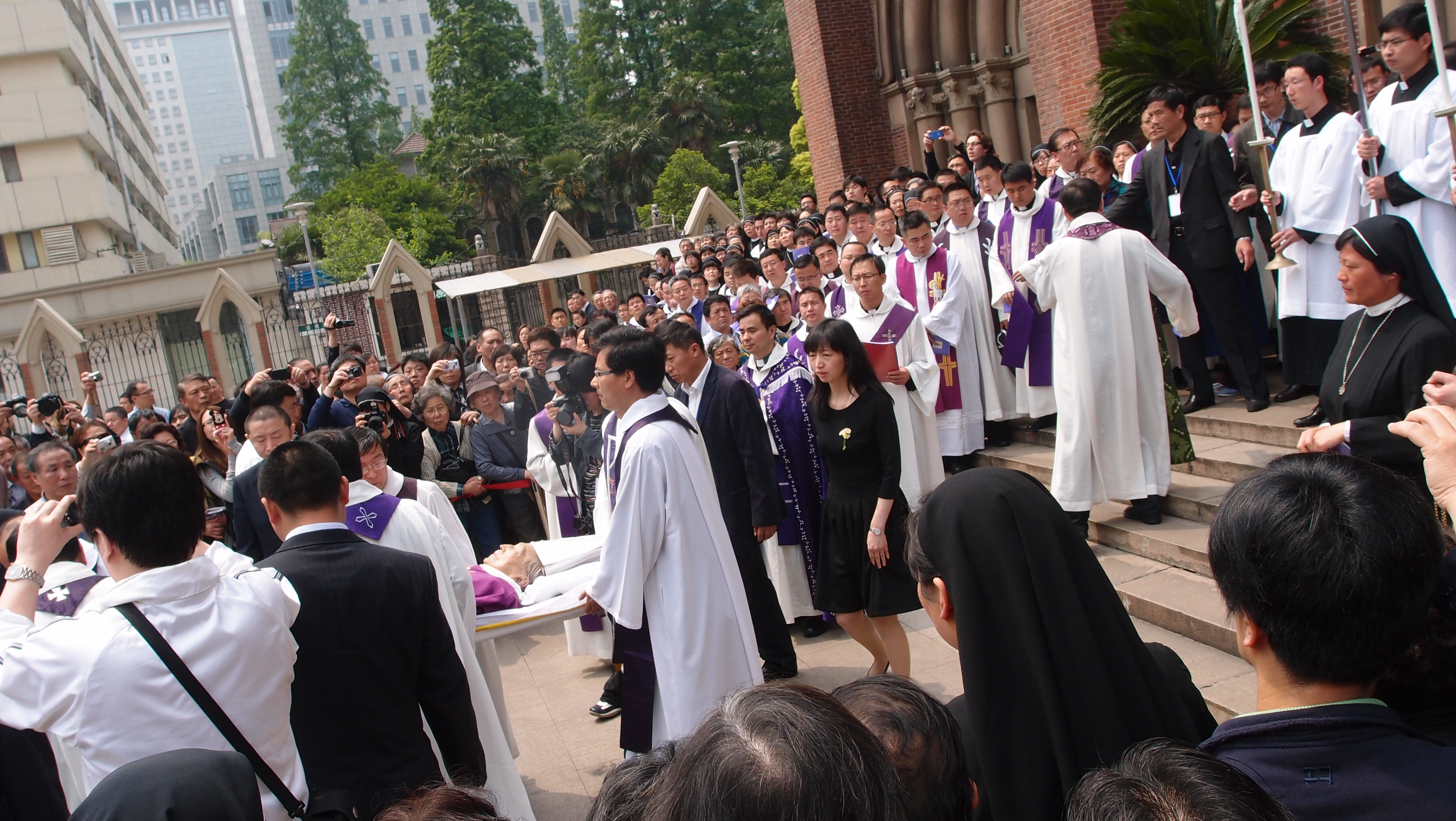
OLYMPUS DIGITAL CAMERAphoto 5When Cardinal Kung dies, the Vatican appointed Jesuit Joseph Fan bishop.  Also a Jesuit returned in 1951 to a China led by Mao. Like thousands of Catholics he was persecuted and imprisoned for 27 years.

When released he did accept the Communist’s government request that he return to his former duties: head of the Shanghai Seminary and then to take the title of Bishop Shanghai without Vatican approval dismayed many Catholics but approval was later was later granted by the Vatican in 2004 during the last days of Pope John Paul II.

Pope Benedict urged China to be open to Christianity, and said that he hoped the Olympic Games would offer an example of coexistence among people from different countries.

Estimates of the Catholic Population in China are as high 90 million and as low as 80 million.

For an comprehensive article please click on this link:  http://www.catholicnews.com/data/stories/cns/1301901.htm

Questions About Marriage

In 07 Observations on 2013/05/01 at 12:00 AM

Following are a few answers  to some commonly asked questions about the definition of marriage:

What is marriage?
Marriage is the lifelong partnership of mutual and exclusive fidelity between a man and a woman ordered by its very nature to the good of the spouses and the procreation and education of children. The bond of marriage is indissoluble – that is, it lasts “until death do us part.” At the heart of married love is the total gift of self that husband and wife freely offer to each other. Because of their sexual difference, husband and wife can truly become “one flesh” and can give to each other “the reality of children, who are a living reflection of their love”.

Marriage between a baptized man and a baptized woman is a sacrament. This means that the bond between husband and wife is a visible sign of the sacrificial love of Christ for his Church. As a sacrament, marriage gives spouses the grace they need to love each other generously, in imitation of Christ.

Why can’t marriage be “redefined” to include two men or two women?
The word “marriage” isn’t simply a label that can be attached to different types of relationships. Instead, “marriage” reflects a deep reality – the reality of the unique, fruitful, lifelong union that is only possible between a man and a woman. Just as oxygen and hydrogen are essential to water, sexual difference is essential to marriage. The attempt to “redefine” marriage to include two persons of the same sex denies the reality of what marriage is. It is as impossible as trying to “redefine” water to include oxygen and nitrogen.

What is sexual difference?
Sexual difference is the difference of man to woman and woman to man. It affects a person at every level of his or her existence: genetically, biologically, emotionally, psychologically, and socially. Sexual difference is an irreducible difference. It is unlike any other difference we experience, because it – and only it – allows for the total personal union between husband and wife that is at the heart of marriage. The difference between men and women is for the sake of their union with each other. It is what makes spousal union possible.

Isn’t marriage just about love and commitment between two people?
Of course love and commitment are important for marriage – as they are for many relationships. But marriage is unique because the commitment it calls for is better described as communion, where “the two become one flesh” (Gen 2:24). Only a man and a woman in marriage can become a “one flesh” communion. The unity of husband and wife is so intimate that from it can come a “third,” the child – a new life to be welcomed and raised in love. No other relationship, no matter how loving or committed, can have this unique form of commitment – communion – that exists in marriage, between a husband and a wife.

What’s the difference between a husband and wife who can’t have children, and two persons of the same sex, who also can’t have children?
Only a man and a woman, as husband and wife, can enter into the two-in-one-flesh communion of persons. Only a man and a woman are able to conceive a child through each other. That is to say, only a man and a woman can be joined so intimately that their bodies work together in the common task of procreation. Even when a husband and wife do not in fact conceive a child (due to infertility, age, and so on), their sexual acts are still the kind of acts by which children are naturally conceived. In contrast, two persons of the same sex may be perfectly healthy, but will never be able to enter a one-flesh communion and thus unite in such a way that a child is conceived.

Why is a child meant to have both a father and a mother?
The fact is, every single child, without exception, does have a mother and a father. Sexual difference between a husband and wife is necessary to conceive a child. But its importance does not end there. Men and women bring unique gifts to the shared task of parenting, that is, of fathering and mothering. Only a woman can be a mother. Only a man can be a father. Each contributes in a distinct and unique way to the formation of children, helping them to understand their identity as male or female. Respecting a child’s dignity means affirming his or her need for – and right to – a mother and a father.

What about single parents? These families lack a father or a mother, just like households headed by two men or two women.
A child is meant to be raised by his or her own, married father and mother. But there are times when, due to family tragedies or other unfortunate circumstances, this ideal cannot be realized. The Church acknowledges the difficulties faced by single parents and seeks to support them in their often heroic response to meet the needs of their children. There is a big difference, however, between dealing with the unintended reality of single parenthood and approving the formation of “alternative families” that deliberately deprive a child of a father or a mother, such as arrangements headed by two men or two women. Undesired single parenthood can still witness to the importance of sexual difference by acknowledging the challenges faced by single parents and their children due to the lack of a father or mother. In contrast, arrangements of two men or two women are incapable of such witness and present motherhood and fatherhood as disposable. These arrangements of themselves contradict the conjugal and generative reality of marriage and are never acceptable. Children deserve to have their need for a father and a mother respected and protected in law.

Reprinted with permission from the ©US Catholic Bishops Conference: CommDept@usccb.org

More detailed information available at: http://usccb.org/issues-and-action/marriage-and-family/marriage/promotion-and-defense-of-marriage/frequently-asked-questions-on-defense-of-marriage.cfm#m3

Prince William and Kate…second anniversary

In 07 Observations on 2013/04/24 at 12:00 AM

The Bishop of London’s Sermon

29th April 2011

“Be who God meant you to be and you will set the world on fire.” So said St Catherine of Siena whose festival day it is today. Marriage is intended to be a way in which man and woman help each other to become what God meant each one to be, their deepest and truest selves.

Many are full of fear for the future of the prospects of our world but the message of the celebrations in this country and far beyond its shores is the right one – this is a joyful day! It is good that people in every continent are able to share in these celebrations because this is, as every wedding day should be, a day of hope.

In a sense every wedding is a royal wedding with the bride and the groom as king and queen of creation, making a new life together so that life can flow through them into the future.

William and Catherine, you have chosen to be married in the sight of a generous God who so loved the world that he gave himself to us in the person of Jesus Christ.

And in the Spirit of this generous God, husband and wife are to give themselves to each another.

A spiritual life grows as love finds its centre beyond ourselves. Faithful and committed relationships offer a door into the mystery of spiritual life in which we discover this; the more we give of self, the richer we become in soul; the more we go beyond ourselves in love, the more we become our true selves and our spiritual beauty is more fully revealed. In marriage we are seeking to bring one another into fuller life.

It is of course very hard to wean ourselves away from self-centredness. And people can dream of doing such a thing but the hope should be fulfilled it is necessary a solemn decision that, whatever the difficulties, we are committed to the way of generous love.

You have both made your decision today – “I will” – and by making this new relationship, you have aligned yourselves with what we believe is the way in which life is spiritually evolving, and which will lead to a creative future for the human race.

We stand looking forward to a century which is full of promise and full of peril. Human beings are confronting the question of how to use wisely a power that has been given to us through the discoveries of the last century. We shall not be converted to the promise of the future by more knowledge, but rather by an increase of loving wisdom and reverence, for life, for the earth and for one another.

Marriage should transform, as husband and wife make one another their work of art. It is possible to transform as long as we do not harbour ambitions to reform our partner. There must be no coercion if the Spirit is to flow; each must give the other space and freedom. Chaucer, the London poet, sums it up in a pithy phrase:

“Whan maistrie [mastery] comth, the God of Love anon,

Beteth his wynges, and farewell, he is gon.”

As the reality of God has faded from so many lives in the West, there has been a corresponding inflation of expectations that personal relations alone will supply meaning and happiness in life. This is to load our partner with too great a burden. We are all incomplete: we all need the love which is secure, rather than oppressive, we need mutual forgiveness, to thrive.

As we move towards our partner in love, following the example of Jesus Christ, the Holy Spirit is quickened within us and can increasingly fill our lives with light. This leads to a family life which offers the best conditions in which the next generation can practise and exchange those gifts which can overcome fear and division and incubate the coming world of the Spirit, whose fruits are love and joy and peace.

I pray that all of us present and the many millions watching this ceremony and sharing in your joy today, will do everything in our power to support and uphold you in your new life. And I pray that God will bless you in the way of life that you have chosen, that way which is expressed in the prayer that you have composed together in preparation for this day:

God our Father, we thank you for our families; for the love that we share and for the joy of our marriage.

In the busyness of each day keep our eyes fixed on what is real and important in life and help us to be generous with our time and love and energy.

Strengthened by our union help us to serve and comfort those who suffer. We ask this in the Spirit of Jesus Christ. Amen.      

Message to a Catholic Women’s Group by Vicki Borin

In 07 Observations on 2013/04/17 at 12:00 AM

Last February, Victoria Borin, the president of Charlotte Catholic Women’s Group sent this message in the monthly newsletter. It’s message is one a wider audience will appreciate. Perhaps it will inspire and motivate some of you living in other cities, states, countries to establish such a group.

The Mission of the Charlotte Catholic Women’s Group is to foster in women a greater desire to know, love and serve Jesus …. For more information on Charlotte Catholic Women’s Group, please Google: Charlotte Catholic Women’s Group or go to charlottecatholicwomensgroup.org

Dear Sisters In Christ,

My husband regularly remarks, “you must be tired,” and because of my medical history my doctors inquire if I am tired all of the time, and when I look in the mirror I can hear my mother’s voice  “Victoria, you look so tired”  (bless her heart…..).  The truth is I have been tired since my second child was born, but there is not a woman I know who by the end of the day is not exhausted, or for that matter many who feel even in their exhaustion that when they lay their head down they prayed or worked enough that day. But there is a distinction that can be made between “tiredness” and “weariness.” When one’s body and mind are tired it is the natural consequence of work (physical, physiological, intellectual, spiritual, etc.) and any properly ordered good work is an act of love.  This is a good thing. Weariness, however, is a privation of a spiritual energy and one that can and often does have physical manifestations.  Weariness, therefore, is something to which we must never consent.

The members of the Charlotte Catholic Women’s Group  are not all young, old, wives, widows or mothers, but we all share the same primary and principle vocation, that of “Christian woman,” adopted daughters of God, who are called to express Christ in our own lives.  This is work that will fatigue us, but regardless, we must not weary. There is divine energy that is transmitted through our willed contact with Christ and it is by this divine energy that weariness is held at bay and our holiness grows. As Fr. Edward Leen describes in his book,  The True Vine and Its Branches, Christ is not only for us a model but a force for our sanctification so that we may reach the ideal of perfection; perfect like the heavenly Father is perfect. (Mt 5:48)  In fact, becoming perfect, or divinized, demands a divine energy flowing from Christ to us.  Fr. Leen tells us that this divine energy is in a mysterious manner latent in the mysteries of the Savior’s life on earth.  These mysteries are quasi-sacramental in their character, each a manifestation of the divine plus something more, because “for those, who by faith, lay hold of Christ in a willingness to be united with Him in act, the mystery possesses a divinizing power.” This is why we contemplate the mysteries of Christ’s life; for today too, in as real a way as when He walked the earth, when contact with Christ is made in “Faith and Love”, effects of sanctification flow out upon our souls.1

The CCWG exists to bring to women concrete opportunities to make contact with Christ in “Faith and Love” and also to provide through our Reflections, retreats, classes and book clubs insights to ponder and contemplate.   The opportunities abound. In February alone we will meet to hear a morning Reflection talk on forgiveness by Fr. Voitus, an evening Reflection with talks on God’s Will for us by Fr. Larry Richards and Dr. Guerendi, a Year of Faith Class entitled Faith and Suffering by Mary McDeavitt (in English and Spanish), and both a morning and evening discussion of our current book club selection, Motherless, by Brian Gail with Marla Walsh.   Moreover, our annual Lenten Retreat has been scheduled for Saturday, February 23rd.  Fr. Matthew Kauth will lead the retreat and we will focus on the Last Four Things: death, judgment, heaven, and hell. Details for all of these events can be found within this newsletter and on our website.

As Catholic Christians this Year of Faith, and as instruments of the New Evangelization, let us not weary in our work but rather take example from the woman in the Gospel suffering from hemorrhage (can’t you imagine how tired she must have been, not to mention anemic).  (Mk 5:24-34, also Mt 9:20-22 and Lk 8:43-48)  Fr. Leen points out that this incident shows how a “slight contact inspired by a firm faith in the divine healing power of Jesus was sufficient to release the divine energy.” He comments:“She said to herself: ‘If I shall touch only His garment I shall be healed.’ She did it without attracting attention, taking advantage of the movement of the crowds that surrounded the Master.  The result responded to her expectations.  Amongst all the number that pressed to the side of Jesus, He singles out ‘one as having touched him.’ And at that touch, as Jesus Himself said, virtue went out from Him.  The Son of man is ever at the service of His brethren for their good. The transformation of their souls is His chief concern, though He is not indifferent to their bodily welfare.  It is certain then, that if a soul lays hold of Him in faith and trusts to receive an inflow of divine life through that contact its expectation will be fulfilled.”2  Jesus Christ is always willing to allow the divinity in Him to energize our souls if not our bodies too.

Join us this winter when together we take advantage of the movement of the crowds that surround the Master, and like the woman with hemorrhage, without attracting attention, receive from our time together and contact with Christ an inflow of divine life, grace and energy.  And as for being tired, well retirement I suppose, is what heaven is for (by God’s grace).

1 Leen, The True Vine and Its Branches, New York: P.J. Kennedy & Sons, 1938.

2 Ibid.

Printed with permission


“A Spiritual Immersion Program” by Linda Granzow

In 07 Observations on 2013/03/27 at 12:00 AM

My daughter is pursuing fluency in Spanish.  At the age of almost 17, she is also pursuing, with great fervor and persuasion of her parents, the opportunity to sojourn in Spain this summer for a four-week immersion program, where she will use the language out of necessity on a daily basis, live with a Spanish family, take classes, participate in cultural activities and ultimately, detaching herself from the familiar and comfortable habits and ways of her life, rise to the challenge and truly unlock the hidden potential within herself to expand not only a part of her brain, but also her very “being” which will be forever changed.

In the meantime, she is grinding through the learning of Spanish grammar, in all of its intricate uses of preterite, imperfect and future tenses.  So it should have come as no surprise to me when she offhandedly commented after Ash Wednesday Mass that the words spoken at the distribution of the ashes, “Remember that you are dust, and to dust you shall return,” seemed grammatically inaccurate.  How could it be possible to be dust, yet in the same breath be reminded that you will be dust someday?  One implies that you already are and the latter that you were and will be again.

In Genesis, we read that God formed man from the earth, the dust, a physical transformation that could only be wrought by the Creator Himself.  In the span of time in which the physical body is breathing and walking and living on this earth, it is still a temporary “temple,” as St. Paul describes in his first letter to the Corinthians, a sacred vessel for God’s Holy Spirit that lies within it, the soul which the Creator infused into the body at its inception.  The body will change in myriad ways as it matures, but no matter how well it is nourished and nurtured and strengthened, it will ultimately and literally return to the earth, to dust.  But what of the soul within that body?  Since we “believe in the visible and invisible” (our Creed), the soul, although it cannot be seen, is as real as any other organ in the body and it too changes during the life of a person.  It too will develop and journey through myriad changes, whether it is nurtured or ignored, weakened or strengthened through free acts of the will and the intellect.  But unlike the body, the soul is not created from the dust, so it will never return there.  This very essence of “being,” as unique as the body itself from every other person who ever lived or will live, is forever changed and will continue on into eternity—an eternity with Him or without Him.  It is hard to imagine spending an eternity with someone if you do not speak the same language.

We are born into the family of mankind where we speak the native language of a fallen human nature.  But the deepest longing of our soul, whether we realize it or not, is to speak the perfect love language of God and with God.   In the pursuit of this fluency, we will undoubtedly encounter mispronunciations in the form of sin.  But as in learning a foreign language, the more we follow the rules of the language, learn the vocabulary and immerse ourselves in a day-to-day practice of the language, we will transform ourselves in such a way that speaking this language of love, which is God, will flow out of us almost effortlessly.

Now is the time to begin our own spiritual immersion program in which to improve our fluency in the language of the soul—the love language spoken by God to each of us every day of our earthly lives.  Detaching ourselves from our familiar habits, participating in the disciplines and devotions of our faith and sustaining ourselves with the Body and Blood of Jesus Christ, will impel us to rise to the challenge of learning His language and ultimately, when our bodies return to the dust, our souls will be able to speak fluently with Him in eternity.

The Aim of Ecumenism Is the Unity of Divided Christians

In 07 Observations on 2013/03/13 at 12:00 AM

The close ties between the work of evangelisation and the need to overcome the divisions that still exist between Christians was the central theme of the Holy Father to the members and consultors of the Pontifical Council for Promoting Christian Unity on the occasion of their plenary assembly dedicated to “The importance of ecumenism in new evangelisation”.

The Pope stated, “We cannot follow a truly ecumenical path while ignoring the crisis of faith affecting vast areas of the world, including those where the proclamation of the Gospel was first accepted and where Christian life has flourished for centuries. On the other hand, we cannot ignore the many signs indicating a persistent need for spirituality, which is made manifest in various ways. The spiritual poverty of many of our contemporaries, who no longer perceive the absence of God in their lives as a form of deprivation, poses a challenge to all Christians”.

In this context, the Pope added, “we, believers in Christ, are called upon to return to the essential, to the heart of our faith, to bear witness to the living God before the world. … We must not forget what it is that unites us: our faith in God the Father and Creator, revealed in His Son Jesus Christ, effusing the Spirit which revives and sanctifies. This is the faith we received in Baptism and it is the faith that, in hope and charity, we can profess together.

“In the light of the primacy of faith we may also understand the importance of the theological dialogues and conversations in which the Catholic Church is engaged with Churches and ecclesial communities. Even when we cannot discern the possibility of re-establishing full communion in the near future, such dialogue facilitates our awareness, not only of resistance and obstacles, but also of the richness of experience, spiritual life and theological reflection, which become a stimulus for ever deeper testimony”.

Benedict XVI emphasised that the aim of ecumenism is “visible unity between divided Christians”. To this end, we must “dedicate all our forces, but we must also recognise that, in the final analysis, this unity is a gift from God, and may come to us only from the Father through His Son, because the Church is His Church. From this perspective we see, not only the importance of invoking the Lord for visible unity, but also how striving after this end is relevant to the new evangelisation.

“It is good to journey together towards this objective, provided that the Churches and ecclesial communities do not stop along the way, accepting the various contradictions between them as normal or as the best they can hope to achieve. It is, rather, in the full communion of faith, Sacraments and ministry that the strength of God, present and working in the world, will find concrete expression”.

The Pope concluded, “Unity is on the one hand the fruit of faith and, on the other, a means – almost a prerequisite – for an increasingly credible proclamation of the faith to those who do not yet know the Saviour or who, while having received the proclamation of the Gospel, have almost forgotten this valuable gift. True ecumenism, recognising the primacy of divine action, demands above all patience, humility, and abandonment to the will of the Lord. In the final analysis, ecumenism and new evangelisation both require the dynamism of conversion, understood as the sincere desire to follow Christ and to fully adhere to the will of the Father”.

VIS 121115

Man Is Considered in Biological Terms or As “Human Capital”

In 07 Observations on 2013/03/08 at 9:11 AM

The Holy Father gave an address to the Plenary Assembly of the Pontifical Council of Justice and Peace.

“Man is nowadays considered in predominantly biological terms or as ‘human capital’, a ‘resource’, part of a dominant productive or financial mechanism. Although we continue to proclaim the dignity of the person, new ideologies – the hedonistic and egotistic claim to sexual and reproductive rights, or unregulated financial capitalism that abuses politics and derails the true economy – contribute to a concept of the worker and his or her labour as ‘minor’ commodities and undermine the natural foundations of society, especially the family. In fact, the human being, …. transcendent by comparison to other beings or earthly goods, enjoys true supremacy and responsibility for himself and for creation. … For Christianity, work is fundamental for man, for his identity, socialisation, the creation of a family and his contribution to peace and the common good. For precisely this reason, the aim of access to work for all is always a priority, even in periods of economic recession.

“From new evangelisation of the social sphere, we can derive a new humanism and renewed cultural and prospective commitment”, the Pope continued. The new evangelisation “helps to dethrone modern idols, replacing individualism, materialistic consumerism and technocracy with a culture of fraternity and gratuity, and with mutual love. Jesus Christ summarised these precepts and gave them the form of a new commandment – ‘Just as I have loved you, you also should love one another’ – and here lies the secret of every fully human and pacific social life, as well as the renewal of politics and of national and global institutions. Blessed John XXIII motivated efforts to build a world community, with a corresponding authority precisely on love for the common good of the human family”.

“The Church certainly does not have the task of suggesting, from a judicial or political point of view, the precise configuration of an international system of this type, but rather offers a set of principles for reflection, criteria for judgement and practical guidelines able to guarantee an anthropological and ethical structure for the common good. However, it is important to note that one should not envisage a superpower, concentrated in the hands of the few, dominating all peoples and exploiting the weakest among them, but rather that such an authority should be understood primarily as a moral force, a power to influence according to reason, or rather as a participatory authority, limited in competence and by law”, concluded the Holy Father.

VIS 121203

Relationship Between Faith and Marriage

In 07 Observations on 2013/03/08 at 12:00 AM

The Holy Father’ address focused on the relationship between faith and marriage in light of the “current crisis of faith that affects various areas of the world, bearing with it a crisis of conjugal society.”

“The Code of Canon Law defines the natural reality of marriage as the irrevocable covenant between a man and a woman. Mutual trust, in fact, is the indispensable basis of any agreement or covenant. On a theological level, the relationship between faith and marriage has an even deeper meaning. Even though a natural reality, the spousal bond between two baptised persons has been elevated by Christ to the dignity of a sacrament.”

“Contemporary culture, marked by a strong subjectivism and an ethical and religious relativism, poses serious challenges to the person and the family. First, the very capacity of human beings to bond themselves to another and whether a union that lasts an entire life is truly possible. … Thinking that persons might become themselves while remaining ‘autonomous’ and only entering into relationships with others that can be interrupted at any time is part of a widespread mentality. Everyone is aware of how a human being’s choice to bind themself with a bond lasting an entire life influences each person’s basic perspective according to which they are either anchored to a merely human plane or open themselves to the light of faith in the Lord.”

“‘Whoever remains in me and I in him will bear much fruit, because without me you can do nothing,’ Jesus taught His disciples, reminding them of the human being’s essential incapacity to carry out alone that which is necessary for the true good. Rejecting the divine proposal leads, in fact, to a profound imbalance in all human relationships, including marriage, and facilitates an erroneous understanding of freedom and self-realization. These, together with the flight from patiently borne suffering, condemns humanity to becoming locked within its own selfishness and self-centredness. On the contrary, accepting faith makes human persons capable of giving themselves … and thus of discovering the extent of being a human person.”

“Faith in God, sustained by God’s grace, is therefore a very important element in living mutual devotion and conjugal faithfulness. This does not mean to assert that faithfulness, among other properties, are not possible in the legitimate marriage between unbaptised couples. In fact, it is not devoid of goods that ‘come from God the Creator and are included, in a certain inchoative way, in the marital love that unites Christ with His Church’. But, of course, closing oneself off from God or rejecting the sacred dimension of the conjugal bond and its value in the order of grace make the concrete embodiment of the highest model of marriage conceived of by the Church, according to God’s plan, arduous. It may even undermine the very validity of the covenant if … it results in a rejection of the very principle of the conjugal obligation of faithfulness or of other essential elements or properties of the marriage.”

“Tertullian, in his famous “Letter to His Wife”, which speaks about married life marked by faith, writes that Christian couples are truly ‘two in one flesh. Where the flesh is one, one is the spirit too. Together they pray, together prostrate themselves, together perform their fasts; mutually teaching, mutually exhorting, mutually sustaining one another.’”

“The saints who lived their matrimonial and familial union within a Christian perspective were able to overcome even the most adverse situations, sometimes achieving the sanctification of their spouse and children through a love reinforced by a strong faith in God, sincere religious piety, and an intense sacramental life. Such experiences, marked by faith, allow us to understand, even today, how precious is the sacrifice offered by the spouse who has been abandoned or who has suffered a divorce—’being well aware that the valid marriage bond is indissoluble, and refraining from becoming involved in a new union. … In such cases their example of fidelity and Christian consistency takes on particular value as a witness before the world and the Church’.”

Lastly, I would like to reflect briefly on the ‘bonum coniugum’. Faith is important in carrying out the authentic conjugal good, which consists simply in wanting, always and in every case, the welfare of the other, on the basis of a true and indissoluble ‘consortium vitae’. Indeed, the context of Christian spouses living a true ‘communio coniugalis’ has its own dynamism of faith by which the ‘confessio’—the personal, sincere response to the announcement of salvation—involves the believer in the action of God’s love. ‘Confessio’ and ‘caritas’ are ‘the two ways in which God involves us, make us act with Him, in Him and for humanity, for His creation. … “Confessio” is not an abstract thing, it is “caritas”, it is love. Only in this way is it really the reflection of divine truth, which as truth is also, inseparably, love’.”

“Only through the call of love, does the presence of the Gospel become not just a word but a living reality. In other words, while it is true that ‘Faith without charity bears no fruit, while charity without faith would be a sentiment constantly at the mercy of doubt’, we must conclude that ‘Faith and charity each require the other, in such a way that each allows the other to set out along its respective path.’ If this holds true in the broader context of communal life, it should be even more valuable to the conjugal union. It is in that union, in fact, that faith makes the spouses’ love grow and bear fruit, giving space to the presence of the Triune God and making the conjugal life itself, lived thusly, to be ‘joyful news’ to the world.”

“I recognize the difficulties, from a legal and a practical perspective, in elucidating the essential element of the ‘bonum coniugum’, understood so far mainly in relation to the circumstance of invalidity. The ‘bonum coniugum’ also takes on importance in the area of simulating consent. Certainly, in cases submitted to your judgement, there will be an ‘in facto’ inquiry that can verify the possible validity of the grounds for annulment, predominant to or coexistent with the three Augustinian ‘goods’: procreativity, exclusivity, and perpetuity. Therefore, don’t let it escape your consideration that there might be cases where, precisely because of the absence of faith, the good of the spouses is damaged and thus excluded from the consent itself. For example, this can happen when one member of the couple has an erroneous understanding of the martial bond or of the principle of parity or when there is a refusal of the dual union that characterizes the marital bond by either excluding fidelity or by excluding the use of intercourse ‘humano modo’.

“With these considerations I certainly do not wish to suggest any facile relationship between a lack of faith and the invalidity of a marital union, but rather to highlight how such a deficiency may, but not necessarily, damage the goods of marriage, since the reference to the natural order desired by God is inherent to the conjugal covenant.”

VIS 130128
The Pope Emphasizes the Importance of Education in the New Context of Our Age

In 07 Observations on 2013/03/01 at 9:11 AM

The Pope focused on the theme of education, one of the principal challenges of our times and which today is located “in a context in which the evolution of ways of life and forms of knowledge create human, cultural, social and spiritual ruptures hitherto unknown in the history of humanity”.

In this regard, he also mentioned that social networks “tend to substitute natural social and communicative spaces, often becoming the only point of reference for information and knowledge. The family and schools no longer appear to be the primary or most natural fertile ground where younger generations receive the lifeblood of their existence. … Schools and universities seem to have become incapable of creative projects leading to a transcendental teleology able to attract young people in the very depths of their being. … Today’s world and its responsible adults are not able to provide them with the necessary points of reference”.

The Holy Father asked whether the dysfunction of certain institutions and services, both public and private, can be explained “by an inadequately provided and received education”, and went on to invite the governments of the nations represented by the ambassadors “to contribute courageously to the advancement of humanity, favouring the education of the new generations through the promotion of a healthy anthropology, the essential basis for all true education, and consonant with our common natural heritage. This task must take as its starting point a sober review of the various problems that exist within your respective countries, where certain political and economic policies may risk a gradual erosion of your anthropological and spiritual heritages, which have been refined through the centuries and patiently constructed on foundations that respect the essence of the human person in all its variety and in perfect harmony with the cosmos”. The Pope continued, “I again urge your governments to have the courage to strengthen and consolidate the moral authority – the call to a coherent way of life – necessary for a genuine and healthy education for the younger generations”.

“The right to an education in correct values can be neither denied nor neglected. The duty to educate in these values must never be limited or weakened by any form of national or supranational political interest. Therefore it is essential to educate in and about the truth: … the truth about mankind, about creation, about institutions, and so on. Alongside education in the righteousness of the heart and mind, the young also need, now more than ever, to be educated in the meaning of effort and perseverance in the face of difficulty. They need to recognise that all human action must be responsible and coherent with the desire for the infinite, and that this action should form a part of their growth, with a view to developing a humanity that is increasingly fraternal and free from the temptations of individualism and materialism”.

Vatican Information Service #121213